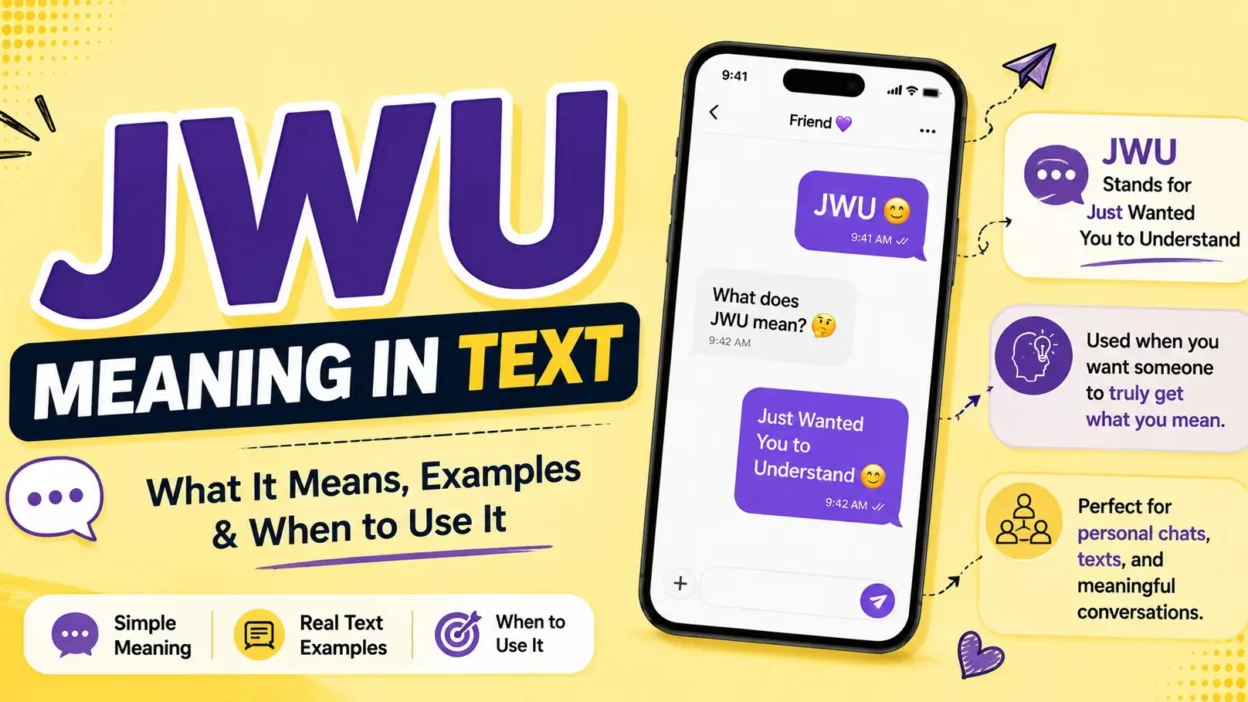
I got a “JWU 😴” text from a friend at 2 PM on a Tuesday. I thought what is JWU Meaning in Text. That’s when I realized this three letter text wasn’t just about mornings anymore it had quietly turned into an all purpose excuse for going dark on someone.
That’s the real story behind JWU that most articles skip. Yes, JWU means “Just Woke a quick way of explaining a late reply. But the way people actually use it today has drifted pretty far from its literal meaning, and understanding that gap is the difference between reading a JWU text correctly and completely misreading someone’s intentions.
Quick Answer about JWU Meaning in Text
JWU stands for “Just Woke Up.” People send it right after getting out of bed to explain why they’re slow to reply but in real conversations, it’s just as often used as a general “sorry I went quiet” excuse, no matter what time it actually is.
- Full form: Just Woke Up
- Word type: Initialism (said letter by letter: J-W-U), not an acronym
- Where it’s used most: Snapchat, TikTok, Instagram DMs, and everyday group chats
- Tone: Casual and low effort rarely meant to offend
- Good to know: Its real world meaning often stretches beyond “I literally just woke up”
What Does JWU Actually Mean?
At face value, JWU stands for “Just Woke Up.” Someone sends it right after they open their eyes, roll over, grab their phone, and see the messages that piled up while they were asleep. It’s meant to explain a delay without writing out a whole sentence.
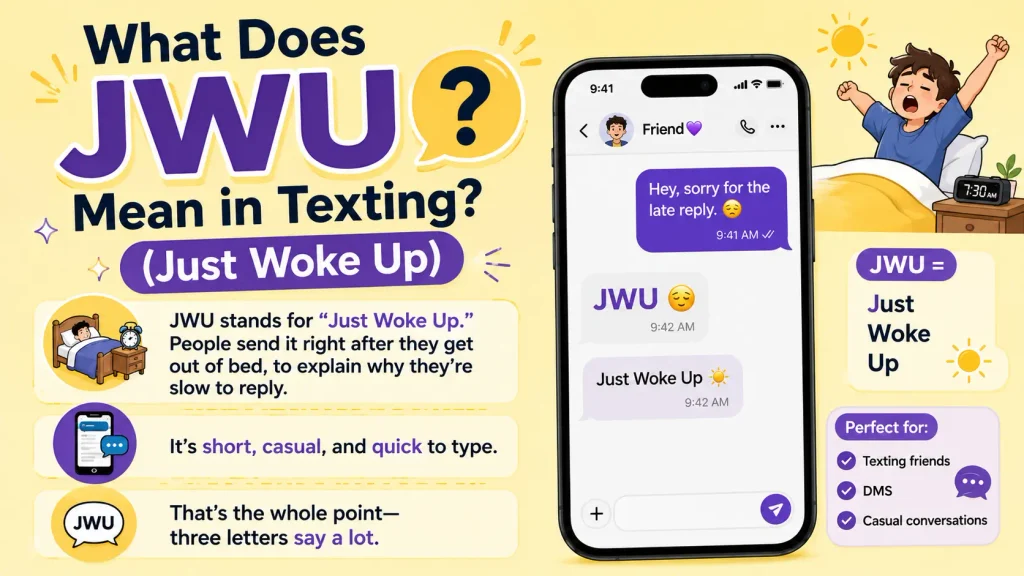
But here’s the part that gets left out of most explainers: JWU has become a social cushion almost as much as a literal statement. In group chats especially, people send “JWU” even when they’ve technically been awake for hours it’s shorthand for “I saw this late and I’m not going to explain why.” Nobody fact checks it, and nobody’s expected to. That’s exactly why it works.
Is JWU an Acronym or an Initialism?
JWU is an initialism, not an acronym. You pronounce each letter separately “J,” “W,” “U” instead of reading it as a single word the way you would with something like “NASA” or “YOLO.” This distinction matters more than people think, because it affects how the term gets typed, searched, and even voice-transcribed on phones.
Where JWU Actually Shows Up (And How the Vibe Changes by Platform)
Most explainers just say “it’s used on social media.” That’s not specific enough to actually help you read the tone correctly. Here’s how it plays differently depending on where you see it:
TikTok — JWU almost always opens a “Get Ready With Me” (GRWM) video, captioned mid-yawn before the transformation montage starts. It’s less a statement now and more a genre marker, the same way “storytime” signals a specific kind of video.
Snapchat — This is where JWU is most literal. A groggy, just-out-of-bed selfie captioned “JWU” is a common streak-saver that requires almost zero effort which is exactly the point.
Instagram — Mostly in Story captions and comment replies, usually paired with a sleepy emoji (😴, 🥱) or a coffee cup. Less about proving you woke up, more about setting a lazy, unbothered mood.
WhatsApp and regular texting — Here the “excuse” usage is strongest. JWU does damage control for an unanswered message, and depending on how many hours actually passed, it can read as genuine or as a socially-accepted white lie.
Real Example Conversations (Not Just Isolated Sentences)
Most JWU explainers give you a list of standalone sentences. That doesn’t show you how it actually functions in a back-and-forth. Here’s what real usage looks like:
Friend: “did you see what happened last night??” You: “omg no JWU, catch me up”
Crush (dating app): “morning 🌞” You: “JWU lol not a morning person”
Coworker (group chat): “did everyone confirm the meeting time?” You: “JWU, checking now”
Notice how the tone shifts depending on the relationship. With a friend, it’s casual and unbothered. With a dating match, it doubles as a soft, low-pressure opener. With a coworker, it’s functional closer to an apology than a joke.
How to Reply to JWU (Match the Relationship, Not Just the Mood)
| If they text | A safe reply | Why it works |
|---|---|---|
| “JWU” | “Morning! Sleep okay?” | Friendly, keeps it warm without overthinking |
| “JWU” | “Finally! Took you long enough 😂” | Works with close friends who won’t take it personally |
| “JWU” | “Same, need coffee first” | Relatable, keeps the low-effort energy going |
| “JWU” | “No worries, whenever you’re free” | Best for coworkers, bosses, or people you don’t know well |
The mistake people make is copy pasting the same playful reply to everyone. A “took you long enough” joke lands fine with your best friend and lands badly with your manager.
Is JWU Rude, Flirty, or Professional Safe?
JWU itself isn’t rude it’s genuinely one of the most neutral texting abbreviations out there. But it’s not built for professional contexts either. Sending “JWU” to a boss technically isn’t disrespectful, but it reads as overly casual. “Sorry, just saw this” carries the exact same meaning with more polish, and costs you nothing extra to type.
As for flirty JWU isn’t inherently romantic, but context does a lot of work here. On a dating app, opening with “JWU 😅 hi” softens the exchange and signals you’re relaxed rather than overeager. Sent from a stranger with no other context, it’s just… someone telling you they woke up.
The Alternate Meaning Almost Nobody Talks About
In a small but real corner of fitness and motivational content, JWU flips meaning entirely — from “Just Woke Up” to “Just Wake Up.” Instead of a status update, it becomes a command. You’ll see it in captions like: “JWU and go get it nobody’s coming to save your day for you.”
This version isn’t announcing anything. It’s telling someone to snap out of a mental fog, not a literal sleep state. It’s rare enough that if you see JWU in a normal text or DM, “Just Woke Up” is almost certainly the correct read but if you stumble across it under a gym transformation post, don’t be surprised if it means something closer to “wake up and take action.”
JWU vs. Similar Sleep and Excuse Slang
JWU doesn’t exist in isolation it’s part of a small family of terms people use to explain being offline or slow to respond. Knowing the differences helps you avoid mixing them up:
| Term | Meaning | Best used for |
|---|---|---|
| JWU | Just Woke Up | Explaining a late morning reply |
| G2S | Got to sleep | Signing off for the night |
| ZZZ | Sleeping (or just “bored”) | Reacting to something dull, or announcing bedtime |
| BRB | Be right back | Short, active pauses in a live conversation |
| AFK | Away from keyboard | Gaming or livestream contexts specifically |
The overlap between JWU and G2S trips people up the most, since both relate to sleep but one explains a delay that already happened, while the other announces one that’s about to happen.
Why This Kind of Slang Exists in the First Place
Abbreviations like JWU didn’t appear out of nowhere. They’re a descendant of early mobile texting, back when phones had strict character limits and multi-tap keypads that made typing a genuine chore — shortening phrases was practical necessity, not just style.
What’s changed is why it survives. Modern keyboards have autocorrect and voice-to-text, so the old constraints no longer apply. JWU sticks around today because speed has become a social norm: a three-letter reply signals “I’m not overexplaining this,” which is its own kind of message.
Who Actually Uses JWU
JWU skews heavily toward teens and young adults, concentrated on platforms built for quick, low-effort posting TikTok and Snapchat especially. Both apps reward speed and casualness over polish, and JWU fits that perfectly: half a second to type, and it instantly explains a gap in response time.
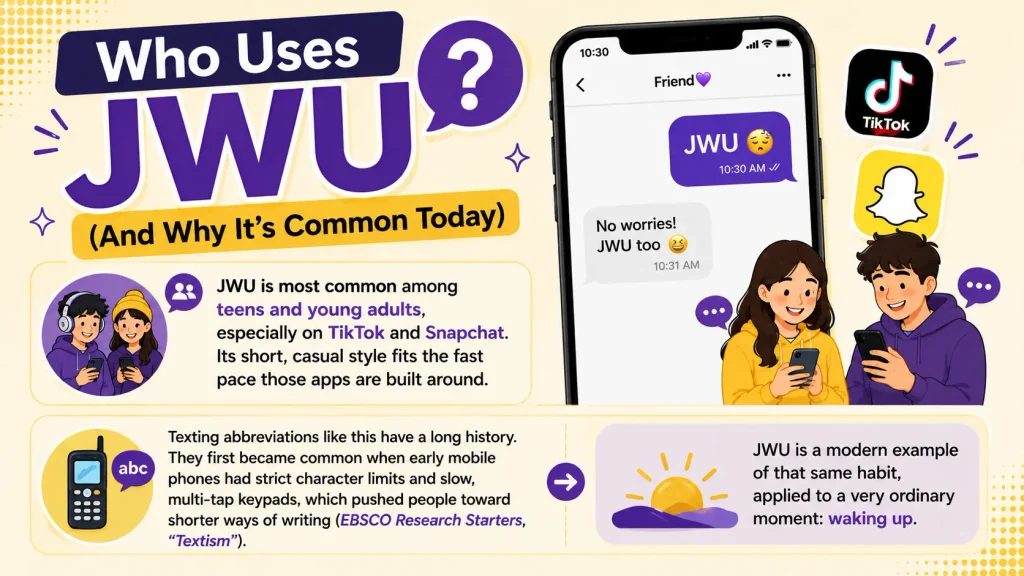
Older millennials and Gen X texters tend to either spell it out fully or skip the explanation altogether part of why JWU can feel like a small generational marker in a text thread.
Frequently Asked Questions
What does JWU mean in a text?
JWU stands for “Just Woke Up.” It’s most often used to explain a late reply, though it’s increasingly sent as a general excuse for going quiet, regardless of the actual time.
What does JWU mean on Snapchat?
On Snapchat, it’s a common caption for a groggy, just-out-of-bed selfie, and a popular low-effort way to keep a streak alive.
How do I reply when someone texts JWU?
Match the relationship: playful with close friends, warm and simple with a crush, and professional (“no worries, whenever you’re free”) with coworkers or a boss.
Is JWU an acronym or an initialism?
It’s an initialism each letter is said on its own, not read as a single word.
Is it rude to say JWU to someone?
No, it’s a neutral, casual phrase. It just reads as informal, so a boss or unfamiliar contact might land better with “Sorry, just saw this.”
Does JWU always mean “Just Woke Up”?
Almost always. The rare exception is fitness or motivational content, where it can mean “Just Wake Up” as a call to action.
What’s the difference between JWU and G2S?
JWU explains a reply that’s already late because you were asleep. G2S (“Got to sleep”) announces that you’re about to go offline for the night they point in opposite directions.
Quick Recap (The Bottom Line)
So, to bring it all together: JWU literally means “Just Woke Up,” but in day to day texting it’s functioned as a blanket excuse for any delayed reply, not just a morning one. It’s an initialism, meaning each letter is said on its own rather than read as a single word. The right way to respond to it depends heavily on who sent it a playful reply works fine with a close friend, something warmer suits a crush, and a simple, professional line is safer with a coworker or boss.
There’s also a rare flip side worth remembering: in fitness and motivational content, JWU can occasionally mean “Just Wake Up” as a call to action rather than a status update. It sits alongside a small family of sleep-related slang like G2S and ZZZ that’s easy to mix up if you’re not paying attention, and like most texting shorthand, it traces back to the character limits of early mobile phones though today it survives less out of necessity and more as a social habit.
JWU looks tiny on a screen, but it’s carrying more social weight than its three letters suggest. Once you can read the gap between what it literally says and what it’s actually doing in the conversation, you’ll never have to guess how to reply again.
More Read: MYF Meaning in Text: A Confusing Slang Term Finally Clarified 2026

A former actress and voice coach, Clara helps learners lose their fear of speaking out loud. She breaks down tricky sounds, stress patterns, and rhythm using techniques borrowed from theater training.