
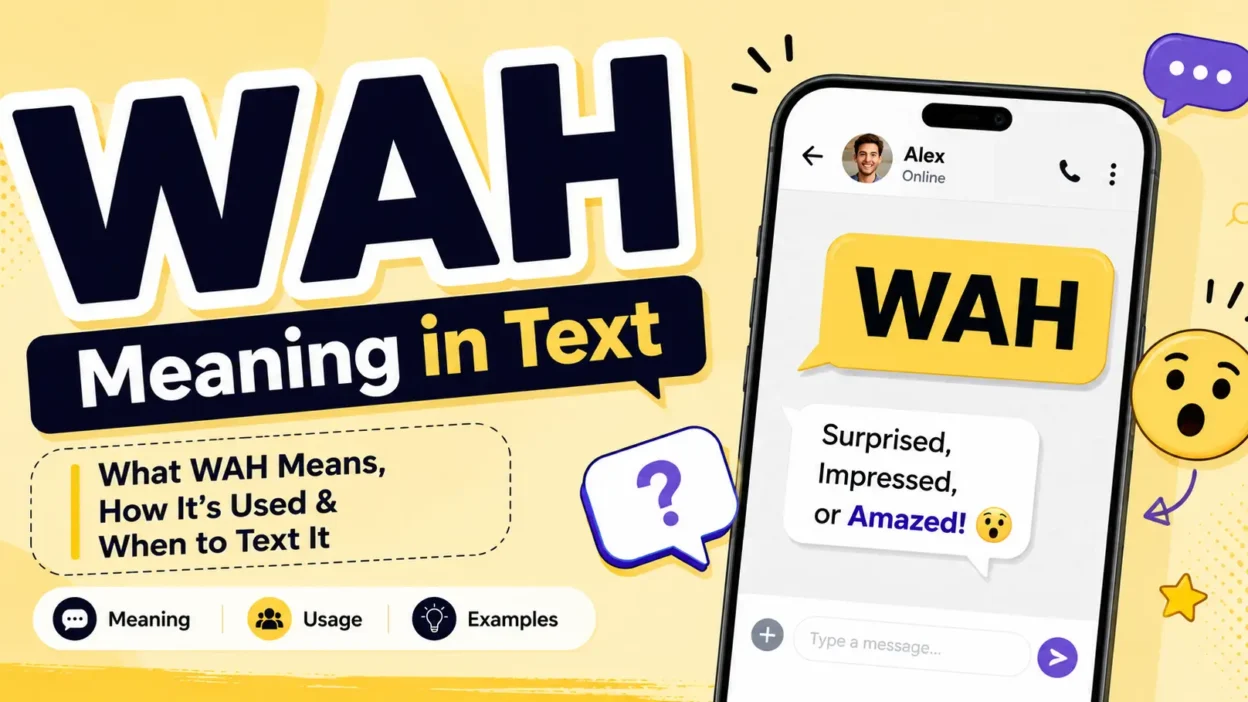
You get a text: “can’t talk, I’m WAH today.” Then, twenty minutes later, a completely different friend sends: “wah!! I can’t believe you did that.”
Same three letters. Two completely different messages.You did not know what is WAH Meaning in Text. If you paused and thought, “wait, which one is this?” you’re not alone, and you’re not wrong to be confused. WAH is one of the rare pieces of internet slang that lives a double life: it’s a workplace acronym meaning “Working At Home” in one context, and a raw, emotional exclamation of surprise, excitement, or distress in another.
This guide breaks down both meanings in full, traces where each one actually came from (including a genuinely surprising fact involving a 200 year old animal naming mix up), and shows you exactly how to tell them apart in five seconds or less something most guides on this topic never fully explain.
WAH Meaning in text at a Glance (Quick Answer)
Quick answer: WAH usually means “Working At Home” when it’s capitalized inside a sentence but written lowercase and on its own, “wah” is just an exclamation of surprise, excitement, or crying, with no connection to work at all.
| Most common meaning | Working At Home |
| Word type | Acronym and a standalone interjection |
| Where you’ll see it | Work chats, scheduling texts, remote-work posts |
| Second meaning | An exclamation of surprise, excitement, or distress |
| Regional note | Extremely common as an interjection in Singlish and Malaysian/Singaporean English |
| Formality | Casual texting, chat apps, social captions |
If a coworker texts “I’ll be WAH tomorrow,” they mean they’re working from home that day. If a friend texts just “wah!” on its own, they’re reacting to something no work involved at all.
Meaning #1: WAH = Working At Home
This is the acronym version. It describes doing your job from home instead of commuting to an office functionally identical to “telecommuting” or “remote work.”
How People Actually Use It
WAH shows up almost exclusively in short, practical updates: telling someone where you are and how to reach you.
- Coworker chat: “Are you coming into the office today?” “No, I’m WAH today email me if you need anything.”
- Group chat: “Can’t make lunch, I’m WAH and slammed with meetings. Rain check?”
- Instagram caption: “WAH vibes today ☕💻 no commute, no complaints.”
- Calendar note: “Blocked 9–5, WAH reachable on Slack only.”
WAH vs. WFH vs. WFA: What’s Actually Different
| Term | Full Form | How Common It Is Today |
|---|---|---|
| WAH | Working At Home | Older, still used, less common than WFH |
| WFH | Work From Home | The default term almost everyone uses now |
| WFA | Work From Anywhere | Growing fast, especially among digital nomads |
| Telecommuting | — | Formal/HR language, rarely used in texting |
Here’s the part most articles skip: WAH isn’t just an older synonym for WFH. It shows up specifically in casual, older style chat and email culture you’ll notice it more from people who started using workplace shorthand before “WFH” became the internet wide standard around 2020. If you’re texting a younger coworker, WFH is far more likely. If it’s an older colleague or a more traditional company culture, WAH still holds on.
Meaning #2: “Wah” as an Exclamation
This is the meaning most guides gloss over in a single sentence but it’s arguably the more common way you’ll encounter the word if you’re active on TikTok, Discord, or group chats with friends rather than coworkers.
Wah as Surprise or Disbelief
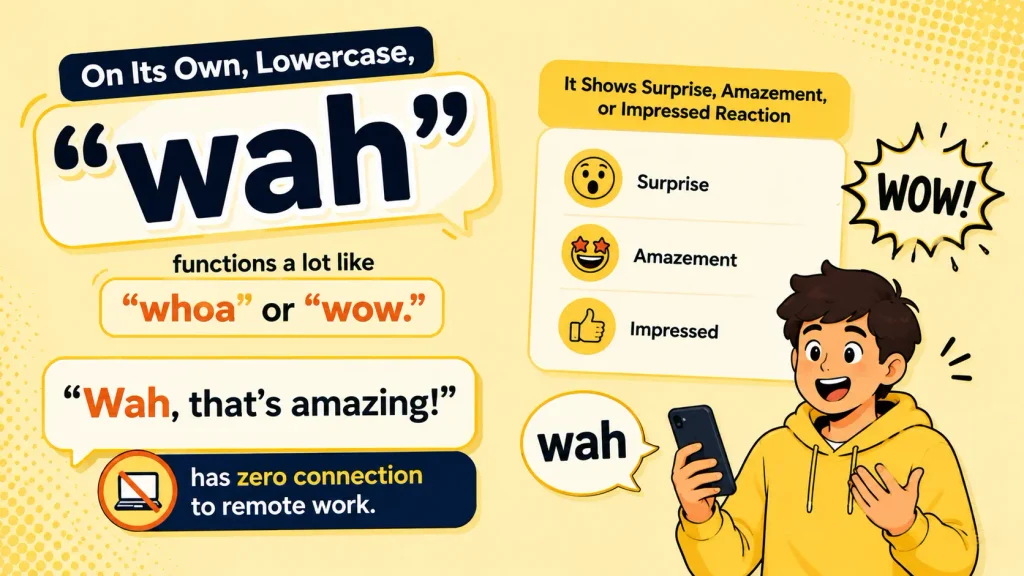
On its own, lowercase, “wah” functions a lot like “whoa” or “wow.” “Wah, that’s amazing!” has zero connection to remote work.
Wah as a Sound of Crying or Complaining
“Wah” can also mimic the sound of crying sometimes genuine disappointment, sometimes playful teasing, as in “wah wah, cry me a river.” Paired with an emoji like 😭 or 🥺, it’s almost never the work acronym.
The Singlish and Malaysian English Connection
This is where the exclamation really comes alive. In Singlish, and everyday English across Singapore and Malaysia, “wah” is used constantly the rough equivalent of “wow” or “oh.” Linguists trace this usage back to Cantonese (哇, wa) and Hokkien exclamations, which were absorbed into English through generations of multilingual daily speech. It also appears in compound phrases like “wah lau” or “wah lao,” which express surprise or mild frustration, and “wah piang,” a softer, more exclamatory version of the same idea.
So when you see “wah” used constantly in Southeast Asian social media comments, it’s not slang invented for texting it’s a much older, spoken expression that simply migrated online.
How to Tell the Two Apart in Seconds
You don’t need context clues from three paragraphs back capitalization and sentence position almost always give it away:
- WAH, capitalized, inside a full sentence → the work meaning. (“I’ll be WAH Thursday.”)
- wah, lowercase, standing alone, often with punctuation or an emoji → the feeling meaning. (“wah!! no way 😭”)
If it’s sent as a single-word text with no other context, it’s almost never about work. People don’t announce “WAH” by itself and expect you to understand it as a schedule update they say it as a reaction.
Where Did WAH Actually Come From?
The Acronym: No Single Origin
There’s no documented “inventor” of WAH as workplace shorthand. Like most workplace abbreviations, it developed informally, long before texting existed, simply as a shorter way to write “working at home” in memos and emails.
The Exclamation: A Genuinely Old Sound
As an interjection, “wah” is imitative it copies a real sound, the same way “ha” copies laughter. This usage predates texting slang by a long time, and it’s documented in language references like Wiktionary as an older, spoken interjection rather than something invented for the internet.
A Surprising Detour: WAH and the Red Panda
Here’s a fact you won’t find in most articles on this topic: “Wah” is also an old name for the red panda and the story behind it is a genuine piece of natural history. In 1821, naturalist Thomas Hardwicke proposed naming the animal “Wah” because of its distinctive high pitched cry, which local Himalayan communities had already been describing phonetically as “wah” or “wha” for generations.
Hardwicke’s paper wasn’t published until years later, so the naming rights ultimately went to a French zoologist instead but “Wah” stuck around as one of the red panda’s enduring nicknames. It’s a small reminder that “wah” as an imitative sound has been used to describe surprising, sharp noises for over 200 years, long before it ever showed up in a text message.
Why Remote-Work Slang Exploded After 2020
WAH, WFH, and WFA all became far more common starting in 2020, when the COVID-19 pandemic pushed millions of workers home almost overnight. WFH pulled ahead as the dominant term, but WAH never fully disappeared it lingers in older email chains, internal company policies, and habits formed before “WFH” took over as the internet’s default.
Other, Rarer Meanings of WAH
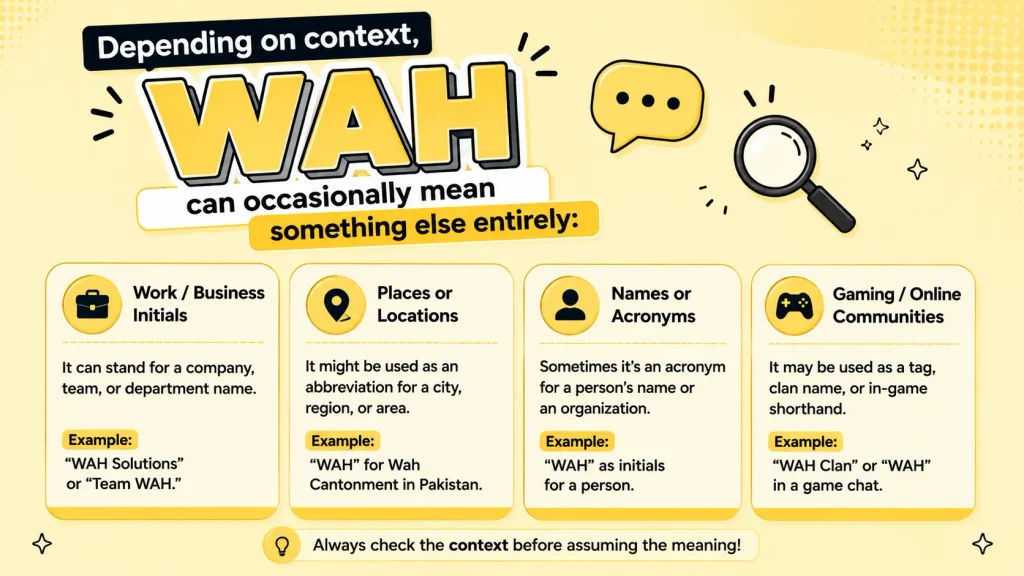
Depending on context, WAH can occasionally mean something else entirely:
- We Are Here — used in casual location check ins
- Working At Height — a workplace safety term for jobs done above ground level
- Web Application Hosting — used in tech and software documentation
Separately, plain “wah” (not the acronym) also refers to a traditional Thai unit of length, roughly two meters completely unrelated to texting. And “wah wah,” written as two words, refers to the guitar and trumpet sound effect, most famous from wah wah pedals again, a different word entirely, just visually similar.
How to Reply When Someone Texts “WAH” or “wah”
Not sure how to respond? It depends entirely on which meaning you’re reading:
- If it’s the work update (“I’m WAH today”), a simple acknowledgment works: “Got it, I’ll email you” or “No worries, see you tomorrow.”
- If it’s the exclamation of surprise, match the energy: “I know, right?!” or ask what happened.
- If it looks like the crying/complaining version, a little empathy goes further than a joke: “Aw, what’s wrong?”
Misreading which one you’re dealing with is an easy way to send an oddly mismatched reply like responding to someone’s excited “wah!!” with “okay, email me if you need anything.”
Common Mistakes People Make With WAH
- Assuming it’s always the acronym. Most confusion happens when people only know the “Working At Home” meaning and get thrown off by the exclamation version.
- Using WAH when WFH is expected. In most modern workplaces, WFH reads as more current; WAH can come across as slightly dated.
- Missing the regional context. If a friend from Singapore or Malaysia texts “wah,” don’t assume it’s a typo it’s a completely normal, standalone exclamation.
Benefits and Challenges of WAH (Working At Home)
Benefits
- No daily commute, saving time and money
- More flexible hours
- A workspace you can set up your own way
- Often a better work-life balance
Challenges
- Less face-to-face time with coworkers
- Harder to separate “work mode” from “home mode”
- Higher chance of feeling isolated
- Requires more self-discipline to stay on task
Related Terms to WAH
| Term | Meaning |
|---|---|
| WFH | Work From Home |
| WFA | Work From Anywhere |
| WAHM | Work-At-Home Mom |
| WAHD | Work-At-Home Dad |
| SAHM | Stay-At-Home Mom |
| SAHD | Stay-At-Home Dad |
| Digital nomad | Someone who works remotely while traveling |
Frequently Asked Questions
What does WAH mean in a text?
Most often, “Working At Home” someone letting you know they’re doing their job remotely that day. Written lowercase and standing alone, “wah” usually means something completely different: an exclamation of surprise or emotion.
What does WAH mean besides working from home?
As a standalone interjection, it can express surprise, excitement, mild complaint, or even mimic the sound of crying, depending on tone and any accompanying emoji.
Is WAH the same as WFH?
Yes, as an acronym, both describe the same remote-work setup. WFH has simply become the more widely recognized term since 2020.
How do I use WAH in a sentence?
As an acronym: “I’ll be WAH tomorrow, so email me if you need anything.” As an exclamation: “Wah, that’s such good news!”
Where did WAH come from?
As an acronym, it grew informally as workplace shorthand with no single documented origin. As an exclamation, it’s imitative copying a real sound and it predates texting slang by generations, with roots in Cantonese and Hokkien speech patterns absorbed into Singlish.
What does it mean when someone texts just “wah” with no other context?
Almost always the exclamation surprise, disappointment, or amusement rather than a work update, since the acronym is normally capitalized and used inside a full sentence.
Bottom Line
WAH carries two genuinely different meanings, and capitalization plus sentence position is the fastest way to tell them apart. In a work chat, WAH almost always means “Working At Home.” On its own, in lowercase, “wah” is an exclamation of surprise, excitement, or upset feelings deeply rooted in everyday speech across Singapore and Malaysia, and far older than texting itself. Once you know the pattern, you’ll never have to guess again.
Read More: BBY Meaning in Text: Avoid This Common Mistake: 2026

Curriculum Developer
Rachel has spent over a decade developing English learning curriculums for schools and online platforms across the United States. Her specialty is structuring content so that even beginner learners can follow along with confidence.
[…] Read More: WAH Meaning in Text: Stop Getting This Frustrating Slang Wrong (Ultimate Guide) 2026 […]
[…] Read More: WAH Meaning in Text: Stop Getting This Frustrating Slang Wrong (Ultimate Guide) 2026 […]
[…] Read More: WAH Meaning in Text: Stop Getting This Frustrating Slang Wrong (Ultimate Guide) 2026 […]