
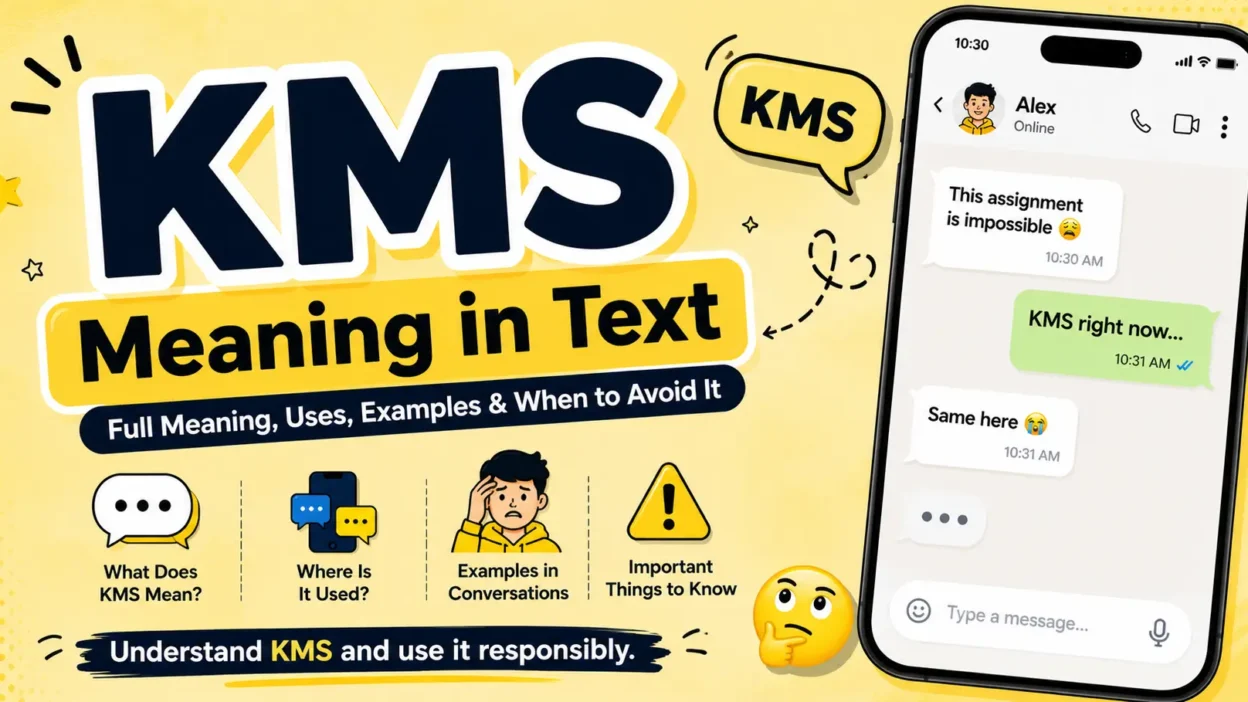
You saw three letters “KMS” pop up in a text, a comment, or a gaming chat, and now you’re stuck wondering what actually KMS Meaning in Text and whether you should be worried.
Here’s the short version: KMS stands for “kill myself.” In everyday texting, it’s almost never literal. It functions more like digital shorthand for “I’m mortified” or “I can’t even” than an actual statement of intent. But “almost never” is not “never,” and that gap is exactly why this guide exists not to repeat the same definition you’ve already seen ten times today, but to help you actually read the message in front of you.
The Blunt Definition First
KMS = kill myself. That’s the literal expansion.
In practice, though, language doesn’t always mean what it literally says think of how often people say “I’m dead” after something funny, or “this is killing me” about a boring meeting. KMS lives in that same category of exaggerated, self-deprecating internet speech. It became common because typing three letters is faster than typing “I am extremely embarrassed right now,” and exaggeration is simply how a lot of online communication works.
That said, the phrase is still built from real words about self-harm, which is why tone and context matter more here than with ordinary slang like “lol” or “brb.”
Why This Phrase Exists at All
It helps to understand why people reach for a phrase like this instead of just saying they’re upset. Hyperbole is a shortcut it signals intensity without requiring an explanation. Saying “KMS” after failing a test conveys “I am disproportionately upset about something objectively small” in three characters. It’s closer to an eye-roll emoji than a confession.
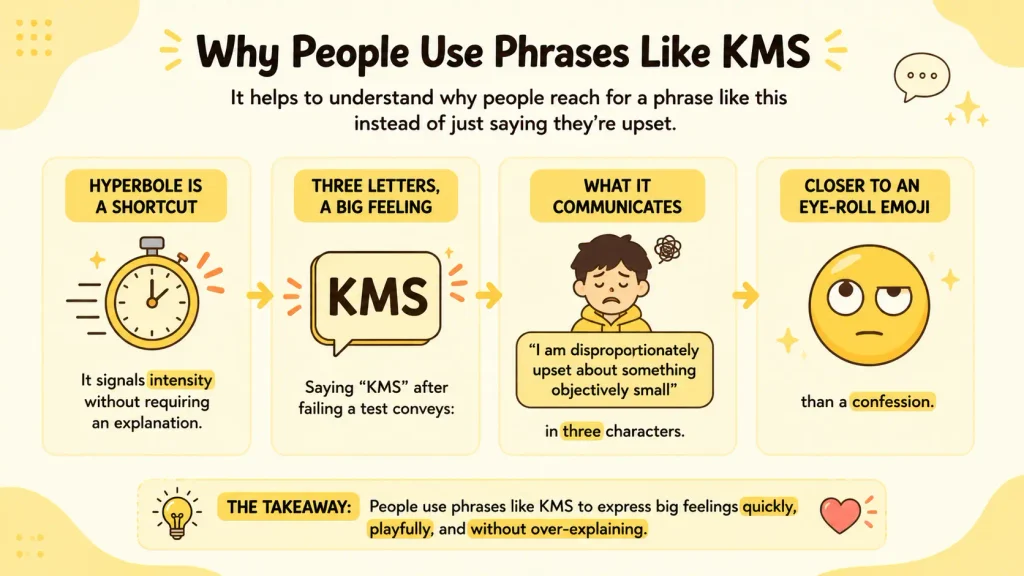
The problem is that the same three letters carry zero tone of voice, no facial expression, and no pause in speech. A sentence that would sound obviously sarcastic out loud can look flat and alarming on a screen. That mismatch real words, unclear intent is the whole reason people search for what KMS “really” means.
A Practical Way to Read It: The Three Question Test
Instead of a simple checklist (which most guides give you), try running the message through three questions:
- What triggered it? A pop quiz, a spilled drink, a missed shot in a game small, ordinary annoyances usually signal a joke. A breakup, a family fight, or no clear trigger at all deserves more attention.
- What’s the pattern? Someone who says “KMS” three times a week the way others say “ugh” is using it as verbal filler. Someone who has never said it before, and suddenly does, is telling you something changed.
- What comes next? If the conversation moves on normally memes, replies, more chatting that’s a strong signal it was throwaway. If the person goes quiet immediately after, or the message arrives completely out of context with no follow-up, take that silence seriously.
None of these questions is foolproof on its own. Together, they give you a far more reliable read than scanning for an emoji.
What It Looks Like in Practice
Likely just venting:
- “Forgot my charger AGAIN. kms 💀”
- “Coach benched me in the last quarter, kms lol”
- “My camera was on the whole meeting and I didn’t know. kms.”
Deserves a direct check-in:
- A message with no punctuation, no emoji, and no obvious trigger.
- “kms” sent alone, after several days of the person not texting at all.
- Any version paired with phrases like “no one would care,” “I’m done,” or “I can’t do this anymore.”
If you land in that second category, don’t try to decode it further from a distance. Reach out directly: “That message worried me can we talk?” is more useful than any amount of guessing.
KMS Across Apps: What Changes and What Doesn’t
The meaning never changes. What changes is how casually it’s thrown around.
| Platform | How it typically shows up |
|---|---|
| Snapchat | Very casual often on disappearing Snaps about embarrassing moments, since the message vanishes anyway. |
| TikTok | Frequently swapped for “unalive” in comments, because the platform’s moderation systems can flag or limit posts containing the literal phrase. |
| Discord / Xbox / PlayStation chats | Common after a bad play or a lost match this is also where the different term “KYS” shows up more often, usually as an insult rather than self directed venting. |
| Instagram & X (formerly Twitter) | Mixed in with other exaggerated slang like “I can’t” or “not me doing this.” |
| LinkedIn & Facebook | Rare both skew toward an older or more formal audience, so the joke doesn’t land the same way. |
The Acronym Family: KMS, KYS, KMSL, KMN
These get confused constantly, and mixing them up matters one is a joke about yourself, one is an attack on someone else.
| Term | Full meaning | Aimed at | Typical tone |
|---|---|---|---|
| KMS | Kill myself | Yourself | Self deprecating, usually a joke |
| KYS | Kill yourself | Someone else | Hostile used as an insult, sometimes in bullying |
| KMSL | Killing myself laughing | No one | Purely positive, like “LMAO” |
| KMN | Kill me now | Yourself | Dramatic exaggeration, similar to KMS |
The one that actually needs your attention if you see it sent to someone: KYS. That’s not self-directed venting it’s directed hostility, and it shows up disproportionately in cyberbullying situations. If you see it aimed at a child or teen repeatedly, that’s a different conversation entirely, likely involving a parent, teacher, or platform report not just a “let it go” moment.
Not Every KMS Meaning in Text Is About Feelings The Other Meanings
Away from texting, the same three letters show up in completely unrelated fields:
- Key Management Service — a Microsoft licensing tool that IT departments use to activate Windows and Office across many computers at once.
- Knowledge Management System — internal business software companies use to store documentation, guides, and shared team knowledge.
- Kilometers — an informal shorthand (“I ran 10 kms today”), even though the technically correct abbreviation is just “km.”
If you searched “KMS” while reading a tech manual or a running app and landed here confused, that’s why same letters, unrelated meaning.
Is This Slang on Its Way Out?
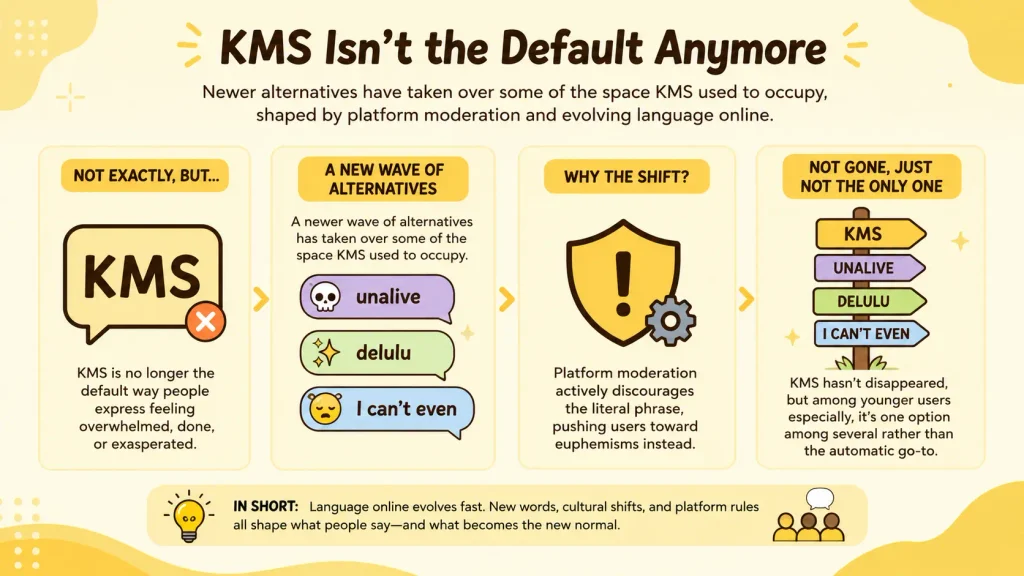
Not exactly, but it’s no longer the default. A newer wave of alternatives “unalive,” “delulu,” “I can’t even” has taken over some of the space KMS used to occupy, partly because platform moderation actively discourages the literal phrase, pushing users toward euphemisms instead. KMS hasn’t disappeared, but among younger users especially, it’s one option among several rather than the automatic go to.
What to Say Instead, If You Want the Same Energy Without the Words
If you’re the one typing and want to convey the feeling without using self harm language:
- Embarrassment: “I am never living this down” / “hide me”
- Frustration: “I’m so over this” / “why is today like this”
- Exhaustion (school or work): “today wrecked me” / “rough one”
These land the same way in conversation, minus the ambiguity.
If You’re the One Worried About Someone
You don’t need the perfect sentence. A direct, low pressure question works better than trying to interpret the acronym alone: “That sounded heavier than usual are you actually okay?” Give them room to answer honestly instead of brushing past it with a joke of your own.
If the message or the pattern around it genuinely worries you, or if you’re the one who sent it and meant it: in the US, you can call or text 988 to reach the Suicide & Crisis Lifeline, free and available 24/7, or chat at 988lifeline.org. Outside the US, findahelpline.com lists crisis lines by country. If someone is in immediate danger, contact emergency services right away.
Quick FAQ
Does KMS always mean “kill myself”?
In texting, yes that’s the near-universal meaning. Outside slang, it can also mean Key Management Service, Knowledge Management System, or kilometers.
Is KMS the same as KYS?
No. KMS is self-directed and usually a joke. KYS is aimed at someone else and is often hostile or bullying language treat the two very differently.
What should I do if a friend texts KMS?
Look at the trigger, the pattern, and what happens next in the conversation. If anything feels off, ask directly rather than assuming it’s a joke.
Why do platforms use “unalive” instead of KMS or “kill”?
Many platforms’ content moderation systems automatically limit or flag posts using literal self-harm language, so users adopted euphemisms to keep posting without getting flagged.
Bottom Line
Most of the time, “KMS” is nothing more than digital shorthand for embarrassment or frustration the text-message version of an eye roll. But it’s built from real words, and real words occasionally mean exactly what they say. The letters themselves will never tell you which situation you’re in; the trigger, the pattern, and what happens right after will.
So don’t scan a message for an emoji and move on. Read the whole conversation, trust your gut when something feels off, and when in doubt, just ask. A two second check in costs nothing assuming it was “probably nothing” sometimes costs more than you’d expect.
This article discusses a sensitive topic. If you’re personally struggling with thoughts of self harm, please know that support is available you don’t have to handle it alone. In the US, call or text 988 (988lifeline.org). Outside the US, findahelpline.com can connect you to local support.
Read More: WYGG Meaning in Text: A Confusing Abbreviation Finally Clarified 2026

Curriculum Developer
Rachel has spent over a decade developing English learning curriculums for schools and online platforms across the United States. Her specialty is structuring content so that even beginner learners can follow along with confidence.
[…] Read More: KMS Meaning in Text: Harmless Joke or Silent Warning Sign? (Essential Guide) 2026 […]
[…] More Read: KMS Meaning in Text: Harmless Joke or Silent Warning Sign? (Essential Guide) 2026 […]