
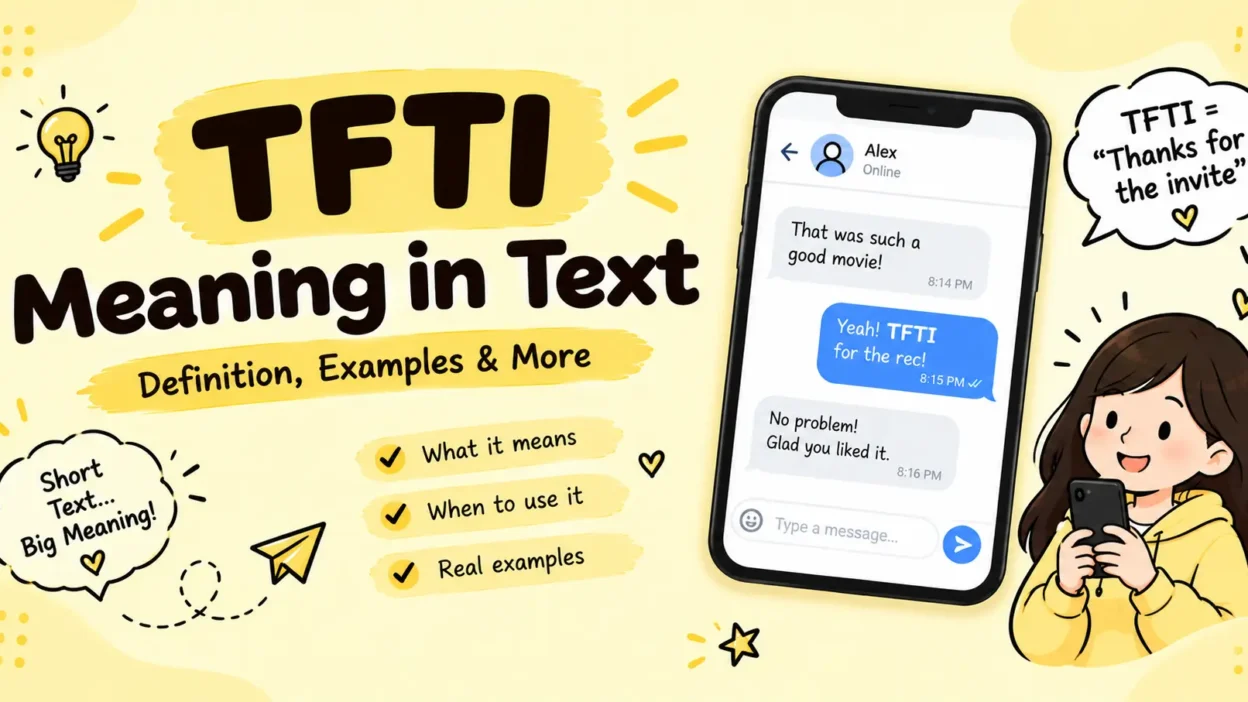
TFTI meaning in text is “Thanks For The Invite,” and in the vast majority of cases, nobody sending it actually means “thank you.” It’s a sarcastic jab aimed at being left out of an event, a hangout, or a group chat dressed up to look polite on the surface. A much smaller slice of people use it to mean “Thanks For The Information” instead, usually when replying to a useful fact rather than a social post. The same four letters can sound playful, genuinely hurt, or sincerely grateful, and the only way to tell which one you’re looking at is tone and context. This guide breaks down both meanings and shows you exactly how to spot the sarcasm.
Quick Answer
| Meaning | How common | Typical trigger |
|---|---|---|
| Thanks For The Invite (usually sarcastic) | Dominant meaning | Seeing a post or story from an event you weren’t part of |
| Thanks For The Information | Much less common | Replying to news or a useful fact |
A few unrelated meanings exist outside texting, like Transport for the Isles or a regional Time For Tea Initiative, but these have nothing to do with chat slang and rarely show up in a phone screen.
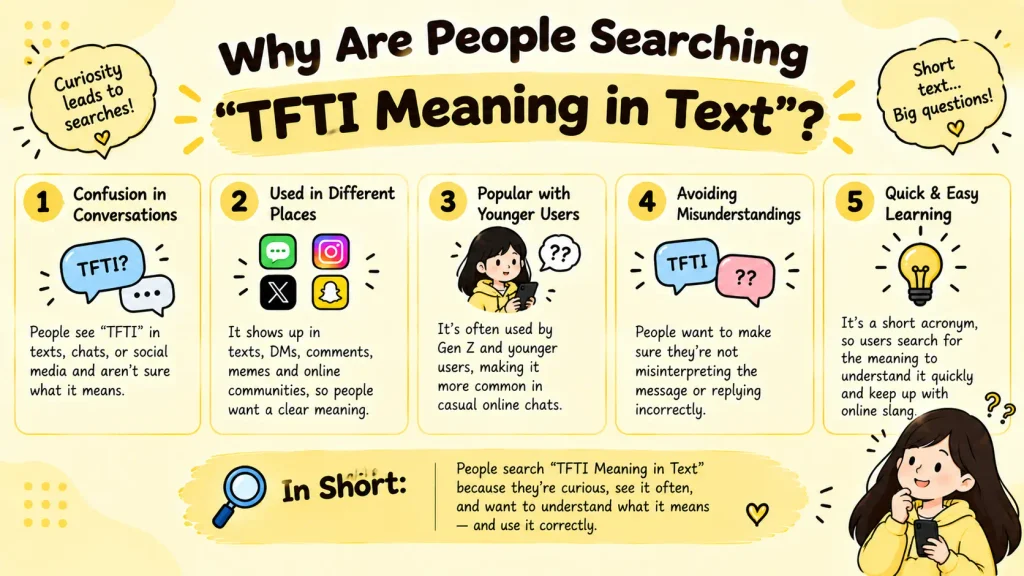
Why Are People Searching “TFTI Meaning in Text”?
Most people land on this exact phrase after seeing “TFTI” show up somewhere it clearly wasn’t a thank you under a party photo, in a group chat, or as a one-word reply that felt oddly cold. The confusion isn’t really about the four letters; it’s about tone. Text strips out voice, facial expression, and timing, so a phrase that reads as playful out loud can land as a real complaint in writing.
That gap between what TFTI looks like (gratitude) and what it usually means (a quiet complaint about being excluded) is exactly why so many people search for it mid conversation, trying to figure out if they should apologize, laugh it off, or just ignore it.
Is TFTI Sarcastic or Genuine?
TFTI is usually sarcastic. It’s a fast way to call out being left out of something without starting a bigger conversation about it. Picture this: your friends post pictures from a party you didn’t know about, and you comment “TFTI” underneath. You’re not thanking them you’re pointing out, lightly, that you were left off the list.
That said, TFTI can be genuine, especially between close friends who already trust each other’s tone. If someone invites you to something and you’re truly glad they thought of you, “TFTI!” can be real appreciation. It can also land as playful teasing friends ribbing each other for going out without telling the group, more joke than complaint.
How to Tell If Someone’s Being Sarcastic
Checking punctuation, emoji, and the situation around the message does most of the work here, since text has no tone of voice.
- Extra punctuation (“TFTI!!” or “TFTI…”) usually reads as annoyed or pointed.
- A flat, one-word “TFTI” with nothing else attached tends to lean sarcastic sincere thanks usually come with more words around them.
- An eye-roll, unimpressed face, or side-eye emoji next to TFTI almost always signals sarcasm.
- A heart, smiley, or a lone exclamation point leans toward genuine thanks.
- Sent right after seeing photos from an event they weren’t part of → probably sarcastic.
- Sent right after being invited to something → probably genuine.
What TFTI Does NOT Mean
TFTI does not always signal genuine gratitude, even though the words spell out a thank you. It also does not always mean anger most of the time it’s closer to a light jab than a real confrontation, and treating every TFTI as a serious complaint tends to overreact to a joke.
It’s worth being equally clear about what it isn’t: TFTI is not a neutral, tone-free acronym like “FYI.” It carries an implied feeling almost every time it’s used, which is exactly why reading it flatly, as if it were purely informational, misses the point entirely.
Where TFTI Came From
TFTI grew alongside texting and social media, once phones became how friend groups actually made plans. Urban Dictionary’s earliest recorded use dates to around 2010, and the meaning back then was nearly identical to today’s: a joking way to call out friends for going somewhere without you. As Instagram and Snapchat grew, so did TFTI the sarcastic tone was clear enough that it rarely needed explaining.
TFTI Across Platforms
| Platform | How it typically shows up |
|---|---|
| Text messages / group chats | The most common home for TFTI often the first reply after plans that left someone out |
| Similar to texting, usually in a group thread reacting to plans made without someone | |
| Comments under a story or post from an event, tagged with a sarcastic edge | |
| Snapchat | Replies to Snap stories showing a hangout the viewer wasn’t part of |
| TikTok | Comment sections under “we went without you” style videos, often joking |
| Comments on event check-ins or photo albums, usually among older users | |
| Discord | Gaming and community servers, when someone’s added late or missed a voice call |
| Rare outside gaming subreddits, but occasionally used sarcastically in comment replies | |
| X (Twitter) | A quick, public reply to a post about an event, often sharper in tone than a private DM |
| Gaming communities | Common in MMOs like World of Warcraft or League of Legends when a raid starts without you |
The tone stays sarcastic everywhere, but public platforms like Instagram and X tend to feel pointier than a private text between close friends.
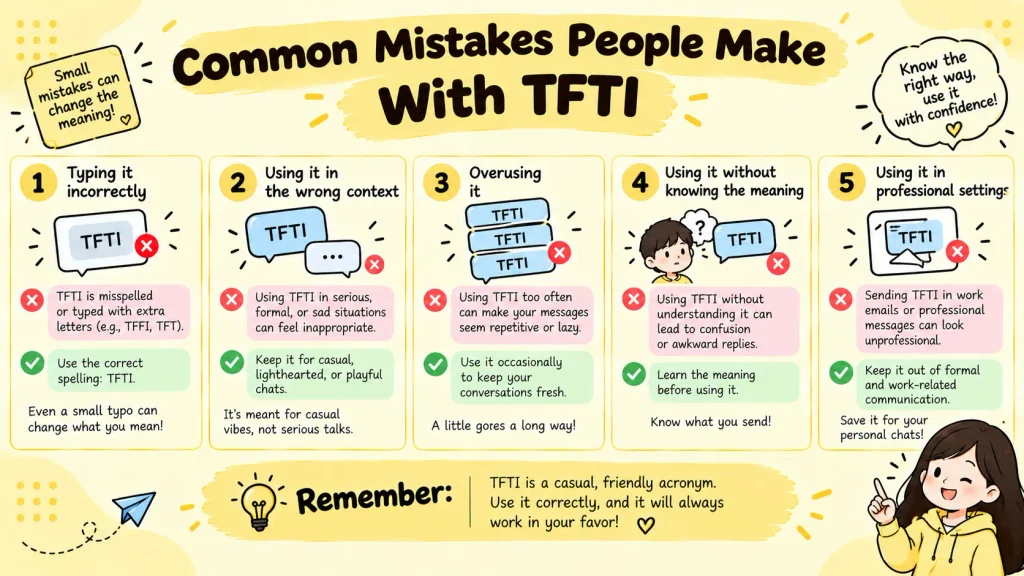
Common Mistakes People Make With TFTI
- Taking it literally. Reading “TFTI” as a genuine thank-you when it’s actually a complaint leads to an awkward, mismatched reply.
- Ignoring the sarcasm entirely. Responding with a cheerful “You’re welcome!” can come across as either clueless or intentionally dismissive.
- Missing the relationship context. The same TFTI from a close friend and from a casual acquaintance can carry very different weight.
- Misreading a joke as rudeness. Not every TFTI is a real complaint some are just playful teasing between friends who already get the joke.
Personal Experience
I first ran into “TFTI” on a friend’s Instagram Story after a group outing someone had commented “TFTI 😒” underneath it, and I had no idea what it meant. Looking it up taught me it usually stands for “Thanks For The Invite,” almost always used sarcastically by someone who felt left out.
Once I knew what to look for, it showed up everywhere: group chats, Snapchat replies, comment sections under party photos. Sometimes it was clearly a joke; other times it read like someone was genuinely a little hurt. That single comment is what first showed me how much a short abbreviation can depend on tone, not just the letters themselves.
Expert Tip
When interpreting abbreviations like TFTI, pay attention to the situation and relationship rather than the words alone. The same four letters mean something different from a best friend teasing you than from an acquaintance who’s genuinely annoyed. Context changes the meaning far more than the letters ever could.
How to Respond If Someone Sends You “TFTI”
If the exclusion was an honest mistake, a quick apology and a real invite for next time usually fixes it: “Sorry, totally forgot to loop you in next time for sure!”
If it feels more intentional, a calm, direct reply works better than getting defensive: “Fair point, I should’ve included you.” If a friend is clearly just joking, joke back the same way a light “you know I’ll invite you next time” keeps things easy.
Similar Acronyms to TFTI
| Acronym | Meaning | Tone | Typical Use |
|---|---|---|---|
| TFTI | Thanks For The Invite | Sarcastic, occasionally sincere | Calling out being left out |
| FOMO | Fear Of Missing Out | Anxious, honest | Naming the feeling behind TFTI |
| TIA | Thanks In Advance | Polite, genuine | Requesting a favor |
| ICYMI | In Case You Missed It | Neutral, informative | Sharing news or a link |
| SMH | Shaking My Head | Disapproving | Reacting to something frustrating |
| LOL | Laughing Out Loud | Light, amused | Softening a joke or reaction |
Frequently Asked Questions
What does TFTI mean from a girl? The meaning doesn’t change based on gender it comes down to tone and context, not who sent it. A sarcastic “TFTI” from anyone usually points to feeling left out.
What does TFTI mean from a guy? Same as above. Reading punctuation, emoji, and what prompted the message matters far more than who’s typing it.
Is TFTI rude? It can come across that way, especially to someone unfamiliar with the joke. Among close friends it’s usually harmless, but with acquaintances or coworkers it risks sounding passive-aggressive.
Can TFTI be used jokingly? Yes a large share of TFTI messages are playful teasing between friends rather than a real complaint, especially when paired with a laughing emoji.
Is TFTI still popular in 2026? Yes. It remains common shorthand for calling out being left out, particularly on Instagram, Snapchat, and in gaming chats.
What does TFTI mean on Snapchat? The same sarcastic meaning as everywhere else usually a comment on a Snap story showing an event the viewer wasn’t invited to.
What does TFTI mean on Instagram? Typically a sarcastic comment under a post or story from an event, pointing out an exclusion in a light, semi-joking way.
Can TFTI be sarcastic? It’s sarcastic most of the time. Genuine use exists but is the minority case, usually reserved for close friends who already trust each other’s tone.
Bottom Line
The TFTI meaning in text comes down to four letters and one quick point: someone probably feels left out. But the real story lives in the tone behind it, not the letters themselves the same message can be a joke between close friends, sincere gratitude, or a sign that someone’s feelings got a little bruised. It shows up the same way whether it lands in a text, an Instagram comment, or a gaming chat, and it isn’t going anywhere in 2026 either. Next time “TFTI” shows up on your phone, don’t just read the letters. Check the punctuation, the emoji, and the moment it arrived in that’s where the actual message is hiding.
Read More: Luv Meaning in Text: The Hidden Signal Most People Completely Misread in 2026

Curriculum Developer
Rachel has spent over a decade developing English learning curriculums for schools and online platforms across the United States. Her specialty is structuring content so that even beginner learners can follow along with confidence.
[…] Read More: https://englishteller.com/tfti-meaning-in-text/ […]
[…] More Read: TFTI Meaning in Text: The Surprisingly Passive Aggressive Phrase Most People Misread (2026) […]