
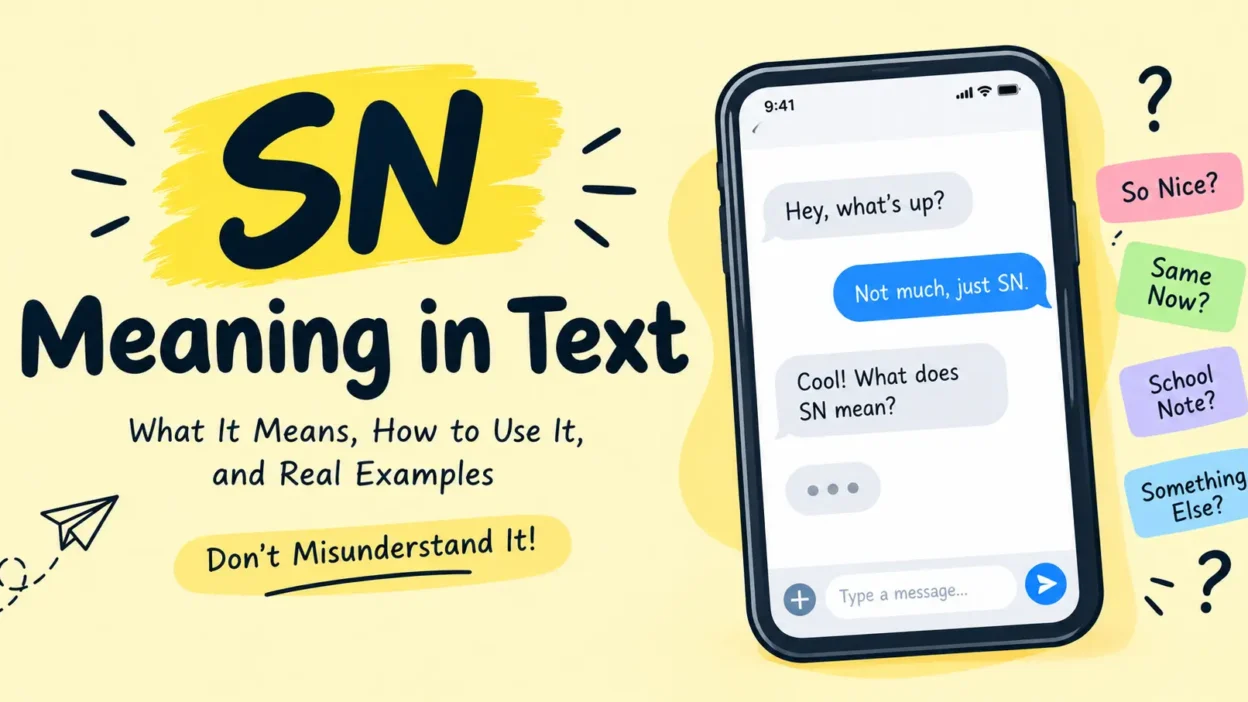
SN Meaning in Text most often points to “screen name,” the username someone uses on apps like Snapchat. Some sources also report “say nothing,” a casual way of saying “it’s nothing” or “keep this private,” and a few people use SN as a “side note.” There is no official definition, so the same two letters can mean different things in different chats. The best clue is the sentence SN appears in: a question about accounts almost always means screen name. If the message is unclear, don’t guess. A quick question to the sender is safer than a confident wrong reply, especially when privacy is involved.
What Does SN Meaning in Text?
SN is informal shorthand, not a standardized abbreviation. No dictionary or authority fixes its meaning, and different groups use it in different ways. That is why you can’t decode it from the two letters alone.
The one principle that matters is simple: look at what SN is attached to. A question, a thank-you, a secret, or an added note each points to a different reading. The rest of this guide builds on that idea instead of repeating it.
The Possible Meanings of SN
The table below shows the three readings I could reasonably support, ordered by how well documented they are.
| Meaning | Plain English | Typical setting | How well supported |
|---|---|---|---|
| Screen name | “What’s your username?” | Adding friends on social apps, gaming chats | Best supported |
| Say nothing | “It’s nothing” or “keep this quiet” | Private chats | Reported, context-dependent |
| Side note | “By the way” | Longer messages, comments | Plausible but uncommon; not well documented |
Screen Name
This is the most widely reported meaning. A screen name is the name you use online, and a request for one usually comes with a reason: someone wants to add you, follow you, or find you in a game.
Illustrative example:
Maya: that clip from the lake was so good
Maya: what’s your SN? i’ll add you
SN sits inside a question and is followed by a reason to share an account, so “username” is the only sensible reading. If someone asks for your SN, send the name they would actually search for.
Say Nothing
Some sources report SN as “say nothing,” used much like “no worries” or “it’s nothing.” It is also plausible as a request to keep something private, though that version is harder to confirm and rests mainly on how it reads in context.
Illustrative examples:
Chris: thanks for covering my shift
Dev: SN
SN follows a thank-you, so “it’s nothing” fits. In a different setting:
Priya: Got the tickets for Jordan’s birthday. SN until Saturday
This follows a secret and carries a time limit, so “keep it quiet” fits. Treat this reading as context-dependent, not a settled definition.
Side Note
Sometimes SN stands for “side note,” an extra thought added to the main message, similar to “PS” or “btw.” I couldn’t find a reliable source documenting this as a common texting usage, so treat it as an uncommon, uncertain reading.
It is most plausible when SN is followed by a colon and extra information.
Dinner at 7 works. SN: the restaurant doesn’t take reservations on Fridays.
If a message just says “SN” alone, this is the least likely reading.
I have not included “sike nah” as a meaning. I couldn’t find credible support for it, and listing it would risk misleading readers.
Why Is SN So Confusing?
Three things make SN harder than most abbreviations. First, it is only two letters, so it overlaps with many other uses. Second, it has no standard definition, so even people who use it regularly may not agree on what it means.
Third, it often arrives without a lead-in. A message like “SN” with nothing else gives you no grammar to work with. Different communities, such as gaming groups and social apps, also develop their own habits.
Quick tip: If you’re staring at a bare “SN,” the confusion is normal. It’s a sign to ask, not a sign you missed something obvious.
How to Tell What SN Means in a Message
Start with what SN is attached to, then use this guide.
| What the message looks like | Most likely reading | Confidence |
|---|---|---|
| SN is inside a question about accounts (“What’s your SN?”) | Screen name | High |
| SN is a reply right after a thank-you | Say nothing (“it’s nothing”) | Moderate |
| SN comes after a surprise or private news | Possibly say nothing (keep quiet) | Moderate to low |
| SN is followed by a colon and extra information | Possibly side note | Low to moderate |
| SN is alone with no clear lead-in | Unclear | Ask |
Two cautions apply. Punctuation and capitalization can nudge your guess, but they don’t prove intent. A period may feel curt, or it may just be the sender’s habit.
Your relationship with the sender matters too. A close friend who writes in fragments is not necessarily being cold.
When Should You Ask?
Ask when a wrong guess has a real cost. That includes sending your username to the wrong person or ignoring a request to keep something private. A short, friendly question works well:
“Do you mean screen name, or say nothing?”
Common Mistakes When Reading SN
Most misreadings come from a few predictable habits.
- Letting the app decide. The platform is a hint, but the message is the real evidence.
- Treating punctuation as proof. A period or all caps suggests a mood, not a meaning.
- Replying with a username to a secret. If SN follows private news, don’t assume it’s an account request.
- Reading a short message as rude. Brevity is common in texting and often means nothing negative.
- Passing along a “say nothing” message. If someone asked you to keep something quiet, don’t repeat it, even if you’re unsure.
Realistic SN Text Examples
These are invented illustrations, not recorded conversations, and they say nothing about how often each meaning occurs.
A request for an account name (screen name):
Jordan: you should join our Fortnite squad tonight
Jordan: what’s your SN?
SN is part of a question and follows an invitation to play together.
Someone sharing private news (say nothing):
Alex: My sister’s engaged but they’re telling everyone Sunday. SN
You: Got it, I won’t say anything
The news is private, a deadline is implied, and the reply confirms the reading.
An extra note (side note):
Sam: Practice moved to 6. SN: bring your own water bottle
The colon and the new information make “side note” the natural fit.
A genuinely ambiguous message:
Taylor: I already told you
Morgan: SN
This could be a dismissive “say nothing,” a typo, or something else. There is no question, thank-you or secret to anchor it. Here you shouldn’t guess, so asking is the safest move.
Does SN Mean Something Different on Snapchat, Instagram, or TikTok?
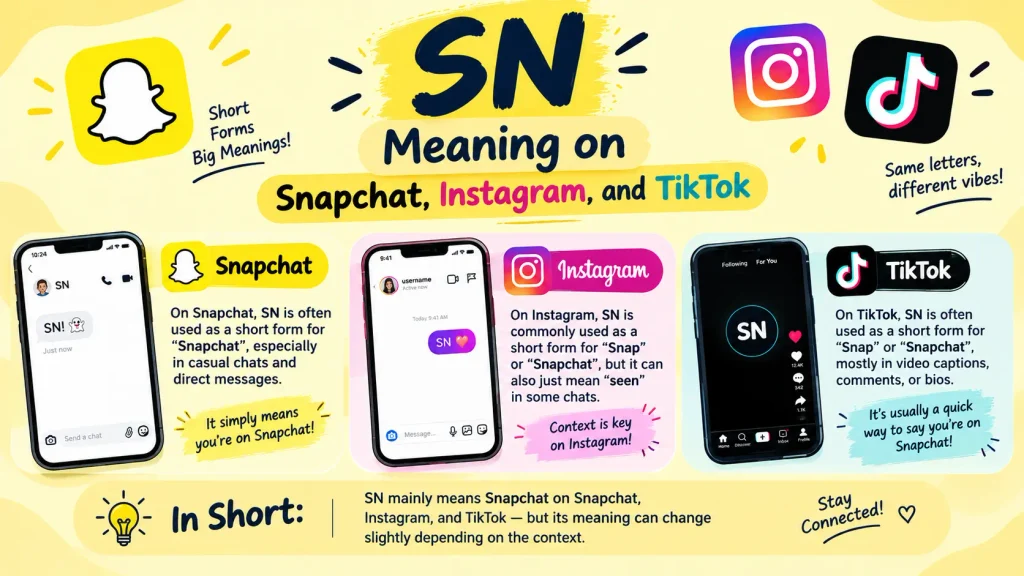
The app is a clue, but the conversation is a better one. Dexerto reports that SN is commonly used on Snapchat to mean “screen name,” which makes sense because people regularly trade accounts there.
I didn’t find reliable evidence that SN has its own distinct meaning on Instagram or TikTok. The same readings can appear on any platform. A question about accounts points to screen name wherever it appears, and a reply to a secret points toward say nothing wherever it appears.
Is SN Rude, Friendly, or Neutral?
SN isn’t rude or friendly by itself. A request for a username is neutral. “SN” after a thank-you usually reads as relaxed and warm.
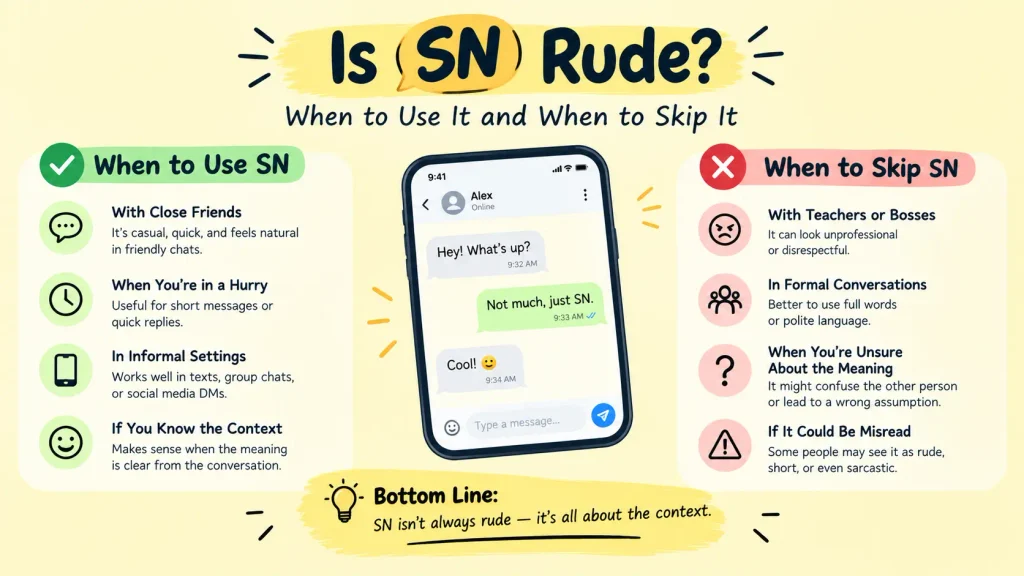
A bare “SN” sent during a tense exchange can feel abrupt, but it’s hard to be sure what the sender meant. If you’re the one sending it and the moment is delicate, spell out the words (“no worries,” “please don’t tell anyone”). It takes a few seconds and prevents a misreading.
How to Reply to SN
| If SN likely means | You could reply |
|---|---|
| Screen name | “Sure, it’s @yourusername.” |
| Say nothing (it’s nothing) | “Anytime!” |
| Say nothing (keep private) | “Got it, I won’t tell anyone.” |
| Side note | “Thanks, good to know.” |
| Not sure | “Do you mean screen name or say nothing?” |
The last row works in almost any situation.
Is It Safe to Share Your SN?
Sharing your screen name is usually low risk with people you know, but it’s worth a moment’s thought. Your username lets others find your profile, so it’s best shared with people you trust.
If someone you don’t know asks for it, you can decline or ask why. When possible, send it in a private message rather than a public group chat or comment thread. Also check your app’s privacy settings so you control who can see your content after they add you.
SN vs. Username, Handle, and Display Name
People say “screen name” loosely, which causes confusion.
- Username: the unique name that identifies your account on an app.
- Handle: a public username, often starting with @.
- Display name: the name shown on your profile. It can usually be changed freely and isn’t always unique.
- Screen name: an older, general term for the name you use online. Today it often refers to a username or handle, but the term itself is loose.
When someone asks for your SN so they can add you, send your username or handle. A display name may not help them find you.
Other Meanings of SN Outside Texting
Outside chat, the same letters appear in very different settings. Capitalization and punctuation usually give it away.
- SN: supernova (as in SN 1987A), serial number on products and paperwork, or student nurse on some schedules.
- S/N: serial number, or signal-to-noise ratio in science and engineering.
- Sn: the chemical symbol for tin.
- s.n.: short for the Latin sine nomine (“without a name”), sometimes used in book citations.
If you see a slash or lowercase letters, you’re almost certainly not looking at texting slang.
Frequently Asked Questions
What does SN mean in a text message?
Most often “screen name.” It can also be “say nothing” or, less commonly, “side note.” The surrounding message determines which.
What does SN mean on Snapchat?
Usually “screen name,” often when someone wants to add you.
Can SN mean screen name?
Yes, and it is the best-supported meaning. It is most likely when SN appears in a question about accounts.
Can SN mean say nothing?
Yes, though this is more context-dependent. It can signal “it’s nothing” after a thank-you or “keep this private” after a secret.
Is SN rude?
Not on its own. Tone depends on timing, the previous message and your relationship with the sender.
How should I reply when someone texts SN?
Match the likeliest meaning using the reply table above. If you can’t tell, ask: “Do you mean screen name or say nothing?”
What does SN mean outside texting?
Serial number, supernova, or student nurse, depending on the setting. See the section above for related forms like S/N and Sn.
Final Takeaway
SN Meaning in Text isn’t fixed, so the smartest move is to read the message before you react. If SN sits inside a question about accounts, it almost certainly means screen name, and you can send your username to someone you trust. If it follows a thank-you or a secret, say nothing is the likelier reading. A colon followed by extra details points to a side note. When the clues disagree, or when privacy is at stake, ask one short question instead of guessing. Slang has no rulebook, but a little context and a quick check will keep you from sharing the wrong thing.
Read More: NVR Meaning in Text: The Essential Slang You’re Getting Wrong 2026

Curriculum Developer
Rachel has spent over a decade developing English learning curriculums for schools and online platforms across the United States. Her specialty is structuring content so that even beginner learners can follow along with confidence.

[…] More Read: SN Meaning in Text: The Powerful Truth Behind This Confusing Slang in 2026 […]