
Quick Answer
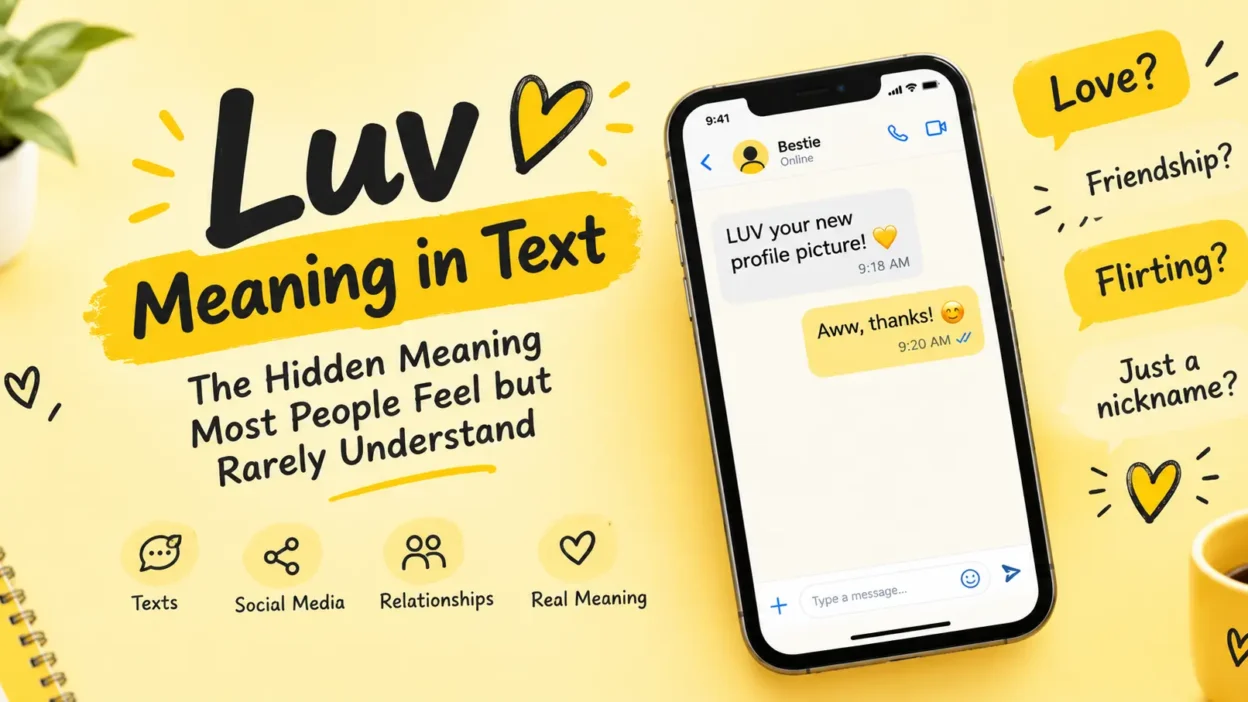
Luv meaning in text boils down to one core idea: it’s a casual, phonetic spelling of “love,” used to soften a message and make it feel warmer without the emotional weight of the full word. But the confusion people search for isn’t really about the spelling it’s about intent.
“Luv” from a close friend, a new match, a coworker, or a stranger behind a counter can mean four completely different things, and the word itself gives almost no clue which one applies.
Pronounced identically to “love” (rhyming with “dove”), “luv” isn’t a new invention it’s a long used informal spelling with roots in British speech patterns, now spread across texting and social media. One unrelated note worth clearing up early: “LUV” is also the New York Stock Exchange ticker for Southwest Airlines, a meaning that has nothing to do with messaging.
Introduction
Understanding the luv meaning in text starts with realizing it isn’t really about decoding a word it’s about reading intent. “Luv” is a casual, phonetic version of love, used to signal warmth, affection, or simple friendliness without the emotional weight of the full word. People almost never look it up when they type it, but often do the moment they receive it, especially when the sender’s feelings feel unclear.
The same four letters can mean casual friendliness from one person and quiet romantic affection from another. This guide skips the obvious definition and focuses on what matters why the word triggers second guessing, how to read it based on who sent it, and where it doesn’t belong at all.
Why Are People Searching “Luv Meaning in Text”?
Almost nobody searches this phrase out of general curiosity about slang. They search it because they just received the word from someone specific, and the surrounding context wasn’t enough to settle the question on its own. The most common triggers are:
- A text or DM from someone whose romantic interest is uncertain, where “luv” felt like it might be a signal.
- A comment or caption from a friend, where the spelling itself (“luv” instead of “love”) seemed to carry extra meaning.
- Hearing a stranger often in a British or Irish accent say “luv” and wondering if it meant something personal.
Context does almost all the interpretive work here, which is exactly why the word causes so much second-guessing when that context is missing or ambiguous.
Primary Meaning Explained
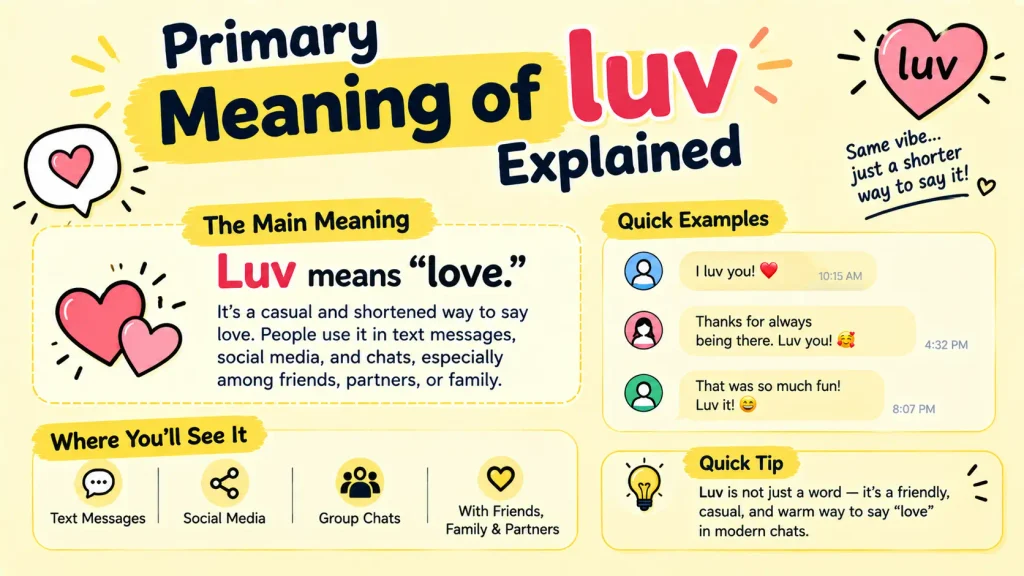
At its simplest, “luv” is a phonetic respelling written the way it sounds rather than the traditional way it’s spelled, the same pattern behind casual spellings like “thx” or “nite.” It carries the same core meaning as “love,” but consistently reads as lighter, faster, and less formal.
Think of the relationship between “luv” and “love” less like two different words and more like two different volumes of the same word. “Love” is spoken at full volume direct, serious, sometimes heavy. “Luv” is the same message turned down, made easier to send casually without it landing as a big declaration.
Origin and History
“Luv” didn’t start on smartphones. In British English, it has long functioned as an informal, friendly term of address used by shopkeepers, bus drivers, or someone giving directions, roughly the way “mate” or “dear” gets used elsewhere.
Said to a stranger, it carries no romantic weight at all; it’s simply a warm, regionally common way of speaking to people.
Its jump into texting culture happened later, driven by the same pressure that shaped most abbreviated slang: speed. Early texting had character limits and clumsy keypads, so shorter, phonetic spellings spread quickly.
Social media later gave the word a second life, especially in comments and captions, where a slightly playful spelling can make a compliment feel more casual and less like a formal statement.
Context-Based Interpretation
The single biggest factor in decoding “luv” isn’t the word it’s the relationship sending it.
| Who Sent It | Likely Meaning |
|---|---|
| A close friend | Warmth, appreciation, casual affection |
| A romantic partner | Softer version of “I love you” |
| A new match or crush | Ambiguous worth checking their overall pattern |
| A stranger (often British/Irish speech habit) | Friendly address, not personal interest |
| A coworker in a casual Slack/DM | Usually just a friendly sign-off, not romantic |
A useful habit: instead of analyzing the word alone, look at whether that person uses “luv” as their general style with lots of people, or specifically and consistently with you. A word used identically with everyone carries far less individual meaning than one reserved for a single conversation.
How Different Platforms Shape the Tone
WhatsApp — Tends toward personal, private use quick check-ins like “made it home, luv” between people who already know each other well.
Instagram — Common in comments and captions as light praise or support; often paired with emojis, which usually signals friendliness over romance.
TikTok — Shows up in captions and comment sections to sound upbeat and casual, closer to enthusiasm about content than affection for a person.
Snapchat — Fits naturally into quick, informal exchanges, often alongside a photo, where the casual tone matches the platform’s throwaway messaging style.
Facebook — Skews slightly older and more general-audience, often used the way it’s used in real-life British speech — a friendly address rather than a romantic signal.
X (formerly Twitter) — Short and fast-moving, “luv” here often reads as casual enthusiasm about a post rather than affection for a specific person.
Discord — Common in relaxed, community-oriented servers as a friendly sign-off, rarely carrying romantic weight given the group-chat setting.
Reddit — Rare compared to other platforms, and when it does appear, it usually shows up inside a specific thread asking exactly this question what someone meant by texting “luv” rather than as organic slang in general conversation.
What “Luv” Does NOT Mean
A few misconceptions worth correcting directly:
- It does not automatically mean romantic love. In plenty of contexts British speech habits, friendly texting, social captions it’s simply a warmer version of “hey” or “thanks.”
- It does not automatically mean flirting. A single “luv” in an otherwise ordinary message is far more often a texting habit than a hidden signal.
- It does not always imply an existing relationship. Strangers use it, coworkers use it, and casual acquaintances use it without any personal undertone at all.
- It does not carry the same emotional weight as “I love you.” The whole appeal of the shortened spelling is that it deliberately avoids that intensity.
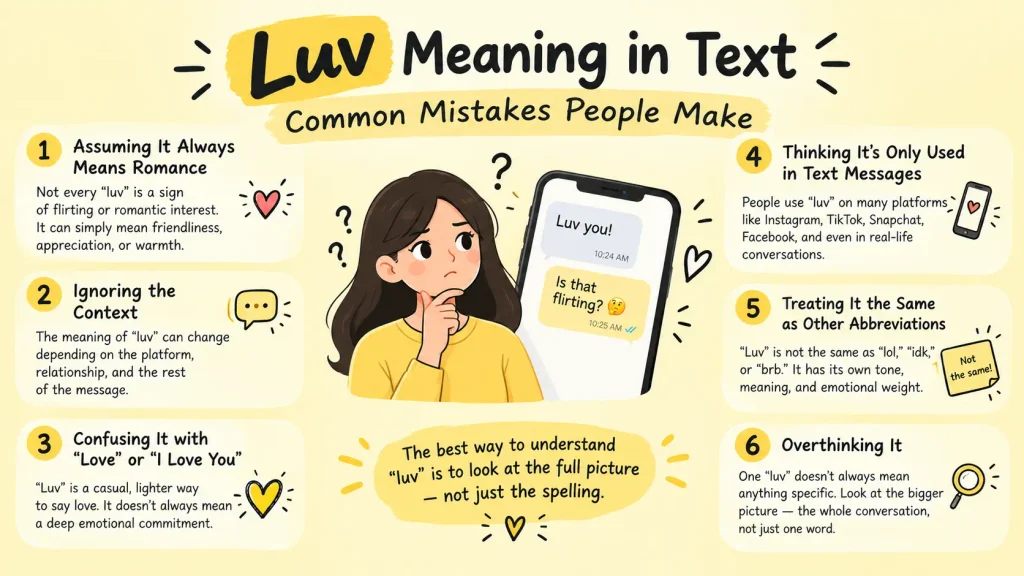
Common Mistakes People Make
- Reading one word in isolation. A single “luv” rarely tells the whole story the rest of the message and the general pattern of that relationship matter far more.
- Assuming every instance means the same thing. The same person might use “luv” identically with a best friend, a sibling, and a partner, without intending three different messages.
- Ignoring regional speech habits. Someone raised around British English may say “luv” reflexively, the same way someone else might casually say “hun” or “bud,” without meaning anything deeper by it.
- Overanalyzing a texting style that predates the relationship. If someone used “luv” with you from the very first conversation, it’s more likely their general style than a sign of growing feelings.
Personal Experience
The moment this word actually confused me wasn’t in a romantic context at all it was a comment from a close friend on an old photo: “LUV this one!!” I remember pausing slightly, not because I thought anything romantic was implied, but because I’d genuinely never noticed the spelling before and wondered if it was a typo.
A quick look through her other comments answered the question immediately she used “luv” constantly, on posts from family members, coworkers, and random photos of her dog, with zero pattern suggesting anything beyond her normal writing style.
That small moment reshaped how I read the word afterward. Instead of asking “what does luv mean,” I started asking “does this person use luv with everyone, or just here?”
That single shift in the question from decoding the word itself to reading the pattern around it turned out to be far more useful than any dictionary definition.
Expert Tip
When you’re trying to interpret a word like “luv,” resist the urge to analyze the spelling itself. Focus on the relationship and the conversation surrounding it instead check whether the sender uses similar language broadly or specifically with you, and weigh that against the rest of the message’s tone.
The word almost never carries the meaning on its own; the pattern around it does.
Similar Terms to Luv
| Term | Tone | Best Use |
|---|---|---|
| Luv | Casual, warm | Friends, texts, social captions |
| Love | Direct, serious | Close relationships, heartfelt moments |
| Luv ya | Casual affection | Friends, family, light romantic use |
| Babe | Flirty, romantic | Dating, established partners |
| Hun | Soft, friendly | Everyday casual chats |
| Dear | Gentle, slightly formal | Letters, older style messages |
| XOXO | Affectionate sign-off | Closing a message, not a standalone label |
Each of these carries a different emotional register even when the underlying sentiment is similar the choice of word often says as much about the relationship as the message itself does.
Frequently Asked Questions
What does luv mean from a guy? It usually reflects his general texting style more than a hidden signal check whether he uses it with friends and family too, or only in conversation with you.
What does luv mean from a girl? Same logic applies: if she uses “luv” broadly across her messages and comments, it’s likely just her natural style rather than a romantic hint.
Is luv still popular in 2026? Yes if anything, casual phonetic spellings like this have become more common as texting and captioning have leaned further into informal tone over the past several years.
Is luv more casual than love? Consistently, yes. The shortened spelling exists specifically to soften the word and reduce its emotional intensity compared to spelling it out in full.
Can luv mean friendship instead of romance? Absolutely, and in casual texting it often does many people use it interchangeably with words like “hun” or “bud” among close friends.
Is luv romantic or friendly? It can be either, and the word alone won’t tell you which. The relationship, the rest of the message, and how consistently that person uses it all matter more than the spelling itself.
Why do British people say luv? It functions as an informal, friendly term of address in British English, similar to “mate” or “dear,” commonly used toward strangers, customers, or acquaintances without any romantic implication.
Does using luv instead of love mean someone isn’t serious about their feelings? Not necessarily. Some people use “luv” as their default casual spelling in every context, including serious relationships, simply because it matches their overall texting style.
Final Thoughts
“Luv” carries far less fixed meaning than most people assume when they first search for it. It’s a flexible, phonetic stand-in for love that leans on context to do almost all the actual communicating who sent it, how they generally text, and what surrounds it in the conversation. Sometimes it signals real affection; other times it’s simply friendliness, habit, or a regional way of speaking.
Once you stop treating the word as a code to crack and start reading the pattern around it instead, “luv” stops feeling mysterious. It becomes exactly what it was always meant to be warm, casual, and rarely as complicated as it first seems.
Read More: CC Meaning in Text: The Overlooked Truth Behind an Abbreviation Millions Misuse (2026)

A former actress and voice coach, Clara helps learners lose their fear of speaking out loud. She breaks down tricky sounds, stress patterns, and rhythm using techniques borrowed from theater training.
[…] Read More: Luv Meaning in Text: The Hidden Signal Most People Completely Misread in 2026 […]
[…] More Reading: Luv Meaning in Text: The Hidden Signal Most People Completely Misread in 2026 […]