
ICL meaning in text is simple: ICL stands for “I can’t lie.” People type it before sharing an honest opinion, a confession, or a compliment they really mean, as in “ICL, that movie was better than I expected.” It belongs to the same family as NGL (“not gonna lie”) and TBH (“to be honest”), though many people use it for a slightly more emphatic, heartfelt tone.
In this guide, you’ll see how ICL appears in real messages, how it compares with NGL, TBH and FR, what “ICL ts pmo” means, how to reply, and which other meanings of ICL exist outside texting.
Quick Answer: What Does ICL Meaning in Text?
ICL means “I can’t lie.” It signals that the next thing you say is honest and unfiltered. It is informal slang, so it fits casual chats, comments and DMs, but not formal writing.
Most of the time the honesty is harmless: a compliment, a confession or a mild complaint. The feeling of the message comes from what follows ICL, not from ICL itself.
A Realistic Example of ICL in a Conversation
Imagine a friend texting, “ICL, I wasn’t expecting the movie to be that good.” In this example, ICL means “I can’t lie.” The sender is sharing an honest opinion about the movie and expressing genuine surprise.
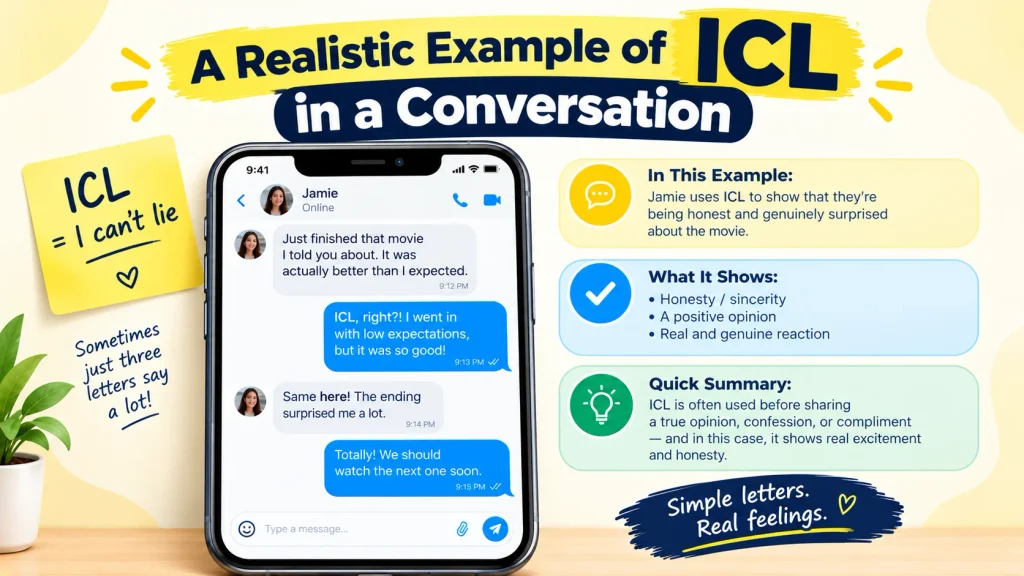
This shows how ICL can make a casual message sound more direct and conversational. Without it, the same message would still be clear, but it would feel a little flatter.
Why Do People Add ICL to a Message?
Written text has no tone of voice, so people often add small signals to show how they mean something. ICL is one of those signals. It tells the reader, “I’m being straight with you.”
It can also make a message feel more personal and relaxed. Compare “That was good” with “ICL, that was good.” The second version sounds like someone actually reacting, not just stating a fact.
How People Use ICL in Messages
ICL usually comes at the start of a message, because it prepares the reader for an honest statement. It can also follow a comma in the middle of a sentence or sit at the end as a quick add-on. “ICL, that was fun” and “That was fun, ICL” mean the same thing, but the start is the most common spot.
Compliments
- “ICL, you look great in that photo.”
- “Your editing is so clean, ICL.”
Confessions
- “ICL, I haven’t started the assignment yet.”
- “ICL, I fell asleep halfway through the show.”
Pleasant surprise
- “ICL, this place is way better than I thought.”
- “ICL, that was easier than I expected.”
Mild complaints or disagreement
- “ICL, the new update is worse than the old one.”
- “ICL, I didn’t love the ending.”
Short Conversations Showing ICL in Action
These are made up examples to show how ICL sounds in everyday chats.
Example 1: A compliment
- “Did you see my new haircut?”
- “ICL, it looks really good on you.”
- “Thanks, I wasn’t sure about it.”
Example 2: A confession
- “Did you finish the project?”
- “ICL, I haven’t even opened it yet.”
- “Same, let’s do it tonight.”
Example 3: Honest disagreement
- “How was the new episode?”
- “ICL, it felt a bit slow.”
- “Really? I liked it. What bothered you?”
In each case, the reply focuses on the message, not the abbreviation. That is how most conversations with ICL flow.
How to Read ICL by Tone and Context
ICL is neutral. It only introduces honesty, so “ICL, you did great” is positive and “ICL, I didn’t like it” is negative. Don’t assume bad news just because you see ICL.
It can also show up in flirty or playful messages, such as “ICL, you’re kind of funny.” Whether a message is flirty depends on the relationship and the rest of the text, not on ICL. When you’re unsure, read the whole message and the earlier conversation before deciding how the sender feels.
ICL vs NGL vs TBH vs FR
These abbreviations overlap a lot. The differences below are typical usage patterns, not strict rules, and people mix them freely.
| Slang | Stands for | Typical use |
|---|---|---|
| ICL | I can’t lie | Introduces an honest opinion, often a compliment or confession |
| NGL | Not gonna lie | Often softens a blunt or slightly negative opinion |
| TBH | To be honest | Neutral, works in more settings |
| FR | For real | Agrees with something or adds emphasis |
If you want the safest choice, TBH is the most neutral. ICL and NGL feel more casual and conversational.
What Does “ICL TS PMO” Mean?
“ICL ts pmo” is a longer version of the same slang. It usually reads as “I can’t lie, this sh*t pisses me off.”
- ICL = I can’t lie
- TS = this sh*t (commonly)
- PMO = pisses me off
People use it when something annoys them. Because it contains profanity, avoid it at school, at work or with anyone who wouldn’t expect that language. You may also see phrases like “ICL ts crazy” or “ICL ts so true,” where “ts” is often the same mildly profane shorthand.
Where You May See ICL Online
ICL is common in casual, informal spaces. You may notice it in private chats on apps like WhatsApp, in comments and DMs on Instagram, and in captions or comments on TikTok and Snapchat.
The meaning stays the same on each platform: “I can’t lie.” What changes is the style around it. A comment might be short (“ICL this is so good”), while a private chat might be a full sentence. Always rely on the surrounding text to understand the tone.
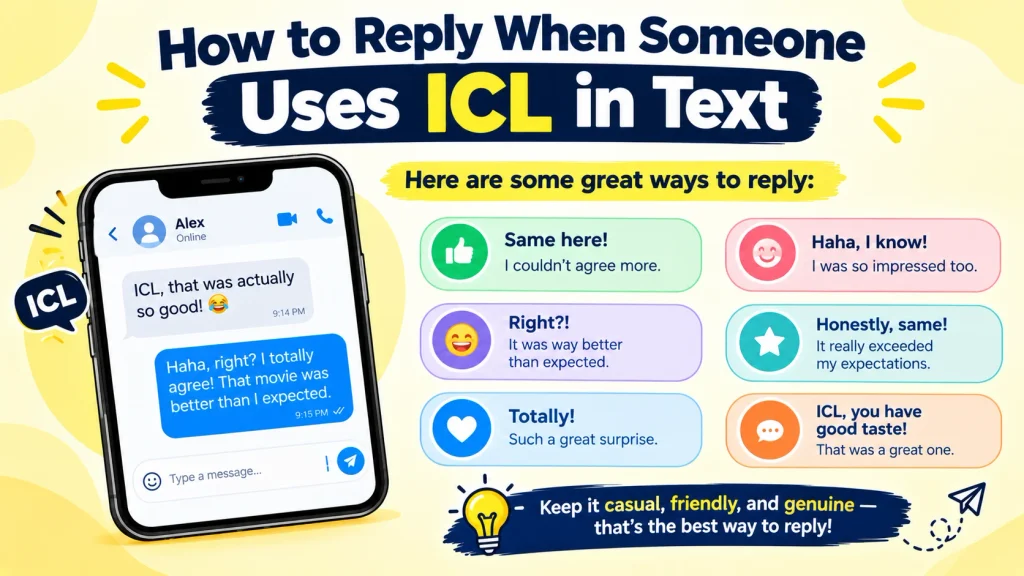
How to Reply When Someone Uses ICL
You don’t need a special reply. Respond to the message itself, not to the abbreviation.
- “Haha, thanks, that means a lot.”
- “Same, honestly.”
- “Really? What did you like most?”
- “ICL, I agree.”
If a friend says “ICL, I didn’t like your idea,” don’t take it personally. A simple “Fair, what would you change?” keeps the chat friendly.
Tips for Using ICL Naturally
ICL works best when you actually mean it. Use it for a real reaction, such as surprise, praise or a small confession. If you use it on every message, it stops sounding sincere.
Place it at the start of your sentence, keep the rest of the message short, and match the mood of the chat. If you’re not sure the other person will understand slang, write “to be honest” or “honestly” instead. That keeps your message clear for everyone.
Is ICL Formal or Informal?
ICL is informal. It works with friends, in casual group chats and in social media comments. Avoid it in emails, job applications, school assignments and professional messages. In those settings, use “to be honest” or “frankly.”
Other Meanings of ICL Outside Texting
If the context isn’t casual chat, ICL may mean something else:
- In context learning: an AI term for a model learning a task from examples in the prompt, without retraining.
- Imperial College London: a university in the UK.
- Implantable Collamer Lens: a lens implanted in the eye to correct vision.
- Indian Cricket League: a cricket league from the late 2000s that no longer operates.
- ICL Group: a global minerals and chemicals company.
In a chat, comment or DM, ICL almost always means “I can’t lie.” In a medical, academic, business or tech setting, check the context first.
Common Mistakes When Using ICL
- Assuming it’s always negative. It’s often used for compliments.
- Using “ICL ts pmo” in the wrong setting. It contains profanity.
- Mixing it up with ILY. ILY means “I love you.”
- Overusing it. If every message starts with ICL, it loses its effect.
- Using it in formal writing. Switch to “to be honest” instead.
Frequently Asked Questions
Is ICL rude?
Not on its own. It only introduces an honest statement, so the tone depends on what follows.
Is ICL the same as NGL?
They are very similar because both introduce an honest opinion. Some people use ICL for emphasis and NGL as a softer introduction, but these are general tendencies rather than strict rules.
Does ICL mean the same thing on every app?
In casual messages on apps like Instagram, TikTok, Snapchat, and WhatsApp, ICL usually means “I can’t lie.” However, context matters, and the abbreviation can have different meanings outside everyday texting.
Can I use ICL in an email?
It’s not recommended. Use “to be honest” in professional writing.
Does the sender’s gender change what ICL means?
No. The meaning and tone come from the rest of the message.
Does ICL always mean the sender is about to say something negative?
No. People use it for compliments and good surprises just as naturally as for complaints. Read the full message to understand the tone.
Should I capitalize ICL?
Either way is fine in casual chat. “ICL” and “icl” mean the same thing. Capital letters are more common in articles and captions, while lowercase is common in quick messages.
Bottom Line
ICL stands for “I can’t lie,” and it works as a casual lead-in to an honest thought, whether that’s praise, a confession or a small complaint. It reads as neutral, so the words after it set the mood. Use it with friends and in relaxed chats, and switch to “to be honest” when you need a more professional tone.
Keep “ICL ts pmo” for informal, private conversations because of its profanity. If you see ICL somewhere that isn’t a casual message, such as a medical or tech document, it probably means something else entirely. When in doubt, read the context.
More Read: TS Meaning in Text: Crack the Hidden Code Behind This Tricky Social Media Slang in 2026

Curriculum Developer
Rachel has spent over a decade developing English learning curriculums for schools and online platforms across the United States. Her specialty is structuring content so that even beginner learners can follow along with confidence.

[…] More Read: ICL Meaning in Text: Easy Examples and Smart Reply Tips in 2026 […]