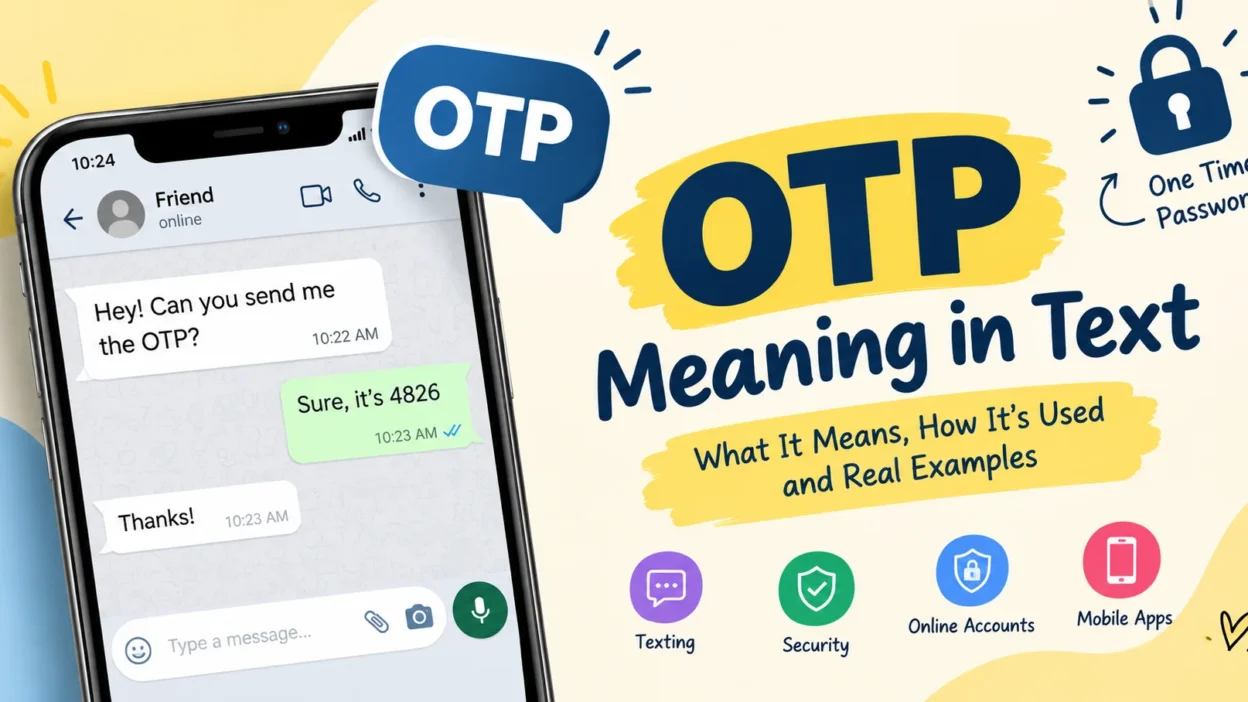
The OTP meaning in text depends on the conversation. In fandom chats and social media comments, OTP usually stands for One True Pairing, meaning your favorite couple. In bank and app messages, it means one time password, a short security code that proves it’s really you. Some people also use it as casual shorthand for “on the phone” when they can’t talk.
This guide explains each meaning in plain English, shows realistic examples, and gives you a simple method to work out which one a sender intends. You’ll also learn how to reply naturally and how to protect your accounts from code-stealing scams.
Quick Answer: The 3 Meanings of OTP Meaning in text
Short version: if the message mentions characters, couples, or a show, think One True Pairing. If it mentions a code, login, or bank, think one time password. If someone says they’re busy or can’t talk, they may mean “on the phone.”
| Meaning | What it refers to | Where you’ll see it | Example |
|---|---|---|---|
| One True Pairing | A favorite couple, fictional or real | Fandom posts, comments, group chats | “Mulder and Scully are my OTP.” |
| One-Time Password | A temporary security code | Bank, app, and account-verification messages | “Your OTP is 000000. Do not share it.” |
| On the Phone | The sender is on a call | Casual texts between people who know each other | “Can’t talk, OTP with my landlord.” |
These are three unrelated meanings that happen to share the same letters, so the surrounding message matters more than the abbreviation. The first two are established meanings, while “on the phone” is informal and far less widely recognized.
OTP Meaning in Slang: One True Pairing
In fandom culture, your OTP is the pairing you support above all others. Dictionary.com’s acronyms entry for OTP describes it as part of “shipping” culture, where fans root for two characters to become a couple. The main Dictionary.com entry also lists it as an informal term among fan-fiction writers and readers.
The term has some history. Dictionary.com reports that OTP has been used online since at least the early 2000s, and that the phrase “one true pairing” may go back to the mid 1980s, with one source pointing to Star Trek fanzines.
An OTP can be:
- Fictional characters from a show, film, book, anime, or game.
- Celebrity couples that fans discuss online.
- Real couples people mention casually, such as friends or relatives.
- Something loved: Dictionary.com notes people sometimes joke about a character’s relationship with a favorite food.
Ship vs. OTP. To ship two people is to want them together. Your OTP is the pairing that outranks all your other ships. Dictionary.com says you can have more than one OTP across different fandoms, but within each one the OTP still takes precedence.
Related terms: Dictionary.com also covers NOTP (a pairing you dislike), BrOTP (a friendship you love without wanting it to be romantic), and OT3 (a favorite trio). They work as verbs too, as in “I’m OTPing these two.”
Examples:
- “Honestly, Elizabeth and Darcy are my OTP.” The speaker names a fictional couple as their favorite.
- “Who’s your OTP this season?” The sender asks which couple you’re rooting for.
- “My cousin and her fiancé are my OTP.” A warm compliment about a real couple, with no fandom involved.
OTP Meaning in Text Messages: One Time Password
A one-time password (also called a one-time passcode or verification code) is a temporary code that confirms a particular sign in or transaction. Companies send them by text, email, or an authenticator app. Dictionary.com defines it as a password provided to a user for a single access to a website or service.
You’ll see this meaning when you sign in from a new device, verify a payment or transfer, or reset a password. A typical message looks like this (the code is made up):
“Your verification code is 000000. It expires in 10 minutes. Never share this code with anyone.”
The safety rule: never give a verification code to someone who contacts you and asks for it. The FTC’s guidance, What’s a verification code and why would someone ask me for it?, explains that scammers pose as a trusted party, claim there’s a problem with your account, and then ask for the code so they can log in as you. It states that anyone who asks for your account verification code is a scammer.
Notice the difference from fandom slang: a friend telling you their OTP is harmless, while a stranger asking for your OTP is a red flag.
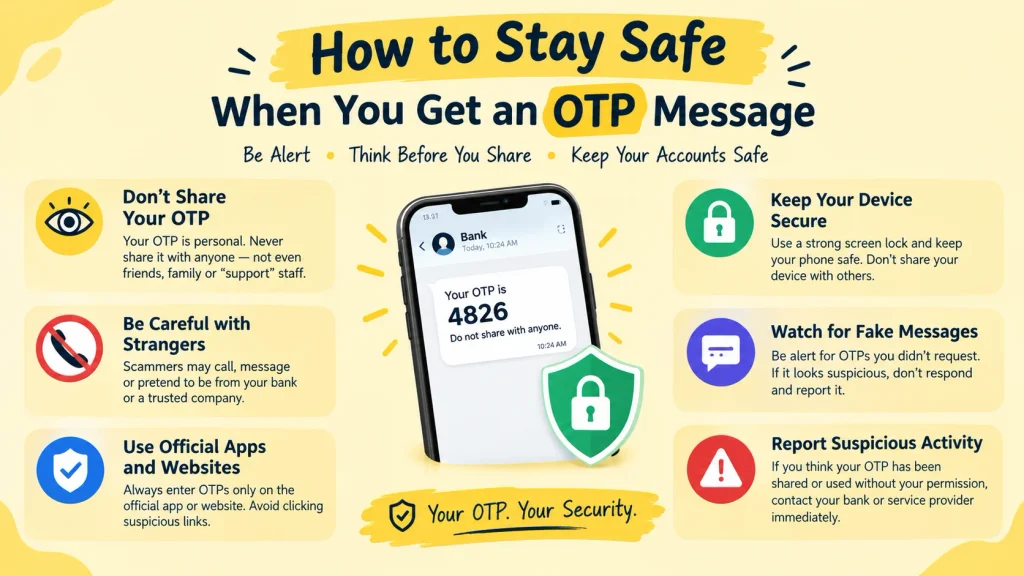
How to Stay Safe When You Get an OTP Message
A few simple habits protect your accounts even when a scammer sounds convincing and knows details about you.
- Keep the code private. It’s meant only for you to log in, never for a caller, a “support agent,” or a stranger.
- Enter it only where you started the action. Use the official site or app you were already signing in to.
- Don’t engage with anyone who asks for it. The FTC advises you to hang up, block the number, stop texting, and report it at ReportFraud.ftc.gov.
- Contact the company yourself. Use the number on your card or statement, or inside its official app, never the number the caller gave you.
- Question codes you didn’t request. If you didn’t start a login or payment, check your account through the official app rather than replying to the message.
Does OTP Mean “On the Phone”?
Sometimes. Some people use OTP as quick shorthand for being on a call, as in “Sorry, OTP rn, text you later.” This is informal usage. It doesn’t appear in the Dictionary.com entries above, and it spreads between people rather than through any official source, so don’t assume everyone knows it.
You can usually spot it because the message explains why the sender can’t chat, often with a promise to follow up. There are no couples or codes anywhere in sight.
- “Can’t answer, OTP with my boss.”
- “I’ll reply after dinner. OTP right now.”
Other Meanings of OTP You Might See
OTP can also be a technical term. Dictionary.com lists one-time pad, a cryptography term, alongside one-time password. In news and business writing, OTP may also be the name or abbreviation of an organization. If the message has nothing to do with couples, codes, or calls, check whether it comes from a company or a technical context before assuming anything.
How to Tell Which OTP Meaning Someone Intends
Ignore the three letters for a moment and read everything around them: the topic, the sender, and what the message wants from you.
- One True Pairing: words like “ship,” “couple,” “characters,” “episode,” “fandom,” or “together.”
- One-Time Password: words like “code,” “verify,” “login,” “bank,” or “account,” often from an automated sender.
- On the Phone: words like “busy,” “call,” “talk later,” or “can’t answer.”
Use this quick three-step check:
- Is a code or account involved? Treat it as a security matter and never share the code.
- Is the sender talking about a couple or characters? It’s almost certainly One True Pairing.
- Is the sender explaining why they can’t talk? It probably means “on the phone.”
Clues help, but they aren’t proof, and a message with little context can fit more than one meaning. If none of the steps fit, just ask: “Wait, OTP as in the couple, or on the phone?” is perfectly polite.
OTP Meaning on Snapchat, Instagram, and TikTok
OTP isn’t tied to one app. What changes from platform to platform is the kind of content you’re looking at:
- Captions, comments, and fan edits on TikTok and Instagram usually involve fandom, so One True Pairing is the likeliest reading.
- Private messages between friends, including on Snapchat, could mean a favorite couple or “on the phone,” depending on the conversation.
- Verification messages that mention OTP come from the platform’s account-security system by text or email. They have nothing to do with slang, and the same never-share rule applies.
Be cautious with articles claiming one platform “commonly” uses a particular meaning. Those claims usually describe how some groups of users talk, not an official definition.
What Does OTP Mean From a Guy or a Girl?
The sender’s gender doesn’t change the meaning. Anyone can use OTP for a favorite couple, a code, or a call, so read the message rather than the sender.
OTP alone also doesn’t show romantic interest. “You two are my OTP” compliments a couple; it says nothing about the sender’s feelings. The abbreviation isn’t flirting. If a message like “we’d be my OTP” feels flirty, that’s the rest of the sentence doing the work.
OTP Text Examples and How to Reply
| Message | Meaning | Clue | Good reply |
|---|---|---|---|
| “Which couple is your OTP in the finale?” | One True Pairing | “couple,” “finale” | “Mine’s the slow-burn pair. Yours?” |
| “Sorry, OTP rn, text you after.” | On the Phone | “Sorry,” “rn,” follow-up promise | “No worries, talk later!” |
| “Enter the OTP we sent to verify your login.” | One-Time Password | “verify,” “login” | Enter it only in the official app or site you were using. |
| “I need your OTP to finish the refund.” | Likely a scam | A stranger wants a code | Don’t reply. Don’t share it. Contact the company through its official app. |
| “OTP?” with no context | Unclear | None | “OTP as in the couple, or on the phone?” |
All examples are illustrative, not collected from real conversations. In the security cases, “reply” often really means “don’t.”
OTP vs. Ship, NOTP, and One-Time Passcode
- OTP vs. ship: Ship is the verb or noun for wanting two people together. OTP is your top-ranked ship.
- OTP vs. NOTP: NOTP is a pairing you dislike or want no part of.
- One-time password vs. one-time passcode: Both describe a temporary code used once. Banks and apps choose whichever wording they like.
Common Mistakes to Avoid
- Assuming OTP always means One True Pairing. It’s likeliest in fandom spaces, but check the topic first.
- Treating every OTP message as a security warning. Most casual uses between friends are slang. Look for a code, login, or bank before getting alarmed.
- Assuming everyone knows “on the phone.” It’s informal and far from standard.
- Reading OTP as romantic interest. It names a pairing, which may have nothing to do with the sender’s feelings.
- Sharing a code without checking the request. Before sending any code, ask whether you started the action that triggered it. If you didn’t, or if someone is asking you for it, don’t send it.

Frequently Asked Questions About OTP
What does OTP mean in text?
Usually One True Pairing, one time password, or, informally, “on the phone.” The conversation tells you which.
Does OTP mean One True Pairing or One Time Password?
Both. One is fandom slang and the other is a security term. A message about a couple means the first; a message about a code or login means the second.
What does OTP mean on Snapchat, Instagram, or TikTok?
The same three things. The app doesn’t decide the meaning; the content does. A code sent by the platform itself is a one-time password.
What does OTP mean from a guy or a girl?
The same thing either way, and it doesn’t show romantic interest on its own.
Can OTP mean “on the phone”?
Yes, in some casual messages, but it’s less widely known than the other two. A line about being busy or unable to talk is the clue.
Should I ever send someone my OTP code?
No. Enter it only where you started the sign in or transaction. If anyone asks you to hand it over, treat it as a scam.
How can I tell which meaning someone intends?
Read the surrounding words. Couples and characters suggest fandom, codes and logins suggest security, and “busy” suggests a call. If it’s still unclear, ask.
Bottom Line
The OTP meaning in text comes down to context. One True Pairing is a favorite couple, one time password is a security code, and “on the phone” is a casual, less universal shorthand. Characters, episodes, or the word “ship” point to fandom, while “code,” “login,” or “bank” point to security. When the meaning is unclear, ask the sender instead of guessing.
Most importantly, remember this rule: a friend may share a favorite pairing, but a verification code is only for you. Never hand one to anyone who contacts you and asks. If any message asks for a number from your phone, stop, verify through the official app, and keep that code private.
Read More: WYMM Meaning in Text: Clear Up Confusing Slang Fast in 2026

Curriculum Developer
Rachel has spent over a decade developing English learning curriculums for schools and online platforms across the United States. Her specialty is structuring content so that even beginner learners can follow along with confidence.