
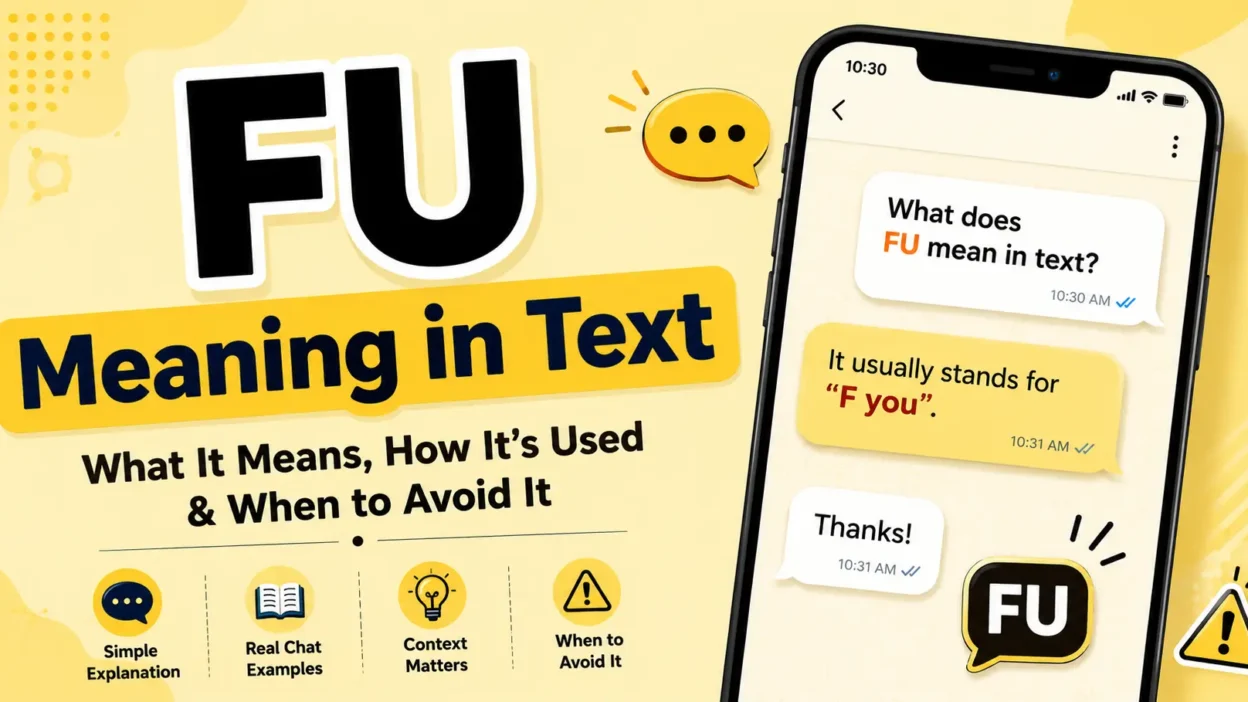
Looking up the FU meaning in text? FU is short for “f*** you.” People use this internet slang term to show anger, frustration, or contempt.FU has a second meaning, too. Some people use it to mean “fully understood.” This meaning is rare. Most of the time, FU means the first thing.
Both meanings look the same on a screen. That’s why context matters so much when you see this abbreviation.
What Does FU Mean in Text? (Quick Answer)
FU Meaning in Text means “f* you.”** This is the common meaning. You’ll see it in texts, comments, and social media posts almost every time.
FU is blunt. Most people see it as rude and offensive. People use it when they feel angry, hurt, or dismissive toward someone.
There’s a second meaning you should know. FU can also stand for “fully understood.” This use is rare. It usually shows up as a quick reply to instructions, not as a reaction to conflict.
Capital letters don’t change the meaning. FU, Fu, and F U (with a space) all mean the same thing.
The Two Meanings of FU, Ranked by How Common They Are
FU Meaning in Text= “F*** You” (the main meaning)
This is what FU means almost every time you see it. People use it to express anger, frustration, or contempt. Sometimes it’s serious. Sometimes it’s a joke between friends.
FU Meaning in Text= “Fully Understood” (rare)
This meaning shows up much less often. Someone might type FU to confirm they understood something. This use is uncommon. Most readers will assume the angry meaning first. Use this second version carefully.
How to Tell Which One Someone Means
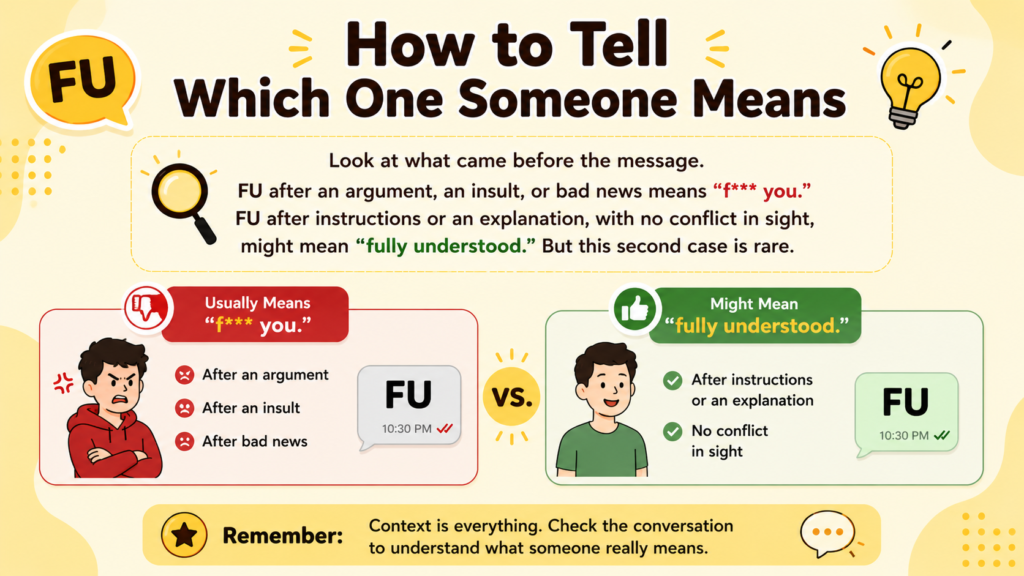
Look at what came before the message. FU after an argument, an insult, or bad news means “f*** you.” FU after instructions or an explanation, with no conflict in sight, might mean “fully understood.” But this second case is rare.
Is FU Rude? Understanding the Tone
FU is generally seen as rude. It stands for a curse word, after all. But the feeling behind it can change a lot depending on the situation.
When FU Signals Real Anger
Someone sends FU right after a fight, an insult, or bad news. This is FU at its most serious and hostile.
When FU Is Sarcastic or Playful
Friends often use FU as a joke. Maybe someone lost a game or got teased. Nobody involved thinks it’s a real attack.
When FU Signals Triumph
Sometimes FU isn’t aimed at a person in the moment at all. It shows up in captions like “FU to the haters,” after someone overcomes a hard situation. Here, it feels more like a win than an insult.
Why FU Sounds Angrier or Funnier Than You Think
I still remember the first time I saw “FU” in a comment thread on social media. The message looked unusually harsh, but I didn’t immediately understand what the abbreviation meant.
After looking it up, I learned that FU is most commonly used as a shortened form of “f*** you.” It’s an offensive expression people often use when they’re angry or trying to insult someone.
Seeing it used in a real conversation taught me more than just the meaning. It taught me the tone behind it, too. Now, whenever I come across abbreviations like FU, I check the context first. Even two letters can completely change the mood of a conversation.
Where Does FU Come From? (Origin, Fact Checked)
The exact origin of FU isn’t well documented. There’s no solid historical record proving where it started.
You may see a popular story online. It claims FU began as “sailor slang,” later shortened by women who wanted to curse without actually cursing. This story gets repeated often. It isn’t backed by clear historical sources, though. Treat it as folk etymology, not confirmed fact.
What we do know is simpler. FU became common once texting and internet chat made short, informal language the norm. People wanted quick ways to express strong feelings in just a few letters. FU grew alongside similar terms like STFU and WTF. [Related: history of internet slang and text abbreviations]
How to Use FU in a Text Message (Real Examples)
FU in Angry or Frustrated Contexts
- “You blamed me for something I didn’t do. FU.”
- “They canceled my flight with no warning. FU to that airline.”
FU in Sarcastic or Humorous Contexts
- “You beat me again? FU, man, you’re too good at this game.”
- “FU for making me laugh so hard I spilled my coffee.”
FU Meaning in Text on Social Media
- “Finally quit that job. FU to anyone who doubted me.”
- “FU to whoever towed my car for no reason.”
Softer Alternatives to FU
Want the same feeling without the curse word? Try phrases like “back off,” “leave me alone,” “get lost,” or “take a hike.” They carry a similar edge with less offense.
FU vs. Similar Text Slang What’s the Difference?
FU vs. STFU
FU Meaning in Text means “f*** you.” It’s a reaction aimed at someone. STFU means “shut the f*** up.” It’s a command telling someone to stop talking. They’re related, but they don’t mean the same thing.
FU vs. WTF
FU Meaning in Text expresses anger or dismissal toward a person or situation. WTF (“what the f***”) expresses shock, confusion, or disbelief. One is an attack. The other is a reaction.
FU vs. GTFO, IDGAF, FOH
| Term | Meaning | Typical Use |
| FU | F*** you | Anger, dismissal, defiance |
| STFU | Shut the f*** up | Telling someone to stop talking |
| WTF | What the f*** | Shock or disbelief |
| GTFO | Get the f*** out | Telling someone to leave |
| IDGAF | I don’t give a f*** | Indifference |
| FOH | F*** outta here | Disbelief or dismissal |
Does FU Mean Anything Else? (Cross-Language Notes)
Outside of English slang, “fu” shows up in other languages. These meanings are completely unrelated to the text abbreviation.
“Fu” (福) in Chinese
In Chinese, 福 (fú) means “good fortune” or “happiness.” You’ll often see this character during Chinese New Year celebrations. It has nothing to do with the English slang term.
“Fu” (風) in Japanese
In Japanese, 風 (fū) means “wind.” It also appears in words linked to traditional style and weaving. Again, this meaning is unrelated to the texting abbreviation.
Is It Ever Appropriate to Send FU?
Texting Friends vs. Professional Settings
Among close friends, FU is often harmless. It can even feel playful, depending on your relationship. In professional messages or emails, avoid it completely. This is especially true with people who might take it literally.
Gaming Chat, Discord, and Social Media
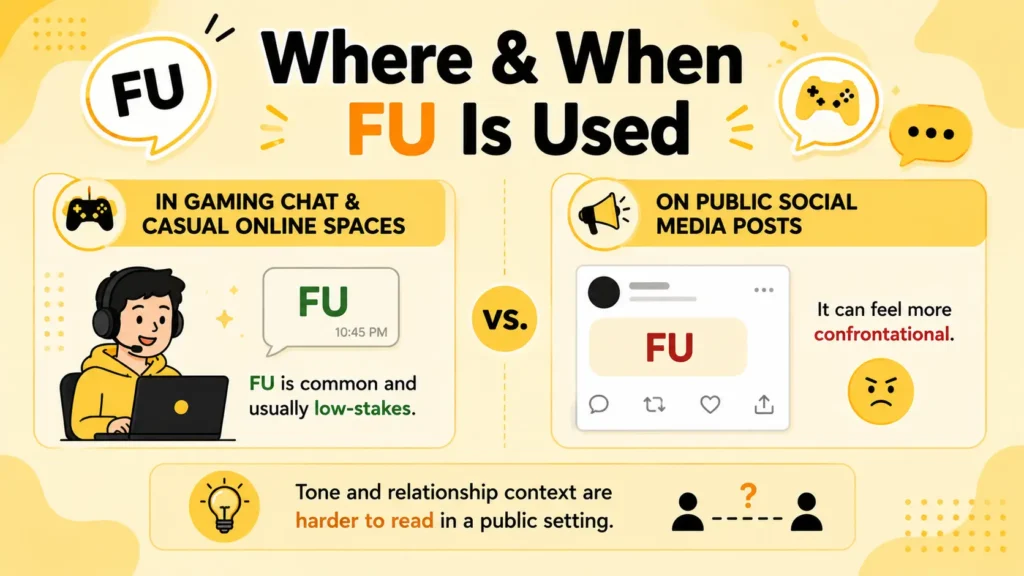
In gaming chat and casual online spaces, FU is common and usually low-stakes. On public social media posts, it can feel more confrontational. Tone and relationship context are harder to read in a public setting.
Frequently Asked Questions
What does FU mean in a text message?
FU is a text slang term short for “f*** you.” People use it to express anger, frustration, or contempt toward someone. It’s considered rude and offensive in most settings, so it’s usually reserved for casual, informal conversations between people who know each other well.
Does FU always mean “f* you”?**
Almost always, yes. FU’s dominant meaning is “f*** you.” In rare cases, people use it to mean “fully understood,” usually as a quick reply confirming instructions. Context around the message makes the intended meaning clear most of the time, so pay attention to what came before it.
Is FU a bad word or offensive?
Yes, FU is generally considered offensive and vulgar. It stands in for a profane phrase, so many people see it as rude. It’s best used only in casual, informal settings with people who know you and won’t be genuinely upset by it.
What does FU mean besides “fully understood”?
FU’s main and most common meaning is “f*** you,” used to express anger or frustration. “Fully understood” is a secondary meaning that shows up far less often in real conversations. Because it’s uncommon, most readers will assume the profane meaning first.
What’s the difference between FU and STFU?
FU means “f*** you” and expresses anger or dismissal toward someone. STFU means “shut the f*** up” and tells someone to stop talking entirely. They’re related terms that share a root word, but they carry very different messages.
Is it ever okay to send FU to someone?
FU is generally fine among close friends in casual or joking contexts, where tone is already understood. It’s inappropriate in professional settings, formal messages, or with anyone who might take the phrase literally and feel genuinely insulted or hurt by it.
Where does the abbreviation FU come from?
The exact origin of FU isn’t well documented, despite popular stories online claiming otherwise. It’s most likely a simple text-and-chat-era shortening of “f*** you,” created to soften the visual impact of the full profane phrase while keeping its meaning intact.
FU Meaning in Text: The Bottom Line
FU is short, but it carries a lot of weight. Most of the time, it means “f*** you” a blunt way to show anger or frustration. Less often, it means “fully understood.”
The letters stay the same every time you see them. What changes is the person typing them, and the situation behind the message. A little context goes a long way with slang like this and now you have what you need to read FU correctly, whether it lands as a joke or a genuine jab.
More Read: IMK Meaning in Text: Avoid This Common Mistake: 2026

Curriculum Developer
Rachel has spent over a decade developing English learning curriculums for schools and online platforms across the United States. Her specialty is structuring content so that even beginner learners can follow along with confidence.
[…] More Read: FU Meaning in Text: A Confusing Abbreviation Finally Clarified 2026 […]
[…] More Read: FU Meaning in Text: A Confusing Abbreviation Finally Clarified 2026 […]