
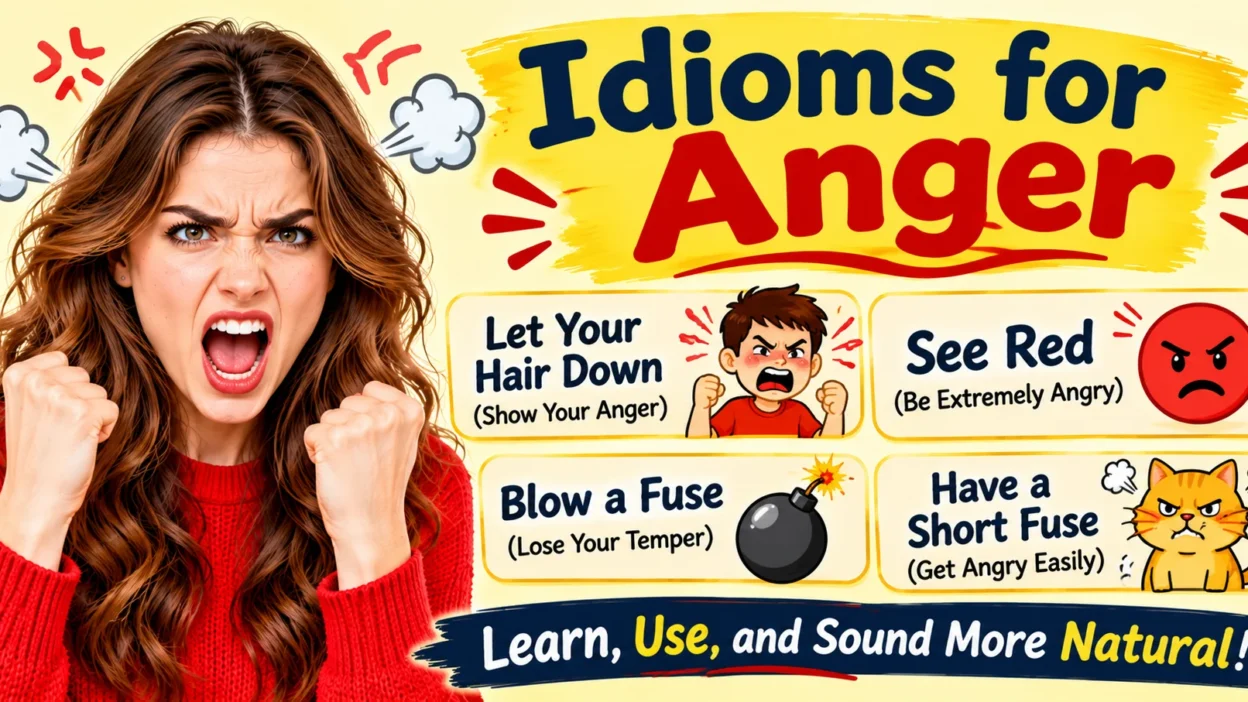
Idioms for anger are fixed phrases that describe rage, irritation, or a lost temper with a picture instead of a plain word, like “blow a fuse” or “hit the roof.” Native speakers use them to sound vivid, natural, and expressive, whether they are mildly annoyed or boiling mad. In this guide you’ll find the meaning of 16 popular phrases, a fact checked origin for six of them, and real example sentences you can reuse at home, at school, and at work.
You’ll also see how strong each phrase is, which ones are too casual for work, and which popular “anger idioms” aren’t about anger at all. Read on and pick the phrase that fits your mood.
⚡ Quick Answer
The most common idioms for anger are “blow a fuse,” “hit the roof,” “fly off the handle,” and “see red.” All four mean very angry and fit sudden outbursts.
- For slow burning irritation, say “hot under the collar” or “get on someone’s nerves.”
- For someone who gets angry quickly, say “have a short fuse.”
- For formal writing, swap in “upset” or “frustrated.”
Fact check: the “see red” bull story is folklore, while “fly off the handle” has a well-supported origin in a loose axe or hammer head.
Best Idioms for Anger: Quick Meaning Chart
The most common idioms for anger are “blow a fuse,” “hit the roof,” “fly off the handle,” “see red,” “hot under the collar,” and “have a short fuse.”
“Intensity” shows how strong the feeling is. “Type” shows whether the anger is sudden, slow, or aimed at someone.
| Idiom | Meaning | Intensity | Type | Tone |
|---|---|---|---|---|
| Get on someone’s nerves | to annoy | Mild | Slow | Casual |
| Drive someone up the wall | to annoy intensely | Medium | Slow | Casual |
| Hot under the collar | angry or irritated | Medium | Slow | Casual |
| Have a short fuse | to get angry easily | Medium high | A habit | Neutral |
| Bite someone’s head off | to snap at someone | Medium high | Aimed | Casual |
| Lose your temper | to lose control from anger | High | Sudden | Neutral |
| Fly off the handle | to turn angry all at once | High | Sudden | Casual |
| Make your blood boil | to fill with anger | Very high | Slow | Casual |
| See red | to become extremely angry | Very high | Sudden | Casual |
| Hit the roof | to explode in anger | Very high | Sudden | Casual |
| Blow a fuse | to lose your temper | Very high | Sudden | Casual |
| Go ballistic | to become wildly angry | Very high | Sudden | Casual, dramatic |
Idioms for Sudden, Explosive Anger
The best idioms for sudden anger are “blow a fuse,” “fly off the handle,” “hit the roof,” “see red,” and “go ballistic.”
Blow a Fuse
Meaning: to lose your temper suddenly.
The picture comes from electricity. Too much power, and the circuit cuts out.
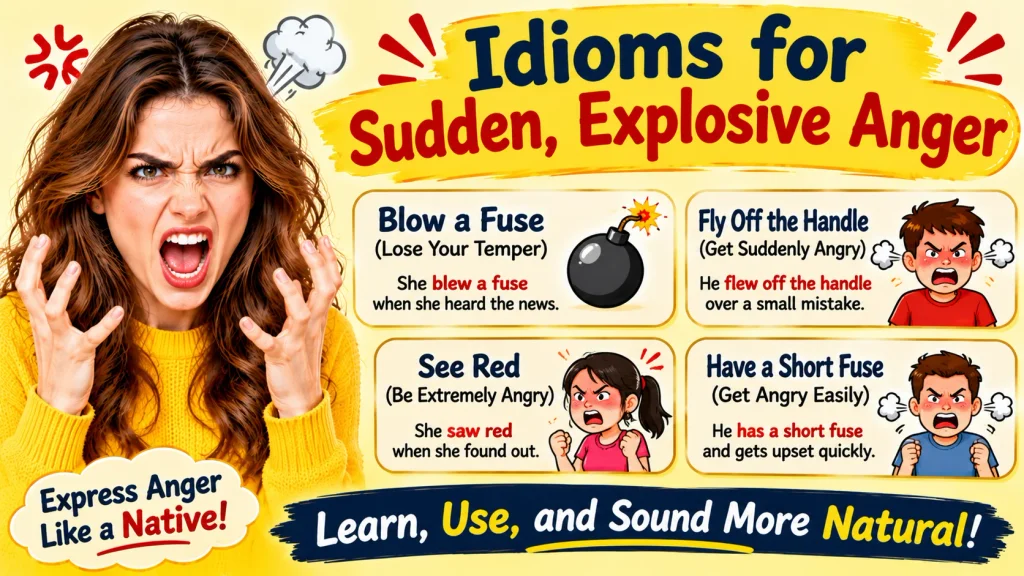
- “My manager blew a fuse when she saw the typo on the invoice.”
- “Dad nearly blew a fuse when the Wi-Fi died during the match.”
Fly Off the Handle
Meaning: to become angry all at once, often over something small.
The key idea is speed, not size.
- “Please don’t fly off the handle before you hear the whole story.”
- “Mr. Khan flew off the handle when a phone rang in class.”
Hit the Roof
Meaning: to explode in anger.
“Hit the ceiling” works the same way.
- “My parents will hit the roof if I miss curfew again.”
- “The customer hit the roof when the refund took six weeks.”
See Red
Meaning: to become so angry that you can’t think straight.
- “I saw red when I found out someone had copied my project.”
- “He saw red the moment the referee blew the whistle.”
Go Ballistic
Meaning: to become wildly, loudly angry.
It sounds dramatic, so people often use it in stories and jokes.
- “My boss will go ballistic if the client calls again today.”
- “My little brother went ballistic when I touched his game controller.”
Idioms for Simmering Anger and Annoyance
Idioms for simmering anger, such as “hot under the collar” and “get on someone’s nerves,” describe slower irritation rather than an outburst. If you want the opposite mood, see our guide to idioms for calm.
Hot Under the Collar
Meaning: angry or irritated, often in a way others can see.
Think of a flushed neck.
- “She gets hot under the collar whenever someone interrupts her.”
- “The coach was hot under the collar after the unfair call.”
Have a Short Fuse
Meaning: to get angry quickly.
This one describes a person’s habit, not a single moment.
- “Be careful what you say. He has a short fuse.”
- “My sister has a short fuse before her first coffee.”
Make Your Blood Boil
Meaning: to fill someone with strong anger, often about unfairness.
- “Cruelty to animals makes my blood boil.”
- “Reading about the unpaid wages made her blood boil.”
Drive Someone Up the Wall
Meaning: to annoy someone intensely.
- “The neighbor’s drilling is driving me up the wall.”
- “My roommate’s loud chewing drives me up the wall.”
Get on Someone’s Nerves
Meaning: to annoy someone in a small, steady way.
- “His constant tapping is getting on my nerves.”
- “The slow printer got on everyone’s nerves at the office.”
Idioms for Angry Words and Actions
Idioms for angry words and actions, like “bite someone’s head off” and “give someone an earful,” describe how anger comes out.
- Bite someone’s head off: to snap at someone harshly. “I only asked for the time, and she bit my head off.”
- Give someone an earful: to scold or complain at length. “Mom gave me an earful about the dirty dishes.”
- Chew someone out: to scold someone angrily. “The coach chewed him out for being late.”
- Let off steam: to release anger through talk or activity. “I go for a run to let off steam after work.”
- Be up in arms: to be angry and protesting, often as a group. “Residents were up in arms about the new parking fees.”
- Be on the warpath: to be angry and ready to confront someone. “The principal is on the warpath about the missing laptops.”
Where Do Anger Idioms Come From? Fact vs. Folklore
Several anger idioms have documented American roots, such as “fly off the handle,” “blow a fuse,” and “hot under the collar,” while the red-cape story behind “see red” is folklore.
The table separates what is recorded from what gets retold.
| Idiom | Popular story | What the record shows | Verdict |
|---|---|---|---|
| Fly off the handle | The head of an axe or hammer flies off a loose handle. | An American phrase, in print by 1816 by one dictionary’s count. The loose-tool picture is the standard explanation. | Well supported |
| Blow a fuse | An electric fuse melts when it is overloaded. | American in origin. Early figurative uses are dated to 1908 in one survey, and to the 1930s in an older dictionary. | Well supported |
| Hot under the collar | Heat from anger flushes the neck. | American English. One survey found it in a Chicago paper in 1869. Etymonline dates it to 1895. | Well supported |
| Hit the roof | No agreed story. | Dictionaries date it to the early 1900s. One dictionary links it to an older phrase meaning enraged. | Unconfirmed |
| See red | A bull is enraged by a red cape. | Bulls react to the cape’s movement, not its color. The earliest printed use explains it as a mental effect of anger. | Folklore, doubtful |
| Go ballistic | A missile that has left its guided flight. | The ballistic missile dates to 1954. The idiom appears in the early 1980s. | Documented, recent |
Where the record is clear, these phrases began in American English, with dates from the early 1800s to the 1980s.
The Three Pictures Behind Anger Idioms
Most anger idioms use one of three pictures: pressure that builds and bursts, heat that rises, or something that breaks loose.
| Picture | Idioms | Best for |
|---|---|---|
| Pressure and machines | blow a fuse, blow a gasket, blow your top, go ballistic | Sudden, loud outbursts |
| Heat | hot under the collar, boil with rage, steam coming out of your ears, make your blood boil | Anger that builds |
| Breaking loose | fly off the handle, lose your cool, flip your lid | Losing control |
Pick the picture that matches the mood.
Idioms That Look Like Anger but Aren’t
Several idioms that show up on anger lists mean something else: “bite the bullet,” “chew the scenery,” and “at your wit’s end” are not about being angry.
- Bite the bullet: to push through something painful or hard. “I’ll bite the bullet and call the bank about the fee.”
- Chew the scenery: to act in an over-the-top, dramatic way. Dictionaries link it to overacting on stage. “The actor chewed the scenery in every scene.”
- At your wit’s end: confused and out of ideas. “I’m at my wit’s end with this broken printer.”
- More in sorrow than in anger: sad rather than angry. The line comes from Shakespeare’s Hamlet. “She said it more in sorrow than in anger.”
You can feel angry and still use these. The words themselves describe effort, acting, confusion, and sadness.
Can You Use Anger Idioms at Work?
Most anger idioms are too casual for reports and formal emails, so use plain words like “upset,” “frustrated,” or “angry” there. For more phrases that suit the office, browse our list of common English idioms.
| Casual idiom | Safer choice |
|---|---|
| Blow a fuse | became very upset |
| Hit the roof | reacted angrily |
| Go ballistic | was extremely upset |
| Get on my nerves | frustrates me |
| Have a short fuse | is quick-tempered |
Here is the difference in one pair of lines:
- ❌ “The client went ballistic over the invoice.”
- ✅ “The client was extremely upset about the invoice.”
When you write about a real incident, describe what happened, such as a raised voice, rather than using a dramatic label.
Common Mistakes With Anger Idioms
The most common mistakes with anger idioms are using a strong phrase for a small annoyance, changing fixed words, and mixing up look-alike phrases. Our guide to emotional idioms shows how to match the phrase to the feeling.
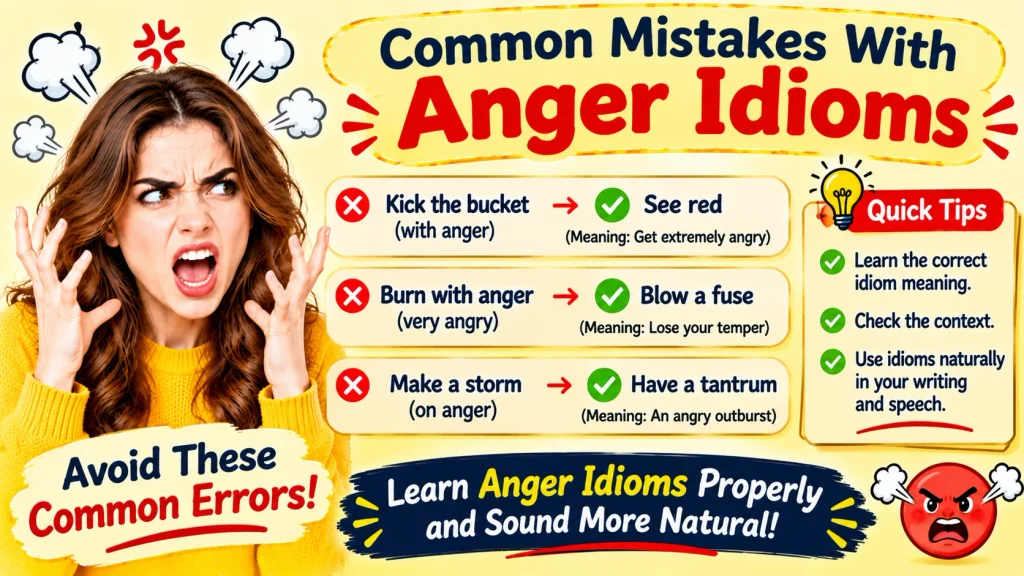
- Using a huge idiom for a tiny problem. ❌ “I saw red because the bus was two minutes late.” ✅ “The late bus got on my nerves.”
- Dropping the possessive word. ❌ “She lost the cool.” ✅ “She lost her cool.” ❌ “He blew the top.” ✅ “He blew his top.”
- Mixing up “hit the roof” and “go through the roof.” Both can mean “get very angry,” but only “go through the roof” also means “rise sharply.” ✅ “Dad hit the roof.” ✅ “Prices went through the roof.”
- Putting words in the wrong order. ❌ “He bit off my head.” ✅ “He bit my head off.”
- Reading non anger idioms as anger. “Bite the bullet” means to push through something hard, not to be furious.
- Forgetting that “mad” changes by region. In American English, “mad” usually means angry. In British English it can also mean crazy, so “angry” is clearer when you write for UK readers.
FAQ: Idioms for Anger
The four answers below cover the strongest anger idioms, the idiom for a quick temper, where “see red” comes from, and the difference between losing your temper and flying off the handle.
What is an idiom for being extremely angry?
“See red,” “hit the roof,” “blow a fuse,” and “go ballistic” are the most common idioms for extreme anger. All four are casual and dramatic, so they fit stories and everyday talk better than formal writing.
What is an idiom for someone who gets angry easily?
“Have a short fuse” describes someone who gets angry quickly. For example: “Be careful around Tom before lunch. He has a short fuse.”
Where does “see red” come from?
Nobody knows for sure. The most popular story points to a bullfighter’s red cape, but bulls react to the cape’s movement, not its color. The earliest printed use explains the phrase as a mental effect of anger, so the bull story is unconfirmed.
What is the difference between “lose your temper” and “fly off the handle”?
“Lose your temper” describes losing control of your anger, while “fly off the handle” stresses how suddenly it happens. Both are common, and either can fit most situations.
Bottom Line
Idioms for anger work best when the phrase matches the size and speed of your feeling. Use “get on someone’s nerves” or “drive someone up the wall” for small, steady annoyance, “hot under the collar” or “make your blood boil” for anger that builds, and “blow a fuse,” “hit the roof,” “fly off the handle,” or “go ballistic” for sudden outbursts. Remember the tone: these phrases are casual, so swap in “upset” or “frustrated” in formal writing and workplace emails.
Watch the look alikes too, because “bite the bullet,” “chew the scenery,” and “at your wit’s end” are not about anger. Treat origins with care as well. “Fly off the handle,” “blow a fuse,” and “hot under the collar” have well supported histories, but the “see red” bull story is folklore. Choose one idiom per sentence, match it to the real situation, and your English will sound clear, natural, and in control
More Read: Idioms for Winter: 15 Powerful Cold Phrases You Must Know

A former actress and voice coach, Clara helps learners lose their fear of speaking out loud. She breaks down tricky sounds, stress patterns, and rhythm using techniques borrowed from theater training.


[…] Read More: Idioms for Anger: 6 Costly Mistakes to Avoid […]