

Idioms for fear and anxiety are fixed English phrases that describe scared, nervous, or worried feelings through vivid pictures. Instead of saying “I was afraid,” a speaker says “I was scared stiff” or “I had butterflies in my stomach,” and the listener feels the emotion at once. This guide gives you 30 idioms, sorted by the kind of feeling they describe, from a sudden scare to a long wait.
Each one comes with a plain meaning and a ready to use example sentence for school, work, or home. You will also find traceable origins, a tone guide, and the common mistakes learners make, so you can use every phrase with confidence.
⚡ Quick Answer
The most useful idioms for fear and anxiety are “scared stiff” (frozen with fright), “jump out of your skin” (a sudden scare), “butterflies in your stomach” (nerves before an event), “on pins and needles” (anxious waiting), and “at your wits’ end” (too stressed to think). The simple rule: fear is a reaction to a threat right now, while anxiety is worry about a threat that may come later. Pick your idiom by timing first, then by strength and tone.
What Are Idioms for Fear and Anxiety?
They are set phrases whose meaning differs from their word-for-word sense and that describe feeling afraid, nervous, or worried.
Nobody turns stiff when they are scared stiff. The phrase borrows a picture so the listener can feel the emotion too.
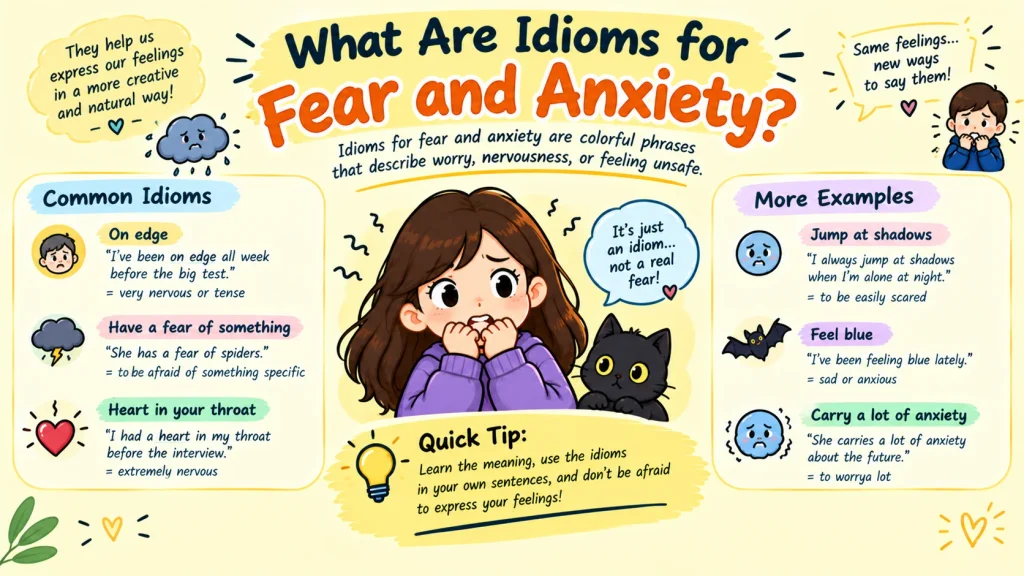
Many of these idioms point to the body: the heart, stomach, blood, skin, and hair. Fear changes how we feel physically, so English keeps reaching for body images. The wording is also fixed. “Scared out of your wits” is a real idiom, but “scared out of your brains” sounds off.
Fear vs. Anxiety: How the Difference Shapes Idioms
Fear is a reaction to a threat that is here now, while anxiety is the expectation of a threat that may come later.
Idioms follow the same split. “Jump out of your skin” fits a sudden scare. “On pins and needles” fits a long wait. A few phrases, such as “heart in your mouth,” work for both. That is why the lists below go by timing, not by alphabet.
One note: this is a language guide, not health advice. If worry feels constant or hard to control, a doctor or counselor can help.
Idioms for Sudden Fear
These nine idioms describe the jolt you feel when something startling or dangerous happens right now.
1. Jump out of your skin – to be badly startled.
The fire alarm went off, and I nearly jumped out of my skin.
2. Scared stiff – so frightened that you cannot move.
My grandmother is scared stiff of thunderstorms.
3. Scared out of your wits – terrified to the point of not thinking straight.
The barking dog scared the children out of their wits.
4. Make your blood run cold – to fill someone with sudden horror.
The message on the voicemail made my blood run cold.
5. Your hair stands on end – to feel a creepy rush of fear.
My hair stood on end when the basement lights flickered.
6. Heart in your mouth – to feel sharp fear about something risky.
My heart was in my mouth as my brother wobbled across the narrow bridge.
This one also fits worried waiting, so it sits on the line between fear and anxiety.
7. Scare the daylights out of someone – to frighten someone badly, often as a joke.
You scared the daylights out of me! I didn’t hear you come in.
8. White as a sheet – very pale from fright or shock.
He turned white as a sheet when the car skidded toward him.
9. Rooted to the spot – unable to move from fear or shock.
I stood rooted to the spot as the snake slid past my shoes.
Idioms for Nervous Waiting and Worry
These ten idioms describe the uneasy feeling of waiting for news, a test, or a big moment.
10. Butterflies in your stomach – a fluttery, nervous feeling before something important.
I always get butterflies before I speak in class.
It can also mix with excitement, so context decides the mood.
11. On pins and needles – anxious while waiting to learn what will happen.
Mia was on pins and needles all weekend, waiting for the college email.
12. On tenterhooks – held in tense suspense.
The whole team sat on tenterhooks while the boss read out the budget.
13. With bated breath – waiting while barely breathing, nervous or excited.
The crowd watched with bated breath as the last runner neared the line.
14. Get cold feet – to lose your nerve just before a planned step.
Dev almost signed the lease, but he got cold feet at the last minute.
15. A bundle of nerves – extremely tense and nervous.
Ayesha was a bundle of nerves on her first day at the new office.
16. A nervous wreck – someone worn out by worry.
The final week of exams left me a nervous wreck.
17. Get the jitters – to feel shaky and uneasy.
Dad gets the jitters whenever the plane hits turbulence.
18. A knot in your stomach – a tight, sick feeling caused by worry.
I felt a knot in my stomach as I opened my report card.
19. Lose sleep over something – to worry so much that you sleep badly.
She loses sleep over every bill that arrives.
Idioms for the Body’s Reaction to Fear
These four idioms describe the physical signs of fear: shaking, sweating, and losing your voice.
20. Shake like a leaf – to tremble from fear or nerves.
He shook like a leaf as he stepped up to the microphone.
21. Break out in a cold sweat – to suddenly sweat from fear or worry.
I broke out in a cold sweat when I remembered the stove was on.
22. Quaking in your boots – very scared, often said with a smile.
I was quaking in my boots when the principal called my name.
23. Tongue-tied – unable to speak well because of nerves or surprise.
I met my favorite author and ended up tongue-tied.
Idioms for Panic and Feeling Overwhelmed
These four idioms describe the point where worry or stress becomes too much to handle.
24. At your wits’ end – so stressed that you cannot think of what to do next.
Lena was at her wits’ end after the washing machine broke twice in one week.
This phrase leans toward helplessness and frustration more than pure fear.
25. Go to pieces – to lose control because of stress or upset.
My little sister went to pieces when she lost her ticket at the airport.
26. Tear your hair out – to be extremely stressed or frustrated.
Parents tear their hair out when a toddler refuses to sleep.
27. Have kittens – to panic in a dramatic way. Oxford labels it British English and informal.
Our teacher almost had kittens when the projector died. oxfordlearnersdictionaries
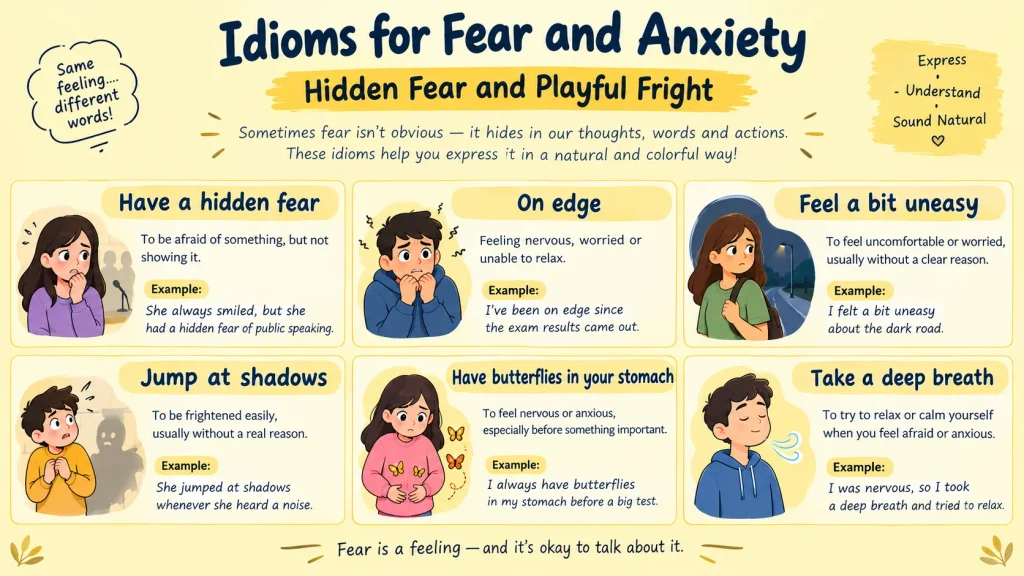
Idioms for Hidden Fear and Playful Fright
These three idioms cover fear that someone hides, fear that comes easily, and fear people joke about.
28. Whistle in the dark – to act brave while feeling afraid.
The coach kept smiling and talking about a win, but we could tell he was whistling in the dark.
29. Afraid of your own shadow – very easily frightened.
After the break-in, she was afraid of her own shadow. oxfordlearnersdictionaries
30. The heebie-jeebies – a creepy, nervous feeling, said in a playful way.
That empty hospital corridor gives me the heebie-jeebies.
Where These Idioms Come From
Five idioms in this list have origins that can be traced in written records, though one is still debated and one is now doubted.
With bated breath
The earliest known citation is in Shakespeare’s The Merchant of Venice, from 1596, and “bated” is a short form of “abated,” meaning lowered. Today the phrase means holding your breath in suspense. The word “bate” has nearly vanished from everyday English, so the phrase is often misspelled as “baited.” phraseswordorigins
On tenterhooks
A tenter was a frame used to stretch cloth as it dried, so the phrase compares a tense person to stretched fabric. An earlier form, “on the tenters,” appears in a 1633 play, and the full phrase is first cited in print in 1690. Another source gives 1748, in Smollett’s Roderick Random, so the exact first date varies by source. What does it mean to be ‘on tenterhooks’? +2
At your wits’ end
The earliest known text is William Langland’s Piers Plowman, written between 1370 and 1390. The King James Bible’s Psalm 107:27 is often named as the source. Most scholars feel the phrase is older than that translation. phrasesbookbrowse
The heebie-jeebies
The phrase is usually credited to cartoonist Billy DeBeck, in a Barney Google strip dated October 26, 1923. That story is often repeated, but a 2025 post on a linguists’ mailing list cites an earlier use in a Chicago newspaper from August 1923. Treat the cartoon credit as doubtful until more records appear. vocabularylinguistlist
Get cold feet
The reason this phrase was coined is unclear, and the earliest cited use in the nervous sense is from Stephen Crane’s novel Maggie in the 1890s. It is often traced back to an old Italian phrase about being poor, to Ben Jonson’s Volpone (1605), or to a German novel translated in 1878. None of these theories is definitive. phraseswordsmarts
For the other idioms here, no firm origin is on record in the sources checked, so this guide leaves them out rather than guess.
Formal or Casual? A Tone Guide
Most fear idioms suit speech and storytelling, and a few are too casual for formal writing.
| Tone | Idioms | Where they fit |
|---|---|---|
| Neutral | on tenterhooks, with bated breath, at your wits’ end, get cold feet, bundle of nerves, lose sleep over | News, speeches, emails, essays |
| Informal | scared stiff, jump out of your skin, butterflies, get the jitters, nervous wreck, shake like a leaf, break out in a cold sweat, go to pieces | Conversation, blogs, messages |
| Playful | scare the daylights out of, have kittens, quaking in your boots, heebie-jeebies, tear your hair out | Friends, family, humor |
| Storytelling | blood run cold, hair stands on end, rooted to the spot, white as a sheet | Fiction, vivid retellings |
“Have kittens” is a British expression. If your readers come from many countries, a plain phrase like “extremely worried” is the safest choice.
Common Mistakes With Fear and Anxiety Idioms
Learners most often slip on spelling, on mixing up fear with excitement, and on picking an idiom that is too strong or too casual.
| Mistake | Fix | Why |
|---|---|---|
| She waited with baited breath. | with bated breath | “Bated” is a shortened form of “abated.” |
| I’m on tenderhooks. | on tenterhooks | The word comes from cloth frames, not from “tender.” |
| I’m at my wits end. | at my wits’ end (or wit’s end) | Either apostrophe is accepted, but the bare “wits end” is not. |
| I got cold feet when the dog barked. | I jumped out of my skin when the dog barked. | Cold feet means backing away from a plan, not a sudden scare. |
| She was scared out of her brains. | scared out of her wits | The wording of an idiom is fixed. |
| The director had kittens, according to the report. | The director was extremely worried, according to the report. | Playful idioms do not belong in formal writing. |
| Butterflies always mean fear. | Check the context. | The phrase can also signal excitement, such as before a trip or a first date. wordoriginsbookbrowse |
Picking the Right Idiom for the Moment
Match the idiom to the timing, the strength, and the setting.
- School: “I get butterflies before every oral exam.”
- Work: “We were on tenterhooks until the client called back.”
- Family: “After the third flat tire, Mom was at her wits’ end.”
- Friends: “That horror movie scared the daylights out of me.”
- Writing a story: “Her blood ran cold, and she stood rooted to the spot.”
FAQs
What are some idioms for fear and anxiety?
Common ones include “scared stiff,” “butterflies in your stomach,” “on pins and needles,” “shake like a leaf,” and “at your wits’ end.” Pick sudden-fright idioms for a jolt and waiting idioms for long worry.
What is an idiom for being easily frightened?
“Afraid of your own shadow” describes someone who is very easily frightened. It describes a person’s nature more than one moment. oxfordlearnersdictionaries
What is the difference between “scared stiff” and “scared to death”?
Both describe extreme fear, but they stress different things. “Scared stiff” focuses on feeling paralyzed. “Scared to death” means very frightened and is often used for emphasis or a joke. rumieoxfordlearnersdictionaries
Are idioms for fear and anxiety formal or informal?
Most are informal or neutral, so they suit conversation, stories, and friendly writing better than reports. Use plain words like “worried” or “alarmed” in formal documents.
Bottom Line
The bottom line is simple: choose the idiom that matches the timing and the strength of the feeling. Use “jump out of your skin” or “scared stiff” for a sudden fright, and “on pins and needles” or “butterflies in your stomach” for anxious waiting. Save “at your wits’ end” for overwhelm. Check the tone before you write, since playful phrases like “have kittens” do not belong in formal reports. Watch the spelling of “bated breath” and “tenterhooks.” Learn five or six phrases well, use them in real sentences each week, and your English will sound natural, clear, and confident.
Read More: Idioms for Birthday: 21 Best Phrases (Avoid Awkward Mistakes)

A former actress and voice coach, Clara helps learners lose their fear of speaking out loud. She breaks down tricky sounds, stress patterns, and rhythm using techniques borrowed from theater training.
[…] Read More: Idioms for Fear and Anxiety: 30 Easy Phrases to Sound Confident […]