
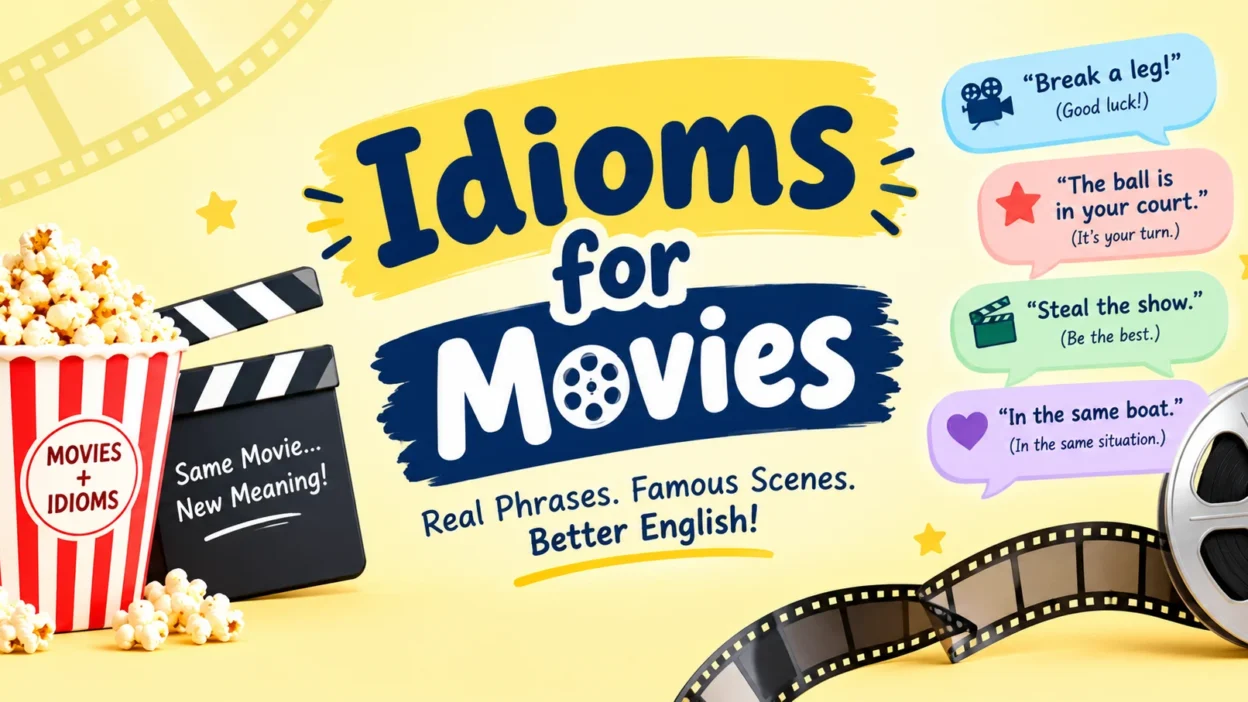
Idioms for movies are phrases that come from filmmaking, or that people use to talk about films, with a meaning beyond their literal words. Some, like “cut to the chase,” were born on screen. Others, like “break a leg,” grew out of the theatre. Learning them helps you understand dialogue, sound natural, and avoid awkward slips.
This guide gives you the clear meaning of each phrase, an honest origin (documented, disputed, or unconfirmed), real example sentences for work, school and home, and the common mistakes learners make. Read on, and you will talk about movies with confidence, not guesswork.
⚡ Quick Answer
Movie idioms are fixed phrases from film, TV or theatre whose meaning differs from their words. The five most useful are:
- Cut to the chase = get to the point
- That’s a wrap = we’re finished
- Jump the shark = past its best
- Break a leg = good luck
- On the edge of your seat = tense and excited
Good to know: “Cut to the chase” has the best-documented origin (a 1929 script direction), while “break a leg” is still disputed.
What Are Idioms for Movies?
Idioms for movies are fixed phrases from film, TV or theatre that carry a figurative meaning.
They fall into three groups. Some started on screen, like “cut to the chase.” Some come from the stage, like “break a leg.” Others are everyday phrases people use when they discuss films, like “on the edge of your seat.”
Words like “sequel,” “trailer” and “cast” are film vocabulary. They mean what they say, so they are not idioms.
c
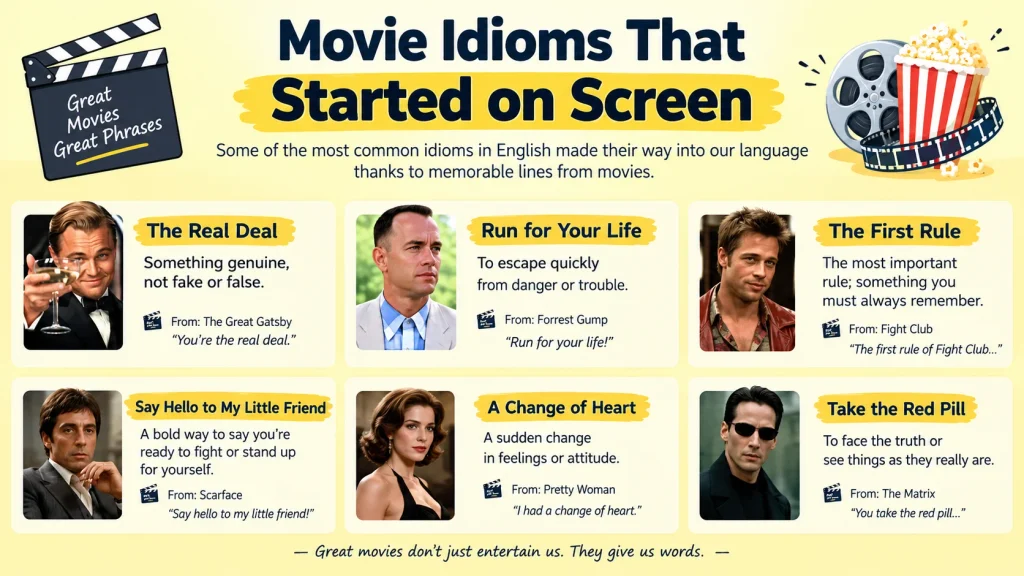
Five common expressions trace back to film or TV: “cut to the chase,” “that’s a wrap,” “jump the shark,” “blockbuster” and “gaslight.”
Cut to the Chase
Meaning: Skip the small talk and get to the point.
Origin (documented): The earliest known printed use is a script direction in Joseph Patrick McEvoy’s 1929 novel Hollywood Girl, according to Phrase Finder. By the 1940s, newspapers used it to mean “get to the point.” A popular story says silent-film directors shouted it at projectionists, but nobody has confirmed that. Sources also disagree on when casual use began.
Examples:
- “Let’s cut to the chase: can you finish the report by Friday?”
- “Dad, cut to the chase. Did you buy the tickets?”
That’s a Wrap
Meaning: The work is finished.
Origin (film-set phrase): Film and TV crews use it to announce that shooting is done for a scene or a day. No dated first use is confirmed, so be careful with exact years you see online.
Examples:
- “Last slide is done. That’s a wrap on our group project.”
- “We painted the final wall, so that’s a wrap on the kitchen.”
Jump the Shark
Meaning: The moment a show, series or brand starts to slide, often after a desperate stunt.
Origin (documented): In a 1977 episode of Happy Days, the Fonz water-skied over a shark. Writer Jon Hein and his college roommate Sean Connolly coined the idiom in the 1980s, as Mental Floss reports. It began with TV, yet people now use it for movie franchises too.
Examples:
- “The fifth sequel jumped the shark when the hero fought a robot dinosaur.”
- “Honestly, that cafe jumped the shark when it added a laser show.”
Blockbuster
Meaning: A film that draws huge crowds and earns huge money.
Origin (documented): The word first described a WWII bomb strong enough to flatten a city block. Hollywood adopted it for hit films by the 1950s. Many people see Jaws (1975) as the first summer blockbuster.
Example: “The studio is betting everything on its summer blockbuster.”
Gaslight
Meaning: To make someone doubt their own memory or sanity on purpose.
Origin (documented): The term comes from the 1938 play Gas Light and its 1944 film version starring Ingrid Bergman. It was in use as a verb by 1956.
Example: “He kept saying she’d imagined the argument, and she realized he was gaslighting her.”
Handle this one with care. Gaslighting describes a pattern of manipulation, not a single lie.
Everyday Idioms People Use About Movies
These phrases don’t all come from film, yet they pop up whenever friends discuss what they watched.
Break a Leg
Meaning: Good luck, said mostly to performers.
Origin (disputed): Wikipedia calls it a saying of uncertain origin. One theory points to the German phrase Hals- und Beinbruch, which Phrase Finder says dates to at least WWII as Luftwaffe slang, earlier than any known English version. Other theories involve Yiddish, stage curtains and a story about Abraham Lincoln’s assassination. None is settled. For more stage talk, see our guide to theatre idioms.
Example: “Your audition is at noon? Break a leg!”
Popcorn Movie
Meaning: A light, fun film you watch to relax, not to think hard.
Example: “Rainy Sunday, a big bowl of snacks, and a popcorn movie. Perfect.”
Live Up to the Hype
Meaning: To be as good as people said it would be.
Example: “Everyone raved about that film, but it didn’t live up to the hype.”
On the Edge of Your Seat
Meaning: Tense and excited, eager to see what happens next.
Example: “My little brother was on the edge of his seat during the final chase.”
Steal the Show
Meaning: To perform so well that you become the thing everyone remembers.
Example: “The dog actor stole the show.”
Quick Reference Table
This table shows each phrase’s meaning, tone and how firm its origin is.
| Idiom | Meaning | Tone | Origin status |
|---|---|---|---|
| Cut to the chase | Get to the point | Casual, can sound blunt | Documented |
| That’s a wrap | Finished | Friendly | Film-set phrase, first use unconfirmed |
| Jump the shark | Past its peak | Casual, critical | Documented |
| Blockbuster | Huge hit | Neutral to positive | Documented |
| Gaslight | Manipulate someone’s sense of reality | Serious, negative | Documented |
| Break a leg | Good luck | Warm | Disputed |
| Popcorn movie | Light entertainment | Neutral | Not firmly documented |
| Live up to the hype | Match expectations | Neutral | Not firmly documented |
Tone and Formality
Most movie idioms suit casual talk, a few work in an office, and one or two can sting if you misjudge your listener.
“That’s a wrap” and “break a leg” sound friendly almost anywhere. “Cut to the chase” can feel sharp when you say it to a boss or a stranger. Soften it with “To cut to the chase, …” or “Let me get to the point.”
“Jump the shark” carries criticism, so use it for opinions, not neutral reports. “Gaslight” is heavy because it accuses someone of manipulation. Save it for situations where you mean it.
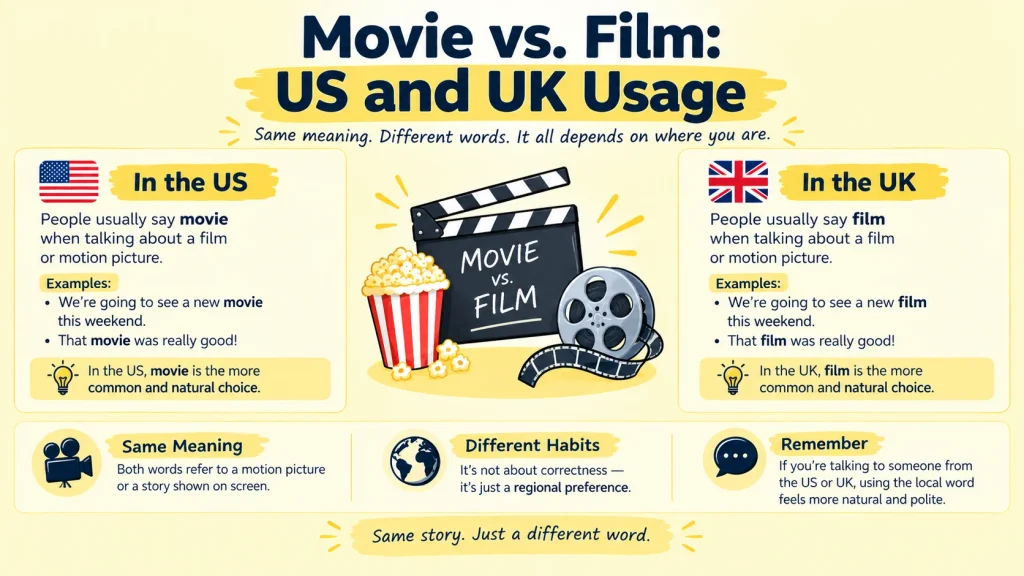
Movie vs. Film: US and UK Usage
Americans usually say “movie,” while British speakers often prefer “film,” and both sides understand each other.
Phrase Finder lists “cut to the chase” as American in usage. Some idioms are tied to US culture. “Film at 11” began in American TV news, promising footage later that night, and now means “details are coming.” You can use these anywhere, but expect a few blank looks outside the US. For more everyday phrases, browse our list of common English idioms.
Common Mistakes with Movie Idioms
Learners most often confuse sound-alike words, drop small words, or stretch a phrase past its meaning.
- “It’s a rap” instead of “it’s a wrap.” The spelling is wrap, as in “wrap up.”
- “Live up the hype.” The correct form includes to: “live up to the hype.”
- “At the edge of my seat.” Native speakers say “on the edge of my seat.”
- Using “jump the shark” for any bad moment. It describes a drop in quality after a stunt, not one weak scene.
- Treating “gaslight” as a fancy word for lying. It means making someone doubt their own mind.
- Calling every popular film a “blockbuster.” The word suggests huge crowds and big money.
New to idioms? Start with our idioms for beginners page.
FAQ
What are some common idioms about movies?
Common examples are “cut to the chase,” “that’s a wrap,” “jump the shark,” “break a leg” and “on the edge of your seat.” Each one has a short meaning and example above.
What does “cut to the chase” mean?
It means to skip extra details and get to the point. The phrase likely began in film-script language, with a documented 1929 script direction, and the general meaning spread in the 1940s.
Where does “that’s a wrap” come from?
It comes from film and TV sets, where crews use it to announce that filming is done. No dated first use is confirmed, so treat claims of an exact year with caution.
What is a popcorn movie?
A popcorn movie is a light, entertaining film you can enjoy without thinking hard. It can be praise (“great fun”) or a mild put-down (“not very deep”), depending on your tone.
Bottom Line
Movie idioms give you short, vivid ways to talk about work, school, family and films. Start with the documented ones, such as “cut to the chase” and “jump the shark,” because their stories are easiest to trust. Treat “break a leg” and “that’s a wrap” with care, since their origins remain unsettled. Watch your tone, keep the small words in place, and pick real situations to practice. A few well-chosen phrases will make your English sound natural, not forced.
More Read: Idioms for Fourth Graders: Stop Struggling with 30 Powerful Meanings & Fun Examples

Curriculum Developer
Rachel has spent over a decade developing English learning curriculums for schools and online platforms across the United States. Her specialty is structuring content so that even beginner learners can follow along with confidence.