
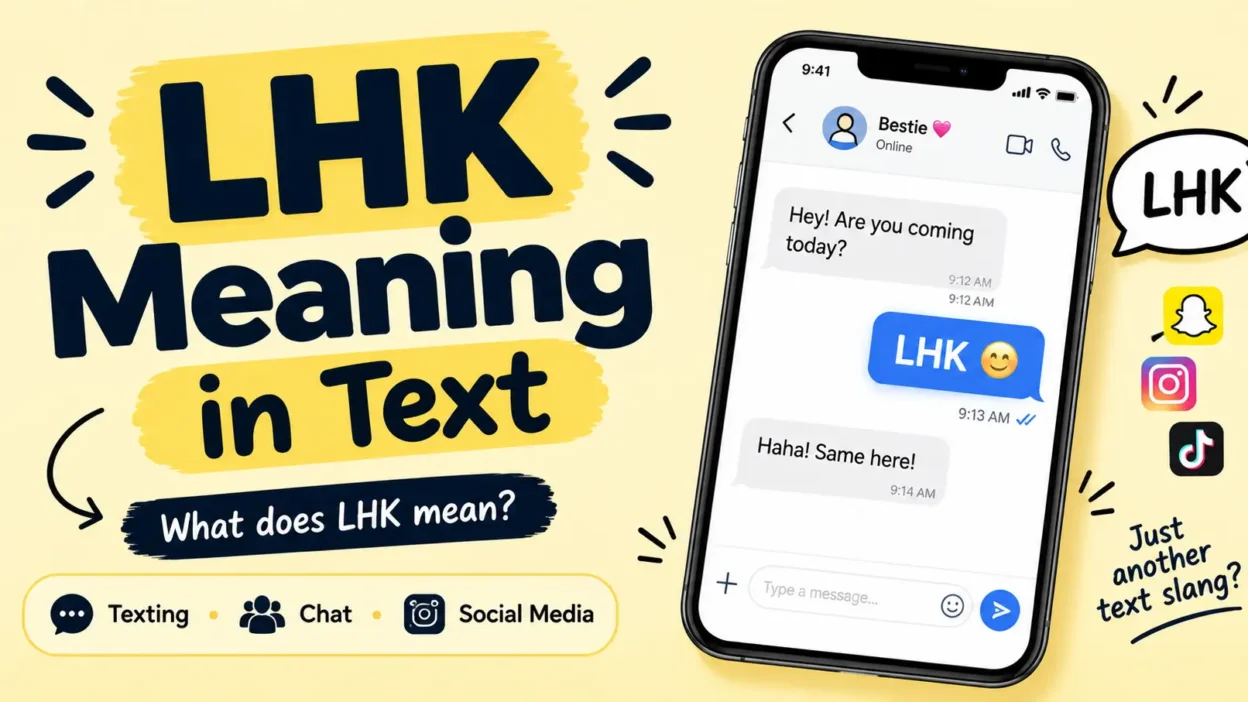
You open a message from someone close to you, and right at the end sit three letters: LHK. That single moment is exactly what most people are searching for when they type “LHK meaning in text” what do these three letters actually stand for? In the vast majority of everyday texting, LHK stands for “Love, Hugs and Kisses.”
It’s a short, affectionate sign off people add at the end of a message instead of a plain “bye.” But here’s the catch: not every website agrees on this definition, which is exactly why so many readers land here confused. This guide gives you the real answer, clears up conflicting definitions online, and shows you how to reply.
What Does LHK Meaning in Text?
In everyday texting, LHK stands for “Love, Hugs and Kisses.” It’s a short, warm signo ff used at the end of a text, chat, or email to close things out on an affectionate note.
LHK is an initialism, not an acronym. This distinction matters: an acronym is pronounced as a new word (like “LOL”), while an initialism is read letter by letter “Ell, Aitch, Kay.” Nobody says LHK like a word; people either type it silently or spell it out loud when reading it aloud.
| Detail | Answer |
|---|---|
| Full form | Love, Hugs and Kisses |
| Word type | Initialism |
| Tone | Casual, affectionate |
| Common senders | Family, partners, close friends |
| Common platforms | SMS, WhatsApp, iMessage, Instagram, Snapchat, email |
| Formality | Never use in business writing |
Where the Confusion Comes From
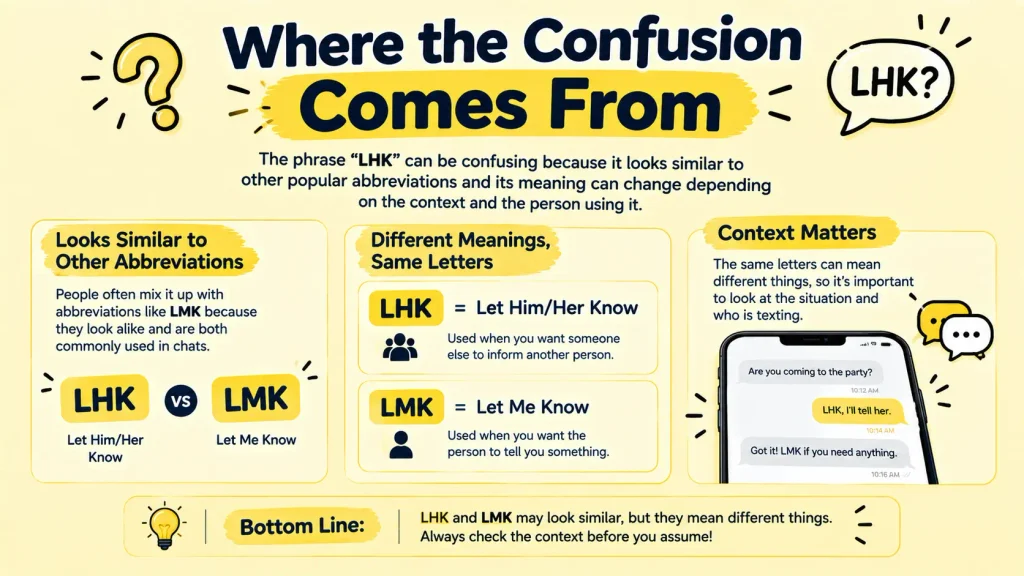
Here’s something most guides to LHK won’t tell you upfront: not every source agrees on what LHK means. Search around and you’ll run into at least three competing claims.
- Love, Hugs and Kisses — by far the most common meaning, used as a warm sign-off between people who care about each other.
- Like, Hug, Kiss — a looser, flirtier reading that occasionally shows up in Instagram comment culture, almost like a playful signal of interest.
- Let Him/Her Know — a rarer, unrelated use that has nothing to do with affection and instead means “pass this information along.”
There’s also a listing on some acronym databases for “Lubricated House Killer.” This is a joke or spam entry rather than something anyone actually uses, and it’s worth mentioning only so you can safely ignore it if you stumble on it.
So which meaning is correct? Context decides. If LHK shows up at the end of a message, right where you’d expect “love ya” or “xoxo,” it almost certainly means Love, Hugs and Kisses. If it shows up mid-sentence tied to a request, it’s more likely being used loosely as “let him/her know.” The sign-off version is far more common in real-world texting, so when in doubt, that’s your safest bet.
make an info graphic image of given below text, the image size is 800×450 color light yellow theme
LHK isn’t locked to one app. You’ll see it wherever people send short, personal messages.
Texting and SMS. This is the classic home of LHK tacked onto the very end of a message, right before someone hits send.
Instant messaging apps. WhatsApp, iMessage, and Messenger conversations use it the same way, as a closing line rather than a greeting.
Email. Between close friends or family, LHK sometimes replaces a full sign off like “with love.”
Social media. On Instagram, Snapchat, and TikTok, the sentiment stays the same even though the format changes a caption, a DM, or a comment can all end in LHK and mean the same warm thing.
Who Actually Sends LHK
Family members often use LHK as a fast way of saying “I care about you” without writing out a full sentence think of a mother texting “Drive safe, LHK, Mom.”
Close friends use LHK to soften a message and add warmth, especially after a heart to heart conversation or a favor.
Romantic partners use it too, often as a casual goodnight or goodbye line that feels sweeter than a plain “bye.”
Who Uses LHK the Most?
LHK is most common among Gen Z and Millennial texters, simply because they grew up sending short, emotion-packed messages instead of long letters or emails. That said, age is not really the deciding factor closeness is.
Older family members, including parents and grandparents, use LHK just as naturally once they pick it up, often after seeing it in a message from a younger relative. It tends to spread inside a family group chat first, then becomes a normal part of how that family texts.
The one constant across every age group is context. Nobody uses LHK with a stranger, a new coworker, or someone they’ve just met. It’s reserved for people who already share some level of emotional closeness, which is exactly why it feels natural between parents and kids, but out of place in a customer service chat.
Common Mistakes People Make With LHK
Even though LHK is simple, a few small mix ups happen often enough to be worth flagging.
Confusing it with LMK. LHK and LMK look almost identical at a glance, but they mean completely different things. LMK stands for “Let Me Know,” a request for information, while LHK is an affectionate sign-off. Mixing the two up mid-conversation can lead to a genuinely confusing reply.
Using it too early in a relationship. Sending LHK to someone you’ve only just started talking to, romantically or otherwise, can come across as overly familiar. It works best once a relationship already has some warmth behind it.
Assuming it always means the same thing. A small slice of online culture uses LHK loosely for “Like, Hug, Kiss” or “Let Him/Her Know.” Reading it as automatically romantic every time can lead to a misread, so it helps to consider who sent it.
When You Should NOT Use LHK
Save LHK for people you’re genuinely close to. It has no place in:
- Work emails or messages to a boss, client, or coworker
- Formal or professional correspondence
- First-time conversations with people you don’t know well
Using it outside a close relationship can come across as oddly familiar or simply confusing to the recipient.
LHK vs. Similar Texting Terms
LHK sits inside a small family of hugs-and-kisses shorthand, and it’s easy to mix these up.
| Term | Meaning | How It Differs from LHK |
|---|---|---|
| LHK | Love, Hugs and Kisses | The standard version |
| LOLHK | Lots of Love, Hugs, and Kisses | Adds emphasis with “Lots of” |
| H&K | Hugs and Kisses | Drops the word “Love” |
| HAK | Hugs and Kisses | Same meaning as H&K, different spelling |
| HNK | Hugs and Kisses | Another spelling of the same idea |
| XOXO | Hugs and Kisses | The oldest, most universally recognized version |
| AML | All My Love | A stronger, more serious phrase |
Is LHK the same as LOLHK? No. LOLHK is a bigger, more emphatic version it adds “Lots of” for extra intensity, so someone using LOLHK is turning the volume up on the same sentiment.
Is LHK the same as H&K or HAK? Not quite. H&K and HAK drop the word “Love” entirely, which makes LHK feel slightly warmer and more personal by comparison.
Is LHK the same as XOXO? They’re close cousins. Both mean “hugs and kisses,” but XOXO is older, dating back to handwritten letters, and is far more widely recognized across generations. LHK is the more modern, texting-native equivalent.
Where the Phrase Comes From
Long before texting existed, people closed letters with lines like “lots of love” or “sending hugs.” LHK is essentially a shorthand descendant of that same habit, condensed for a medium where speed matters and every extra keystroke counts.
As texting shorthand evolved through the 2000s and 2010s, warm sign offs like LHK, HAK, and XOXO became a natural way to preserve emotional warmth in a format built for brevity.
How to Reply to LHK
You don’t need to write a paragraph back. A short, matching response is all it takes:
- Send LHK back
- Reply with XOXO
- Type ILU2 (“I love you too”)
- Drop a heart or kiss emoji (❤️ 😘 🤗)
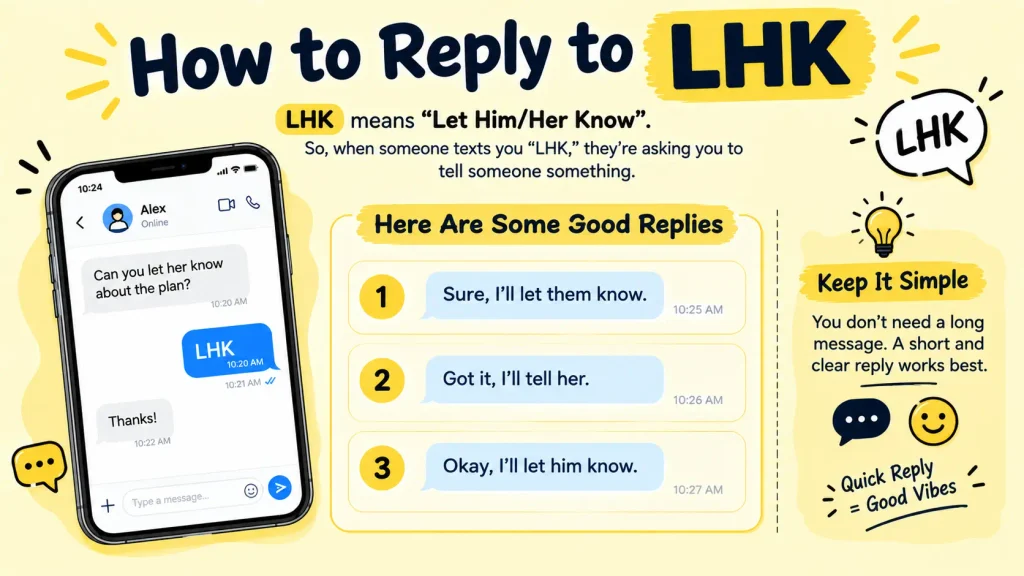
Any of these mirrors the warmth the sender was going for, and none of them require overthinking.
LHK in Real Conversations
Between friends: “Thanks for listening tonight. You’re the best. LHK.”
Between partners: “Can’t wait to see you tomorrow. LHK.”
Between family: “Drive safe and call me when you land. LHK, Mom.”
Frequently Asked Questions
What does LHK mean in a text? Most often, LHK stands for “Love, Hugs and Kisses,” an informal way to close a text message with warmth. It’s common between friends, family, and romantic partners, and it isn’t meant for formal writing.
Is LHK the same as LOLHK? No. LHK means “Love, Hugs and Kisses,” while LOLHK means “Lots of Love, Hugs, and Kisses” a more intense version of the same feeling.
What’s the difference between LHK and H&K? H&K means “Hugs and Kisses” and skips the word “Love.” LHK includes “Love,” which gives it a slightly warmer, more personal tone.
Is LHK romantic or just friendly? It can be either. Romantic partners use it as a sweet goodbye, while friends and family use it just as often to show they care. The relationship between sender and recipient decides the tone.
How do you reply to LHK? Keep it short and warm: send LHK back, reply with XOXO, write “ILU2,” or use a heart or kiss emoji.
Can LHK mean something other than “Love, Hugs and Kisses”? Occasionally. In some Instagram comment culture it’s used loosely for “Like, Hug, Kiss,” and in rare cases people use it to mean “Let Him/Her Know.” These uses are far less common if LHK appears as a message sign-off, “Love, Hugs and Kisses” is almost always the intended meaning.
Can you use LHK in a professional message? No. It’s casual texting shorthand meant for close relationships, not business emails or messages to a boss or client.
Bottom Line
LHK meaning in text, in almost every real-world case, comes down to one warm phrase: “Love, Hugs and Kisses.” Three letters carry the same feeling as a hug goodbye, and they belong to a wider family of affectionate sign-offs, including LOLHK, H&K, HAK, and the much older XOXO.
The exact meaning can shift slightly depending on where you see it and who sent it, which is exactly why so many people search for clarity in the first place. Now that you know both the standard meaning and the rarer alternatives floating around online, you’ll never have to second-guess an LHK again whether you’re reading one from someone you love or sending it yourself.
Read More: MYF Meaning in Text: A Confusing Slang Term Finally Clarified 2026

Curriculum Developer
Rachel has spent over a decade developing English learning curriculums for schools and online platforms across the United States. Her specialty is structuring content so that even beginner learners can follow along with confidence.
[…] More Read: LHK Meaning in Text: The Sweet Truth Behind a Widely Misunderstood Abbreviation in 2026 […]