
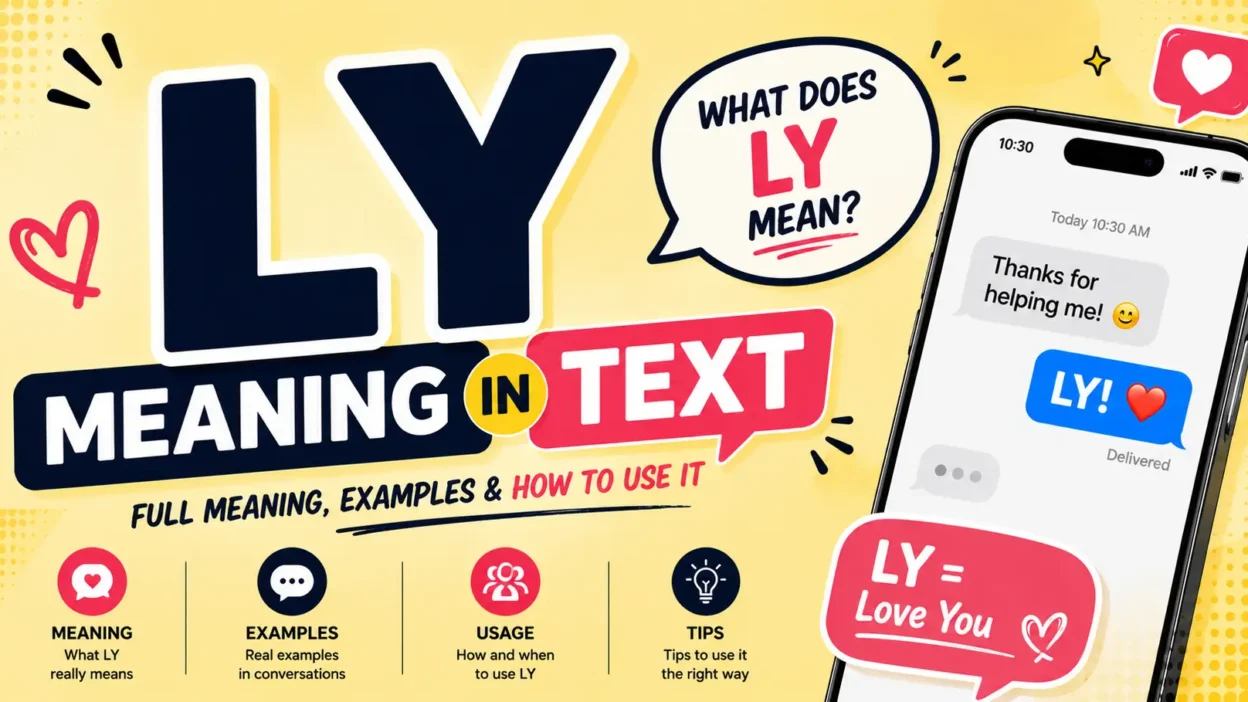
LY meaning in text comes down to two words: Love You. People type it at the end of a text, DM, or chat to share warmth without spelling out the full phrase a two-letter hug instead of a three word declaration. But if you landed here, chances are you want more than a dictionary definition. You want to know what it means when this specific person sent it to you.
That’s exactly what this guide solves: not just what LY stands for, but how to read it in context, how to reply without overthinking it, and where else the letters “LY” show up from ILY to grammar and blood tests so you’re never confused again.
Quick Answer: What Does LY Meaning in Text?
LY stands for “Love You.” It’s a casual, low-pressure sign-off used with friends, family, and partners. It rarely announces deep romantic feelings on its own think of it as a wave goodbye, not a declaration. Compared to ILY (“I Love You”), LY is lighter, quicker, and far more common in everyday chats.
People reach for LY because typing the full phrase can feel like a bigger moment than the conversation calls for. It gives the same warmth without the weight, which is exactly why it works so well in fast, casual messaging. You’ll see it close out a goodnight text, a thank-you message, or a simple “talk later” and in almost every one of those cases, it means exactly what it says: someone cares about you enough to say so, even briefly.
Where LY Shows Up
LY travels across almost every messaging platform, but the tone shifts slightly depending on where you see it:
- SMS and iMessage — a warm, personal closer between people who already know each other
- WhatsApp — common in family groups and before saying goodnight
- Snapchat and Instagram DMs — quick, casual, often paired with an emoji or streak
- TikTok comments — shown to friends or a favorite creator, rarely anything deeper
- Twitter/X and Threads — used between people with an existing relationship, not strangers
One rule holds across all of them: LY is a personal message word. It doesn’t belong in work emails or messages to your boss, and we’ll get into why later.
The 4 Question Framework (Skip the Guessing)
Most guides just say “it depends on context” and leave you there. Here’s an actual method for reading it.
- How long have you known this person? A first time LY from someone new lands very differently than one from a friend of ten years.
- What platform are you on? A quick Snapchat LY is casual by default; the same word in a long, personal text thread carries more weight.
- What came right before it? If the conversation just turned emotional, LY is likely sincere. If it followed a joke, it’s probably light.
- Does it happen often? A single LY is usually just friendly. A repeated pattern especially alongside other sweet messages is worth paying attention to.
No single question gives you the full picture, but stacked together, they tell you almost everything you need to know.
LY by Relationship
From a friend: Almost always platonic. It functions the same way as “take care” or “talk soon” a warm close, not an opening for a bigger conversation.
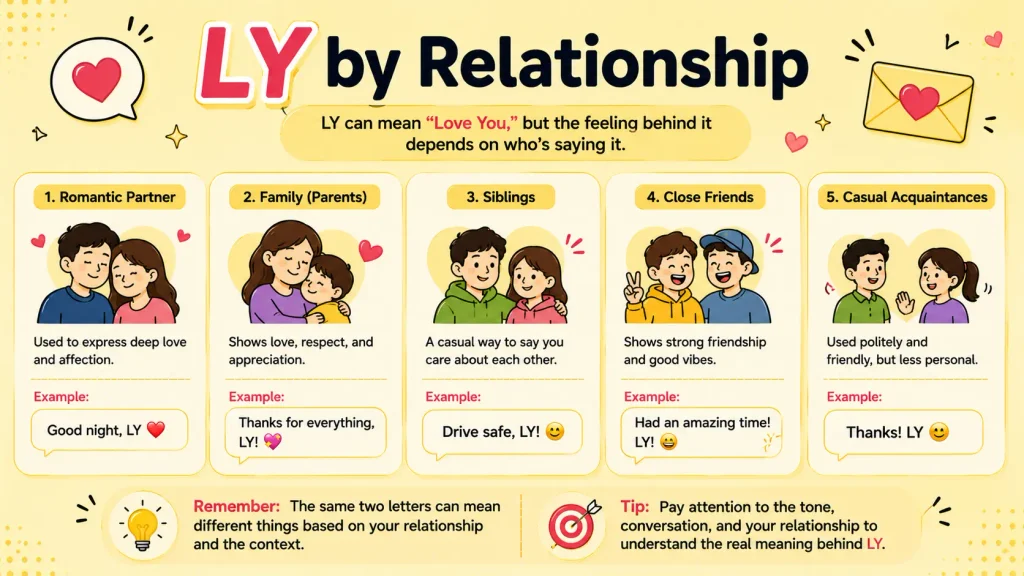
From a crush: Context is everything here. One LY, especially after a group hangout, is probably casual. A pattern of LY plus other affectionate texts is a real signal worth noticing.
From family: Usually habitual rather than meaningful in the moment. Many families end every message this way, the same way some people always sign off with “talk soon.”
From a partner: Carries more emotional weight by default, since the relationship itself is already romantic. It’s often used as a quick, everyday version of “I love you,” reserved for the bigger moments.
How to Reply to LY
- From a friend or family member: Send it back “LY too!” or a simple “LY” both work fine.
- From a partner: Match their tone. “Love you too” or “LY2” keeps the exchange natural.
- From a new crush, and you’re unsure: Keep it warm without overcommitting “Aw, you too!” works.
- If you don’t feel the same way: Try “Thanks, that’s sweet!” It’s kind, honest, and doesn’t promise something you don’t mean.
Common Mistakes People Make With LY
- Reading too much into a single LY. One instance is rarely a confession patterns matter more than isolated messages.
- Using it in professional contexts. LY has no place in a work Slack message or an email to a client, no matter how friendly the relationship feels.
- Assuming it always means romance. Family members and close friends use LY constantly with zero romantic intent.
- Skipping a reply entirely. Not answering an LY especially from a partner or close friend can read as colder than intended, even if that’s not what you meant.
- Using LY for a first “I love you.” The first time you want to say those words to someone, they deserve the full sentence, not the shorthand.
When to Use LY (and When to Skip It)
Good times to use it:
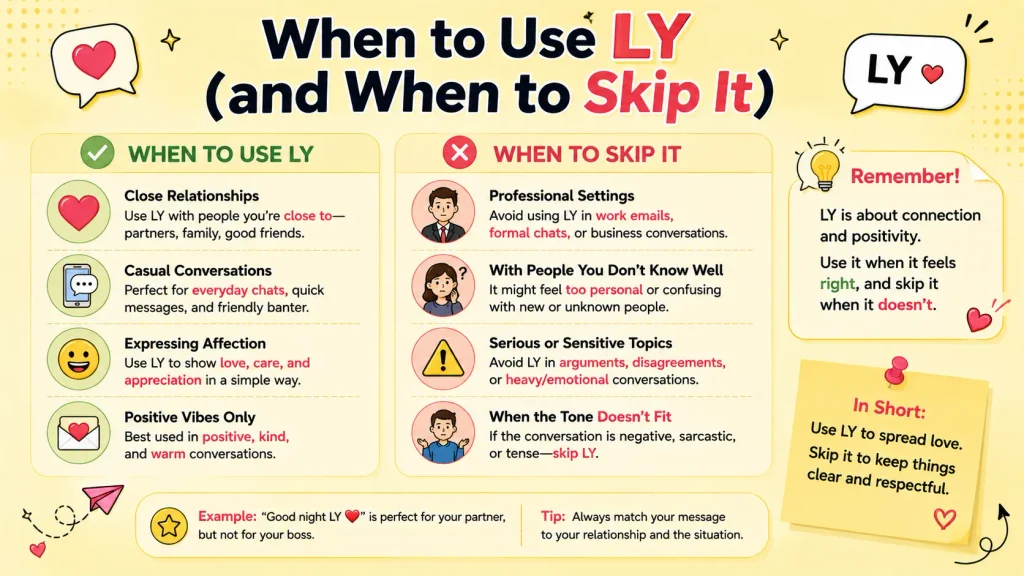
- Ending a chat with close friends
- Light, caring messages with family
- Relationships where both people already say it
- Casual goodnights or sign offs
Times to skip it:
- Work emails or messages to a boss
- Conversations with someone you just met
- A serious talk that needs a real, thoughtful response
- The first time you want to say “I love you” that moment deserves the full words
LY vs. Similar Abbreviations
| Abbreviation | Meaning | Tone | Typical Use |
|---|---|---|---|
| LY | Love You | Warm, casual | Friends, family, partners |
| ILY | I Love You | Bigger, more serious | Romantic partners |
| LYA | Love You Always | Deep, lasting | Long term close relationships |
| LYLAF | Love You Like a Friend | Friendly, unambiguous | Friends, when clarity matters |
| LU | Love You | Very casual | Quick everyday messages |
| LY2 | Love You Too | A reply | Answering LY or ILY |
| 143 | I Love You | Playful, numeric code | People who enjoy fun shorthand |
| XOXO | Hugs and Kisses | Warm, affectionate | Casual or affectionate goodbyes |
Other Meanings of “LY” (So You Don’t Get Confused)
The letters “LY” appear in several places that have nothing to do with texting:
- Grammar suffix: Added to adjectives to form adverbs “quick” becomes “quickly.” A few words like “friendly” and “lovely” are actually adjectives, not adverbs, despite the same ending.
- Blood test result: “LY” refers to lymphocytes, a type of white blood cell involved in fighting infection. This is a medical term, not a texting one always ask a doctor to explain your own results.
- Bit.ly: A popular link shortening service. The “.ly” comes from Libya’s internet domain code, not from “Love You.”
- Light-year (ly): In astronomy, “ly” measures the distance light travels in one year used for describing distances between stars.
- Country and organization codes: “LY” is also the ISO code for Libya and appears in names like Taiwan’s Legislative Yuan.
LY in Pakistan and South Asian Texting Culture
LY is used exactly the same way in Pakistan, India, and across South Asia as it is anywhere else people usually borrow the English abbreviation directly rather than translating it. It’s common in WhatsApp family groups, between friends on Instagram, and in couple chats.
It’s often mixed naturally into Roman Urdu conversations, like “Theek hai, LY, Allah Hafiz.” The meaning doesn’t change with the language around it LY still means “Love You,” and the same context rules apply.
Frequently Asked Questions
What does LY mean in a text from a girl?
LY means “Love You” regardless of who sends it. From a girl, it’s usually a warm, friendly sign off between friends or family, though it can carry more weight from a partner. The relationship not the word itself determines the meaning.
Is LY the same as ILY?
No. LY feels lighter and more casual, while ILY (“I Love You”) feels bigger and more deliberate. People often reserve ILY for stronger, more serious moments.
Can LY be used between friends?
Yes, very commonly. It’s closer to “take care” than a romantic statement, and many friends use it as a standard way to end a conversation.
What does LY mean on WhatsApp?
The same as everywhere else “Love You,” used as a warm close to a chat with a friend, family member, or partner.
What does LY mean in Urdu texting?
The same as in English people typically use the English abbreviation directly rather than translating it.
Can LY mean anything other than “Love You” in texting?
Rarely, it can stand for “Lately” or “Like You” depending on the sentence. But in the vast majority of texts, LY means “Love You.”
The Bottom Line
LY is a small abbreviation with a big emotional job: it lets people share warmth quickly, without turning a message into a bigger moment than it needs to be. Whether it comes from a friend, a partner, or family, LY almost always means Love You the real question is just how much weight it’s carrying. The two letters alone won’t tell you everything, but the relationship, the platform, and the moment around them almost always will.
Use the framework in this guide, watch for patterns instead of single messages, and save the full “I love you” for the moments that truly deserve it. Once you know what to look for, you’ll never wonder what LY means again.
Read More: TB Meaning in Text: Stop the Confusion The Simple Truth Explained in 2026

[…] Read More: LY Meaning in Text: The Sweet Secret You’re Probably Getting Wrong in 2026 […]