
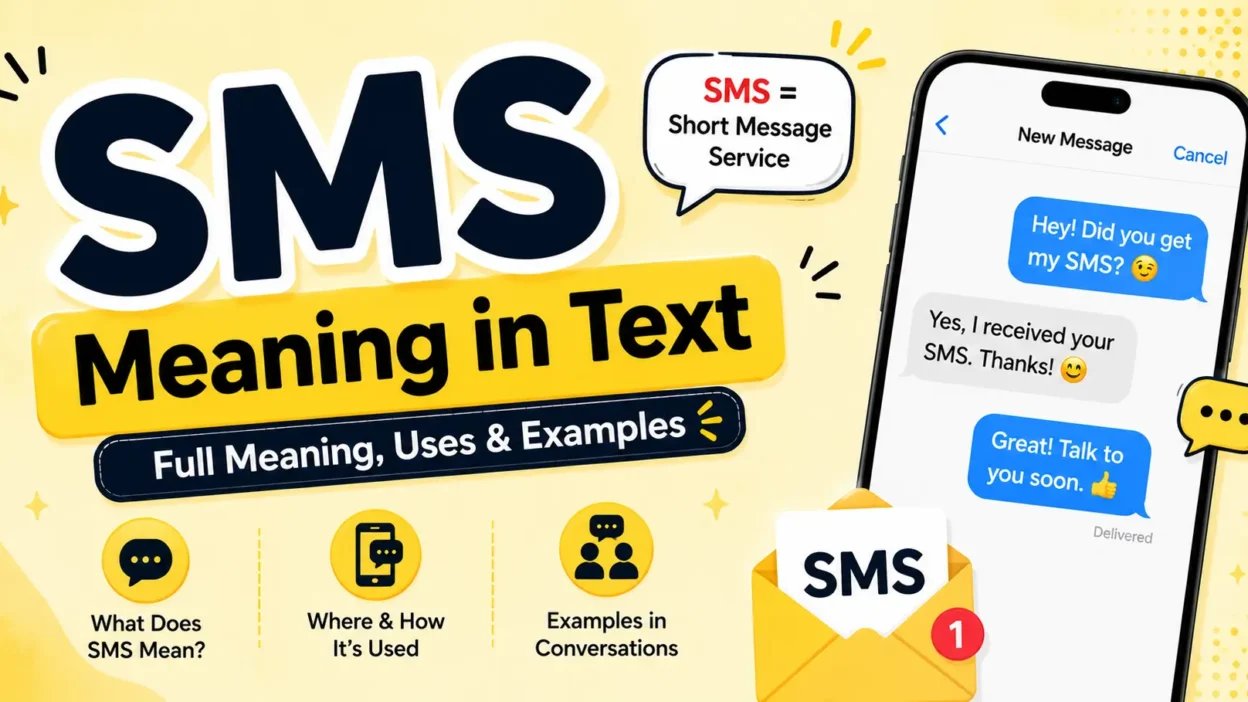
SMS Meaning in Text Short Message Service. It is a simple technology that lets your phone send a short text message over the cell network, with no internet needed. In everyday texting, “SMS” just means “text message.” This guide covers the full SMS meaning in text slang, from the technical definition to the abbreviations everyone asks about, like LOL, BRB, and IDK.
SMS Meaning in Text: What Does SMS Stand For?
SMS Meaning in Text means Short Message Service. It is the basic system your phone uses to send and receive plain text messages. It works over the cell network, not the internet.
SMS Full Form Short Message Service
The letters “SMS” stand for Short Message Service. This is worth saying clearly, because those same three letters are used in other places too.
In a school, SMS Meaning in Text can mean School Management System. At a workplace, it can mean Safety Management System. Both are real and correct uses of the term.
But on your phone, in your texting app, SMS Meaning in Text one thing: Short Message Service. That is the meaning this whole guide is about.
Simple Definition of SMS Meaning in Text
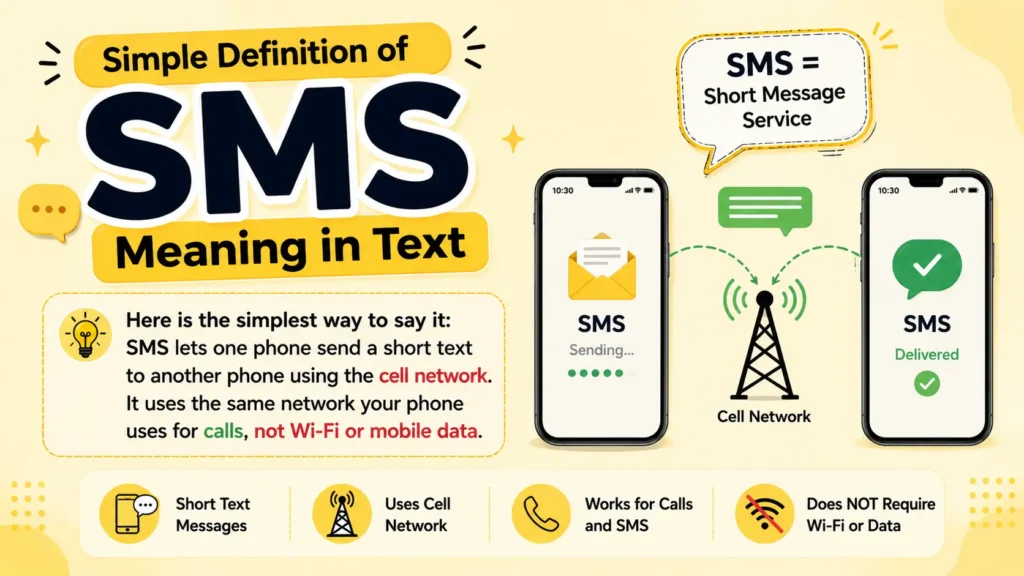
Here is the simplest way to say it: SMS lets one phone send a short text to another phone using the cell network. It uses the same network your phone uses for calls, not Wi-Fi or mobile data.
A Personal Note on Why This Definition Matters
One of the first times I truly understood what SMS meant, I wasn’t reading about it. I was traveling, far from home, with no reliable mobile data.
Every app on my phone just spun and spun. Nothing would send. Then a short text came through from a family member. It was plain and simple, just a few words, but it was the only message that got through all day.
Before messaging apps became my default, SMS was the fastest and most reliable way to stay connected. That was especially true when data wasn’t available at all.
That same trip taught me something else: “SMS” isn’t only a texting word. I later found out about School Management System and Safety Management System, two totally different uses of the same letters. For everyday texting, though, Short Message Service is by far the most common meaning, and it’s the one this article focuses on.
The whole experience taught me something simple: SMS is dependable. It works on almost any phone, smart or not. So now, whenever someone asks me what SMS means in a text, I think of that short, plain message that reached me exactly when nothing else could.
SMS vs. “Text Message” Are They the Same Thing?
Yes, in everyday use, SMS and “text message” mean the same thing. Most people use these words interchangeably.
But there is a small technical difference. SMS is the exact set of rules your phone follows to send that text. “Texting” is a bigger, more casual word for the same act. It can also include app messages, like iMessage or WhatsApp, which do not use SMS at all.
So here’s the simple rule: every SMS is a text message, but not every text message is an SMS.
Why Is It Called “Short” Message Service?
The word “short” is not just a name. It is a real limit.
A standard SMS message can only hold 160 characters. That number comes from how much data fits into one signal packet on older cell networks.
If your message is longer than 160 characters, one of two things can happen. Older phones may cut the message off. Newer phones split it into several linked messages and put them back together for you.
How SMS Works Behind the Scenes
SMS works by sending your message through your phone carrier’s network, using a system called an SMSC, until it reaches the other person’s phone.
The Journey of a Text Message
When you hit “send” on a text, your message does not go straight to the other phone. The message takes a short path first.
- Your phone turns the message into data and sends the data to your carrier.
- The carrier passes the message to something called the Short Message Service Center (SMSC). Think of the SMSC like a digital post office just for texts.
- The SMSC finds the best path to the other phone.
- If that phone is off or out of range, the SMSC holds the message. The SMSC tries again once the phone connects.
- Once the message arrives, the other phone turns the data back into readable text.
All of this usually happens in just one or two seconds.
The 160 Character Limit, Explained.
Standard texts use a system called GSM-7. This system packs each letter into a small piece of data, allowing up to 160 characters per message.
But some messages use certain symbols, emojis, or letters from languages like Arabic or Chinese. Those messages switch to a different system called UCS-2. This system uses more data per character, so the limit drops to just 70 characters.
What Happens When You Go Over the Limit
Going over the limit does not cut your message short. Instead, your phone splits the message into smaller pieces.
Each piece is usually 153 characters long. A little space is saved in each piece so your phone knows how to put them back together. The pieces are sent one after another, then joined back into one message on the other end.
Most people never even notice this is happening.
A Short History of SMS Meaning in Text
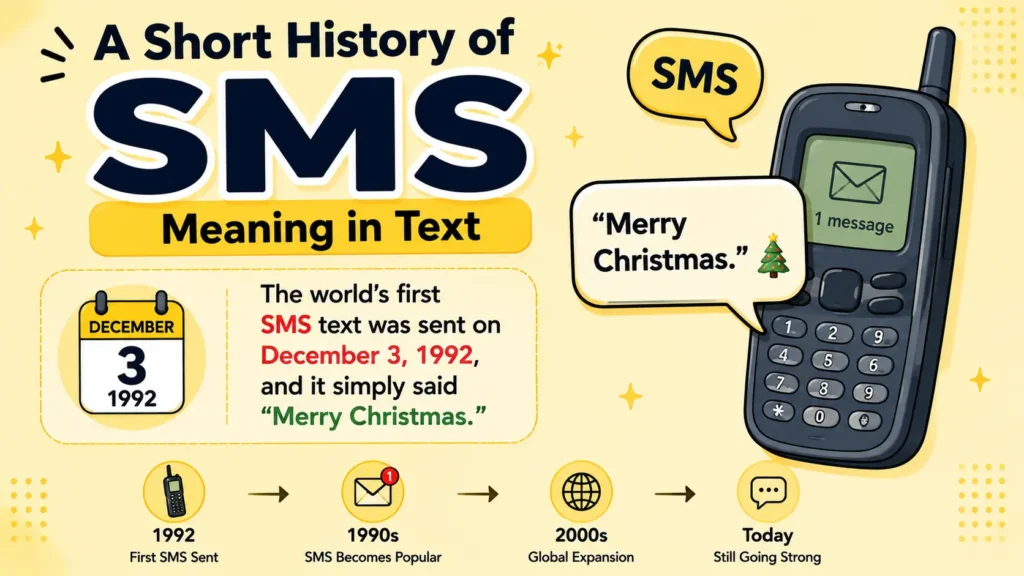
The world’s first SMS text was sent on December 3, 1992, and it simply said “Merry Christmas.”
The First Ever Text Message
An engineer named Neil Papworth sent that first message. He sent it to a colleague at the phone company Vodafone.
It’s a small, simple detail. But this message marks the true starting point of a technology that has since carried trillions of messages around the world.
From Expensive Novelty to Global Habit
At first, SMS was slow to catch on. Messages cost money, and early on, you often could only text someone using the same phone carrier.
That slow start changed fast during the 2000s. Phones got cheaper. Carriers dropped their per message fees. Texting quickly became a daily habit instead of a rare treat.
By the time smartphones arrived, SMS was already a normal part of daily life. This is a big reason SMS never fully disappeared, even after apps like WhatsApp and iMessage came along.
SMS vs. Other Messaging: What’s the Real Difference?
SMS differs from MMS, iMessage, RCS, and WhatsApp in two main ways: whether the service needs the internet, and what kind of content the service can send.
| Feature | SMS | MMS | iMessage | RCS | |
| Needs internet | No | Partly | Yes | Yes | Yes |
| Text only | Yes | No | No | No | No |
| Character limit | 160 | Higher | None | None | None |
| Works on all phones | Yes | Yes | Apple only | Mostly Android | Needs the app |
| Read receipts | No | No | Yes | Yes | Yes |
| Encryption | Weak/none | Weak/none | Strong | Improving | Strong |
SMS vs. MMS
SMS sends text only. MMS sends photos, videos, and sound.
MMS stands for Multimedia Messaging Service. MMS is the upgrade that lets you send pictures and video clips. MMS also skips the strict 160-character rule that SMS follows.
SMS vs. iMessage
iMessage is Apple’s own messaging system, and it’s why some texts show up in blue and others in green.
When you message another iPhone using Wi-Fi or data, the message goes through iMessage, and the bubble turns blue. When that’s not possible, like when there’s no internet or the other phone isn’t an iPhone, the message falls back to SMS. That bubble turns green.
SMS Meaning in Text vs. RCS
RCS stands for Rich Communication Services, and it’s the Android version of iMessage style texting.
RCS adds features like read receipts, typing indicators, and better-quality photos and videos. RCS sits on top of regular texting. RCS is slowly replacing plain SMS on newer Android phones, though this depends on your carrier.
SMS vs. WhatsApp and Other Chat Apps
WhatsApp, Messenger, and similar apps all need the internet to work. SMS does not.
These apps are called “over the top” apps, a term for any app-based messaging service that runs on internet data instead of a phone carrier’s own network. Both people need the app installed, and both need Wi-Fi or mobile data. SMS skips all of that. SMS just needs a working cell signal, which is exactly what helped me on that low-signal trip I mentioned earlier.
SMS Meaning in Text: What All Those Abbreviations Actually Mean
SMS slang means the short words and letter codes people use in texts, like LOL or BRB, to say more using fewer characters. SMS slang is one type of a much bigger category called internet slang, which also shows up on social media and in online chats.
Why Texting Created Its Own Language
SMS slang did not appear by accident. Two things pushed it into being.
First, there was the 160 character limit. Second, early phones made you press a number key several times just to type one letter. Both problems pushed people to say more with less.
Linguist David Crystal has studied this kind of texting language closely. Crystal has pointed out that these short forms follow real patterns and are not random. Texters lean on initials, dropped vowels, and sounds like “8” (as in “l8r”) to save time and effort.
Classic SMS Meaning in Text Everyone Should Know
Here are some of the most common texting abbreviations, grouped by how people use them.
Reactions and feelings
| Slang | Meaning |
| LOL | Laugh Out Loud |
| OMG | Oh My God |
| SMH | Shaking My Head |
| LMAO | Laughing My Head Off |
Saying goodbye or stepping away
| Slang | Meaning |
| BRB | Be Right Back |
| TTYL | Talk To You Later |
| GTG | Got To Go |
Sharing facts or opinions
| Slang | Meaning |
| IDK | I Don’t Know |
| FYI | For Your Information |
| IMO | In My Opinion |
| TBH | To Be Honest |
Slang That Isn’t as Simple as It Looks
Not every short form has just one meaning. A few are truly tricky, and knowing this matters more than memorizing a list.
- LOL usually means “laugh out loud.” Some people, especially older texters, use LOL to mean “lots of love.” In rare cases, LOL has even meant “little old lady.” The right meaning depends on who sent the message and what else the message says.
- “K” and “KK” can also confuse people. A plain “K” can feel cold or annoyed, even when the sender did not mean it that way. “KK,” on the other hand, often feels friendlier and can simply mark the natural end of a chat.
This kind of mix up happens in real life more than any dictionary would suggest. One single letter can change the whole feeling of a message, based only on who reads it and how they read it.
Modern Texting Slang (Gen Z Terms)
Texting slang keeps changing. Newer words have moved from social media straight into everyday texts.
- Bet — okay, or “for sure”
- Sus — suspicious
- No cap — no lie, being serious
- FR — for real
- Ghosting — suddenly stopping contact with no explanation
Even “Text” Gets Shortened: The Self Referential Slang of “Txt”
Even the word “text” gets the short-form treatment. The word “text” becomes “txt.” The same habit that created LOL and BRB applies just as easily to the word for texting itself.
Is SMS Secure?
SMS is not fully secure because SMS does not use strong encryption as some newer messaging apps do.
What Is Smishing (SMS Phishing)?
Smishing is a scam that happens through text messages. Smishing is phishing, but by text instead of email.
A smishing text might pretend to be your bank or a delivery company. The scam’s goal is to trick you into clicking a bad link or giving away personal details.
Why SMS Isn’t Encrypted (and When That Matters)
Standard SMS does not have strong, built-in encryption. Apps like WhatsApp and iMessage do have this protection.
This lack of encryption does not mean your texts get read all the time. But the lack of encryption is still a good reason to avoid sending sensitive things, like passwords or full card numbers, through plain SMS.
Simple Habits to Stay Safe
- Never share a one-time code with anyone, even if the text looks official.
- Watch out for urgent messages, like “your account will be locked.” This wording is a classic scam trick.
- Block and report strange numbers instead of replying to them.
Common Business Uses of SMS
Businesses still use SMS today mainly for reminders, security codes, and marketing texts.
- Appointment reminders and delivery updates — SMS reaches almost any phone, with no app required.
- One-time passwords (OTPs) — Banks and other services use SMS because nearly every phone can receive it.
- SMS marketing — Companies send promotions by text because people tend to open texts quickly, often faster than marketing emails.
Frequently Asked Questions
What does SMS Meaning in Text?
SMS Meaning in Text stands for Short Message Service, the technology mobile phones use to send and receive short, text only messages. SMS works over a cellular network instead of the internet, so it doesn’t need Wi-Fi or mobile data to send or receive a message. This is why SMS still works in low signal areas.
Is SMS the same thing as a text message?
Yes, in everyday use, “SMS” and “text message” mean the same thing, and people use both words interchangeably. Technically, SMS is the specific messaging protocol phones follow. “Texting” is the broader term, which can also include app-based messages like iMessage or WhatsApp.
What is SMS slang, and what do common abbreviations mean?
SMS Meaning in Text refers to the shortened words and letter codes people use in text messages. This slang started because of the 160 character SMS limit and slow typing on old phone keypads. Common examples include LOL (laugh out loud), BRB (be right back), OMG (oh my god), and IDK (I don’t know).
What’s the difference between SMS and MMS?
SMS is limited to plain text and a strict 160-character limit per message. MMS, which stands for Multimedia Messaging Service, supports photos, videos, and audio files. MMS does not follow the same strict character limit that SMS does, which makes it better suited for richer content.
What does “sent as SMS” mean on my phone?
“Sent as SMS” means your message was delivered using standard SMS instead of a richer option like iMessage or RCS. This usually happens automatically when there’s no internet connection available, or when the recipient’s device or carrier can’t receive rich, data-based messages.
Does SMS need internet to work?
No, SMS does not need internet to work. SMS works over a mobile carrier’s cellular signal instead of Wi-Fi or mobile data. This is exactly why SMS can still work in places where the internet connection is weak, unreliable, or missing entirely.
Why do some texting abbreviations have more than one meaning?
SMS slang grew naturally among different groups of texters, rather than through one official dictionary. Because of this natural growth, some abbreviations picked up extra meanings over time. “LOL,” for example, can mean “laugh out loud” or “lots of love,” depending on who sent it and the context around it.
The Bottom Line
SMS is a simple idea with a lot of history packed behind it. SMS Meaning in Text stands for Short Message Service, and it still works the same basic way it did back in 1992: short text, sent fast, over the cell network.
What’s changed is everything around SMS. Slang grew out of real limits, like the 160 character cap and clunky old keypads. Newer options like RCS and iMessage have added richer features on top of basic texting. But SMS is still the one message type that reaches almost any phone on the planet, with no internet needed.
That reliability is exactly why, on a trip with no signal and no app that would send, a plain SMS was the one message that got through. The full SMS meaning in text slang comes down to this: a simple, dependable message format, wrapped in decades of shorthand that people invented just to say more, faster. Sometimes the simplest technology is still the one you can count on.

A former actress and voice coach, Clara helps learners lose their fear of speaking out loud. She breaks down tricky sounds, stress patterns, and rhythm using techniques borrowed from theater training.
[…] More Read:https://englishteller.com/sms-meaning-in-text […]
[…] Read More: SMS Meaning in Text: A Confusing Abbreviation Finally Clarified 2026 […]