
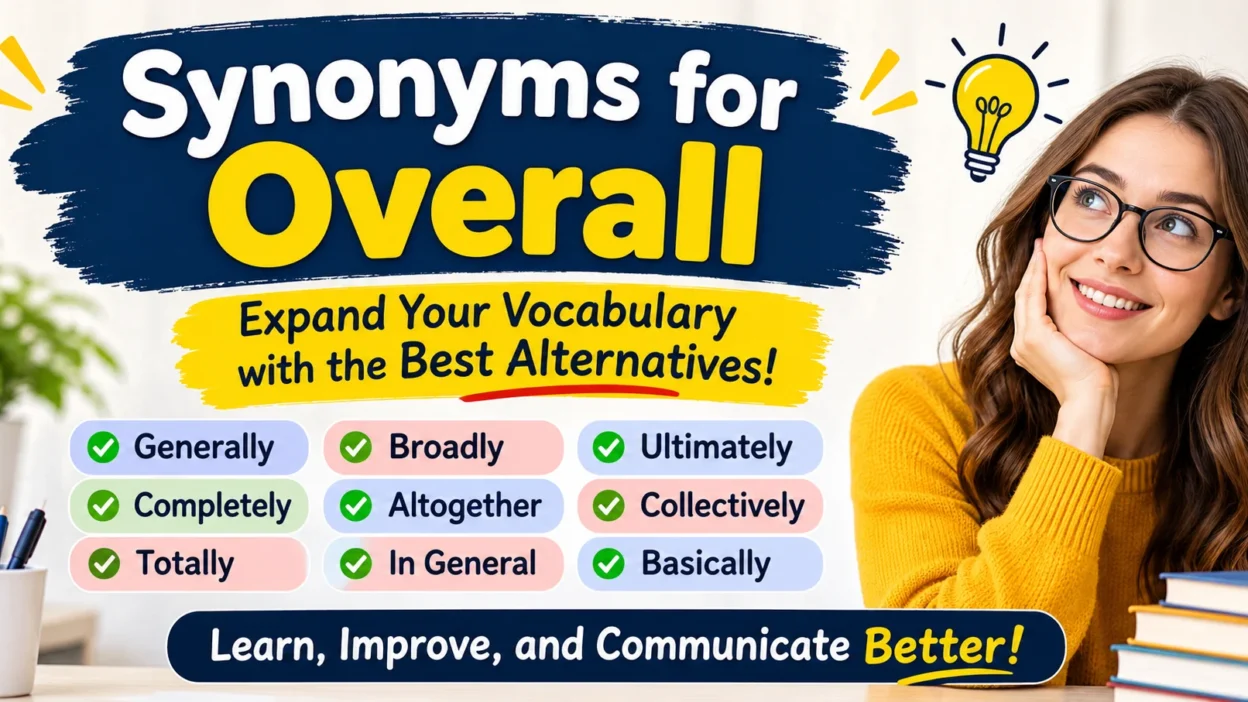
Looking for synonyms for overall? The best options are on the whole, all in all, by and large, generally, on balance, as a whole, total and general. But these words are not the same. Some give a final verdict, some describe a pattern, and some describe the whole picture. Choose the wrong one, and your sentence can sound odd or even change meaning.
This guide sorts 20 synonyms for overall by sense, tone and context. You get original examples, a comparison table, a quick quiz and clear FAQs. Use it to pick the right word for essays, emails, reports and daily speech, without second-guessing.
Quick Answer: Which Word Should You Use?
Choose by the job “overall” does in your sentence:
- Final verdict: use on the whole, all in all or on balance (formal).
- General pattern: use generally, by and large or for the most part.
- Whole picture: use total, general or whole before a noun, and as a whole after one.
Safe default: on the whole fits most neutral sentences where overall gives a verdict.
Watch out: comprehensive, holistic and global are only partial matches, so check the meaning first.
Meaning of Overall
Overall is an adverb, an adjective and, less often, a noun. Its core idea is “taking the whole picture into account.”
- Adverb: in general, considering everything. “Overall, the trip went well.”
- Adjective: covering everything, seen as a whole. “The overall winner” or “the overall cost.”
- Noun (overall / overalls): a work garment. See the confusable words section for the US/UK difference.

Pronunciation hint: the adverb is usually said oh-ver-AWL, and the adjective is usually OH-ver-awl. Check the audio in a dictionary to hear the stress.
Origin: the word is built from “over” and “all.” It pictures something that covers everything.
Register: neutral. It works in speech and writing. In essays, it is easy to overuse as an opener, which is why learners look for alternatives. Writing for exams? [Internal link: IELTS Task 1 overview phrases → /ielts-task-1-overview/]
Quick List of Synonyms for Overall
Verdict phrases (adverbs): all in all, on the whole, all things considered, on balance
Generalizing words (adverbs): generally / in general, by and large, for the most part, broadly speaking, largely, mostly
Whole-picture words (adjectives and one phrase): general, total, whole, aggregate, comprehensive, holistic, global, overarching, as a whole
How we chose these synonyms: we kept only words that can replace “overall” in at least one sense without changing the meaning, and we marked where they cannot. Words that only look similar, such as “normally” or “mainly,” are left out.
Synonyms for Overall by Sense and Context
Ask one question first: what job is “overall” doing in my sentence? It may give a verdict, describe a pattern, or describe the whole picture. Then choose from the matching group.
1. Giving a final verdict
Use these at the start or end of a sentence when you sum up your opinion.
All in all is a friendly way to close with your verdict. It suits speech, emails and reviews.
- All in all, we had a great weekend, even with the rain.
- The hotel was noisy, but all in all, Maya would stay there again.
On the whole gives a judgment that allows small faults. It sounds a little more formal than “all in all.”
- On the whole, the staff were helpful and polite.
- The film was slow in places, but critics liked it on the whole.
All things considered gives a verdict after you weigh the difficulties. It often sounds sympathetic.
- All things considered, Tariq played well for his first match.
- We chose the smaller house, all things considered.
On balance is formal. You weigh good and bad points before you decide.
- On balance, the benefits of the new schedule outweigh its costs.
- The committee, on balance, favored the cheaper plan.
2. Describing a general pattern
These words say what is true in most cases. They do not give a final verdict.
Generally (or in general) describes what is usually true. It sets a pattern.
- Generally, trains on this line run on time.
- In general, our customers prefer morning appointments.
By and large means “with few exceptions.” It is casual but fine in most writing.
- By and large, the neighbors get along well.
- The roads were by and large clear this morning.
For the most part means “in most respects or most cases.”
- For the most part, the exam questions were fair.
- The students listened quietly for the most part.
Broadly speaking gives a loose summary and skips the details. It is neutral to formal.
- Broadly speaking, the project has three stages.
- Prices are similar across the three shops, broadly speaking.
Largely means “mostly,” and it often points to a cause. It is more formal than “mostly.”
- The delay was largely due to bad weather.
- Her report is largely accurate.
Mostly describes the biggest part or number. It is plain and common, but it shows a proportion, not a final verdict.
- The audience was mostly teenagers.
- The kitchen is mostly finished.
3. Describing the whole picture
These words replace “overall” before a noun, as in “overall score” or “overall view.”
General means broad, not detailed. It matches “overall” in phrases like “overall impression.”
- My general impression of the school was positive.
- The general mood in the office improved after the move.
Total means the sum of all parts. Use it for amounts and scores.
- The total cost came to $240.
- Her total score across four tests was 312.
Whole is the plain word for “entire.” It works with “picture,” “story” and “view.”
- Look at the whole picture before you decide.
- The whole story is more complicated than the headline.
Aggregate is formal. It means combined from several parts, and it is common in sports, data and finance.
- Her aggregate score over two rounds won the title.
- The study reports aggregate data from twelve clinics.
Comprehensive is only a partial match. It means complete coverage in detail, not a broad look. An “overall review” is a general look. A “comprehensive review” is a thorough one.
- The nurse gave us a comprehensive guide to wound care.
- The auditors wrote a comprehensive report on every department.
Holistic is also a partial match. It treats parts as connected. You see it in health, education and business.
- The school takes a holistic approach to student well-being.
- A holistic review looks at grades, essays and activities together.
Global can mean “of the whole,” but many readers will think “worldwide.” Use it only when the meaning is clear.
- The manager asked for a global assessment of the program’s strengths and weaknesses.
- Before editing single pages, take a global look at the site’s design.
Overarching is formal. It names the top-level idea that covers smaller ones.
- The overarching goal is to cut waiting times.
- Each chapter supports the book’s overarching argument.
As a whole treats a group as one unit, not as separate parts. It comes after the noun.
- The team as a whole improved this season, though some players struggled.
- Society as a whole benefits when more people can read.
Overall Synonyms Comparison Table
| Word | Meaning | Tone / register | Best used when | Example |
|---|---|---|---|---|
| all in all | final verdict | Casual, friendly | Reviews, emails, speech | All in all, a solid week. |
| on the whole | verdict despite small flaws | Neutral | Reports, essays | On the whole, results improved. |
| on balance | verdict after weighing both sides | Formal | Decisions, academic writing | On balance, we should wait. |
| by and large | with few exceptions | Informal | Talk, blogs | By and large, clients agreed. |
| mostly | the biggest part | Plain | Describing what something is made of | The team is mostly new. |
| general (adj.) | broad, not detailed | Neutral | Impressions, trends | a general trend |
| total | sum of all parts | Neutral | Money, scores, amounts | the total score |
| comprehensive | thorough, nothing missing | Formal | Reviews, guides, plans | a comprehensive plan |
| holistic | parts seen as connected | Academic / professional | Health, education, business | holistic care |
Overall vs Confusable Words
Some words look close to “overall” but change your meaning. Do not swap them in as synonyms.
| Word | Meaning | Why it is not a synonym | Example |
|---|---|---|---|
| over all (two words) | across or about the whole of something | It is a preposition plus “all,” not a summary word. | She read over all the notes before the exam. |
| overalls | a work garment | A different noun. In US English it usually means trousers with a bib front. In UK English it often means a one-piece work suit. | He wore blue overalls in the garage. |
| all-around (US) / all-round (UK) | skilled or useful in many areas | It describes ability, not a summary. | She is an all-around athlete. |
| mainly / chiefly | for the main reason or part | It points to a cause or main part, not the whole picture. | He failed mainly because he skipped class. |
| in conclusion / in sum | marks the end of an argument | It is a signpost for structure, not a general judgment. | In sum, the data support the plan. |
How to Choose the Right Synonym for Overall
Use a simple swap test. First, say what “overall” is doing in your sentence: giving a verdict, describing a pattern, or describing a whole picture. Then pick from that group and check the tone of your text. [Internal link: transition words for essays → /transition-words-for-essays/]
- Formal and academic writing: choose on balance, as a whole, broadly speaking, aggregate or overarching. Broadly speaking, the three interviews pointed in the same direction.
- Casual speech and emails: choose all in all, by and large or mostly. By and large, Dad liked his new phone, but the battery annoyed him.
- Business writing: choose on balance for decisions, as a whole for teams or companies, and total or aggregate for numbers. On balance, the new supplier saves us money, even with slower delivery.

Antonyms of Overall
Overall has no single opposite. The best antonym depends on the sense you use.
- in part / partly: the roof was repaired in part, so water still leaks in one corner.
- in particular / specifically: I liked the whole trip, and the museum in particular.
- partial (opposite of total): we got a partial refund, not the full amount.
- specific / detailed (opposite of general): she asked for specific feedback, not general comments.
- individual (opposite of whole): check each individual result before you look at the total.
Related Words, Idioms and Collocations
Common collocations with “overall”: overall score, overall winner, overall impression, overall health, overall goal, overall cost, overall trend, overall quality, overall performance and overall rating.
Idioms and phrases with a similar idea:
- the big picture: the whole situation, not the details. “Stop checking every line and look at the big picture.”
- when all is said and done: after you consider everything. “When all is said and done, the move was worth it.”
- at the end of the day: informal, and often overused. “At the end of the day, the choice is yours.”
Common Mistakes Learners Make With Overall
- Missing comma. Write “Overall, the results were good,” not “Overall the results were good.”
- Writing two words. The adverb is one word. Write “Overall, the plan worked,” not “Over all, the plan worked.”
- Opening every paragraph with “Overall.” This is a common essay habit. Save it for a real summary and vary the rest.
- Swapping in “mainly” or “normally.” “Normally, the hotel was good” talks about habit, not your final judgment.
- Using “in conclusion” in the middle of an essay. Use “on the whole” or “overall” for a mid-text summary. [Internal link: ways to say “in conclusion” → /conclusion-transition-words/]
Mini Quiz: Synonyms for Overall
- “The hotel was noisy, but the staff were kind. ___, I would stay again.” Which fits best? (a) On balance (b) Total (c) Aggregate (d) Cumulative
- Which word does NOT keep the meaning in “Overall, the plan works”? (a) On the whole (b) All in all (c) Mainly (d) By and large
- You weighed pros and cons before a decision in a report. Which phrase fits best? (a) all in all (b) on balance (c) mostly (d) whole
- True or false: “a comprehensive review” and “an overall review” mean exactly the same.
- Which word is an antonym of “overall” in “an overall view”? (a) total (b) detailed (c) general (d) whole
Answers
- (a) On balance. It shows a verdict after weighing good and bad points.
- (c) Mainly. It points to the main reason or part, not a general judgment.
- (b) On balance. It fits formal decisions that weigh both sides.
- False. “Comprehensive” means thorough. “Overall” means general.
- (b) Detailed. It is the opposite of a broad, general view.
FAQs About Synonyms for Overall
What is another word for overall?
Another word for overall is “on the whole” when you give a verdict, and “generally” when you describe a pattern. Before a noun, use “total” or “general.” The right choice depends on the job overall does in your sentence, so check the sense before you swap it.
What can I use instead of “overall” in an essay?
In an essay, use “on balance,” “on the whole,” “as a whole” or “broadly speaking.” Choose “on balance” when you weigh evidence, and “as a whole” when you discuss a group. Avoid casual phrases such as “all in all” in strict academic writing. Do not start every paragraph the same way.
What is a formal synonym for overall?
“On balance” is a strong formal choice for verdicts, and “aggregate” or “overarching” work formally before nouns. “Broadly speaking” is neutral to formal for summaries. Choose by meaning, not only by tone: “aggregate score” is correct, but “aggregate impression” sounds odd.
What is a casual way to say overall?
“All in all” and “by and large” are friendly, casual options for speech, emails and reviews. “Mostly” also works when you describe the biggest part of something. Keep these out of formal reports, where “on the whole” or “on balance” sounds more careful.
What is the difference between overall and in general?
“Overall” usually gives a summary judgment after you consider everything. “In general” describes what is usually true. Compare: “Overall, the trip was good” is a verdict, while “In general, trips here are cheap” is a pattern. The two often overlap, but they are not always interchangeable.
Can I start a sentence with overall?
Yes. Overall is an adverb, and it often opens a sentence as a summary. Put a comma after it: “Overall, the results were positive.” In essays, use it sparingly, not at the start of every paragraph, so it keeps its summarizing force.
What is the opposite of overall?
Overall has no single opposite. For the adverb, use “in part” or “specifically.” For the adjective, use “partial,” “specific” or “detailed.” The best antonym depends on the sense: “partial” is the opposite of “total,” while “specific” is the opposite of “general.”
Can I use “comprehensive” instead of “overall”?
Sometimes, but not always. “Comprehensive” means complete and detailed, while “overall” means general or taking everything into account. A “comprehensive report” covers every part in depth. An “overall assessment” is a broad judgment. Swap them only when you really mean thorough coverage.
Conclusion
The best synonyms for overall depend on the job the word does in your sentence. Use on the whole, all in all or on balance for a final verdict. Use generally, by and large or for the most part to describe a pattern. Use total, general or as a whole for the whole picture. Watch the partial matches: comprehensive, holistic and global can change your meaning.
More Read: Synonyms for Profound: 25 Powerful Synonyms for Profound

Curriculum Developer
Rachel has spent over a decade developing English learning curriculums for schools and online platforms across the United States. Her specialty is structuring content so that even beginner learners can follow along with confidence.


[…] More Read: Synonyms for Overall: 20 Powerful Words That Sound Smarter […]