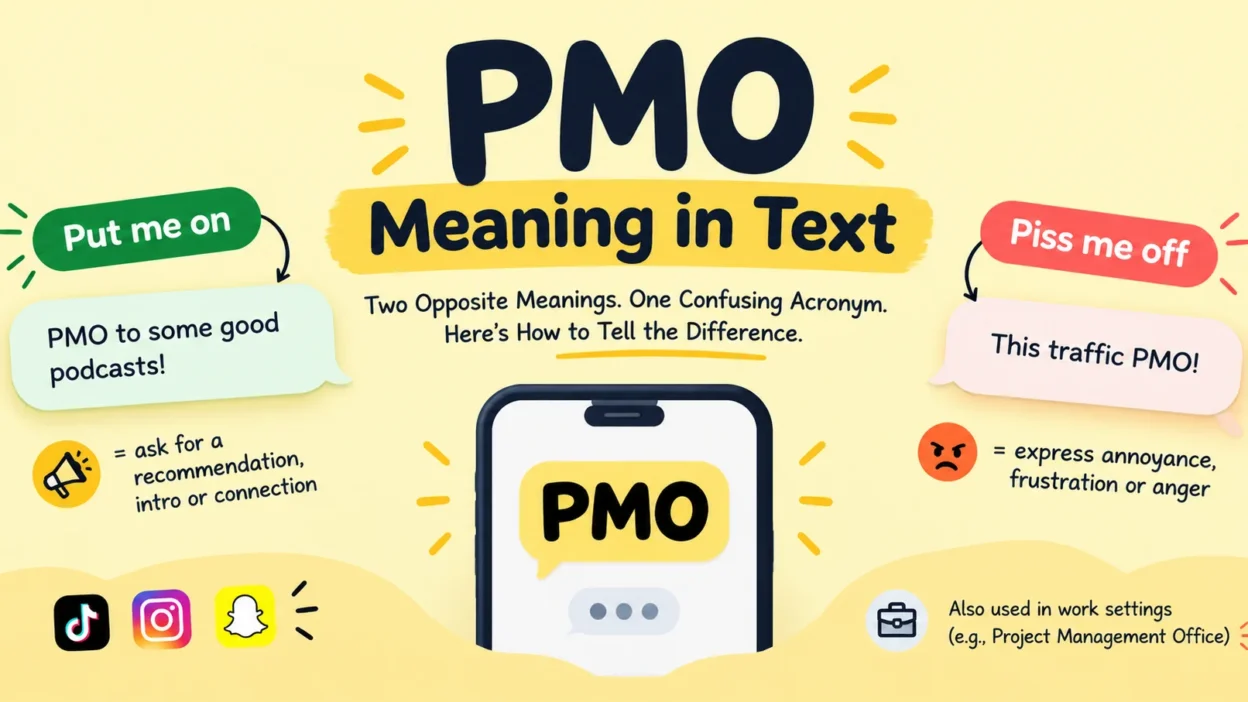
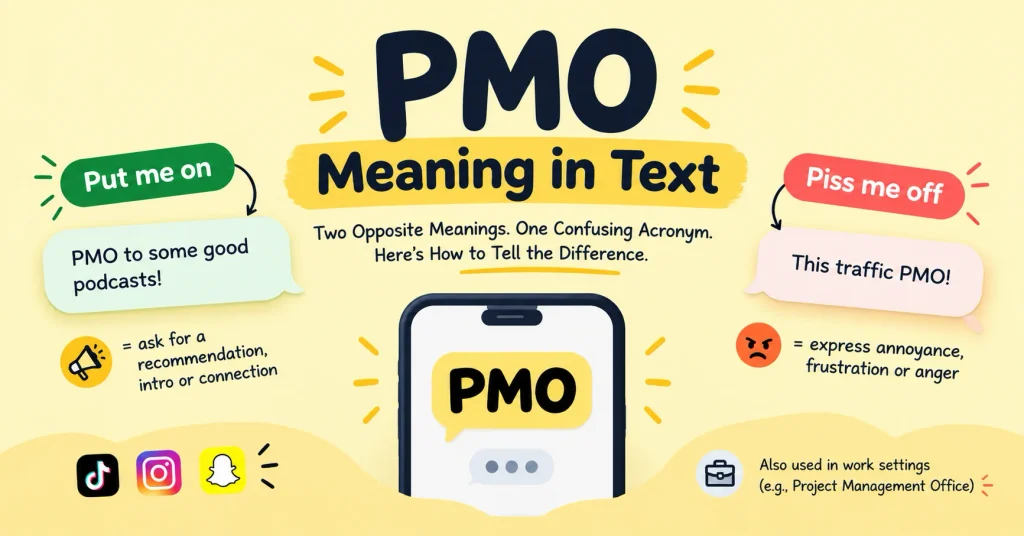
PMO meaning in text usually comes down to two slang phrases: “put me on” (asking for a recommendation, introduction, or access to something) and “piss me off” (expressing annoyance). Context decides which one fits. “PMO to some good podcasts” asks for recommendations, while “this traffic PMO” says the traffic is annoying. In work messages, PMO usually means Project Management Office, which is a separate meaning.
This guide focuses on how to tell the two slang meanings apart, what to do when a message gives you too little to go on, and how to reply without guessing, whether the message comes from a friend, a comment section, or a group chat.
PMO Meaning in Text: The Quick Answer
The same three letters can invite a recommendation or vent a complaint. The table compares the two slang meanings, and the examples are constructed for illustration.
| PMO meaning | What the sender usually intends | Typical sentence pattern | Example message | Context clue |
|---|---|---|---|---|
| Put me on | Recommend, introduce, or share something with me | “PMO to [something]” | “PMO to your favorite horror movies” | A thing to discover follows PMO |
| Piss me off | That annoys or angers me | “[Something] PMO” or “you’re PMO” | “This traffic PMO” | The message describes something irritating |
The patterns differ because the phrases work differently. “Put me on” is usually followed by what you want to be put on to, so PMO is often followed by “to” plus a thing. “Piss me off” has a subject that does the annoying, so PMO often comes after the subject: “this traffic” is the thing doing it.
These patterns are habits, not rules, because casual messages bend grammar. Neither meaning is established as more popular, and no current usage data shows otherwise.
What I Look At Before Interpreting PMO in a Text
As an editor who explains slang, I find PMO confusing for a simple reason: its two meanings feel almost opposite. One is an invitation and the other is a complaint, yet the letters give no hint which is which. So I do not start with the abbreviation. I start with the words around it.
The three scenarios below are illustrative examples, not real conversations.
- Put me on: “Found a band that sounds like early 2000s indie.” / “PMO to their best album.” PMO follows a discovery, comes before “to,” and names something to share, so a recommendation request fits.
- Piss me off: “Ordered at 6 and it’s 8:30. This delivery PMO.” The sender describes a delay, and “this delivery” is the thing doing the annoying, so a complaint fits.
- Ambiguous: After “I got tickets to the show!” someone replies “PMO 😭.” It could mean “put me on” (include me or tell me how) or mild jealous annoyance. I would not guess here.
My practical rule: ask what comes before, what comes after, and whether the person is asking for something or venting. If those answers disagree, I ask instead of replying to the meaning I prefer.
How to Decode PMO From Context
Five checks help, and none is infallible. Slang shifts by group, and one person’s habits may differ from another’s.
- The words right before and after PMO. A “to” plus a noun suggests “put me on.” A subject or “you’re” before PMO suggests “piss me off.”
- Asking or venting. Is the sender requesting something, or reacting to something?
- The topic. Music, products, contacts, and opportunities suggest a request.
- Something annoying. Delays, rude behavior, and complaints suggest frustration.
- Enough information. If two readings still fit, treat the message as unclear.
| Illustrative message | What the clues suggest | Confidence |
|---|---|---|
| “PMO to your skincare routine” | Put me on: “to” plus a thing to learn about | High |
| “That group chat PMO today” | Piss me off: describes something annoying | High |
| “PMO with a good coffee spot” | Put me on: asks for a place recommendation | Medium |
| “You really PMO right now” | Piss me off: aimed at the listener, but tone matters | Medium |
| “PMO 😭” after “I got tickets!” | Ambiguous: request or jealousy | Low |
What If Someone Sends Just “PMO”?
A standalone “PMO” does not contain enough information to identify the meaning. Without a topic, a pattern, or a previous message to anchor it, any confident reading is a guess.
Natural ways to ask:
- “Do you mean put me on?”
- “Wait, what do you mean by PMO?”
- “What happened?” (best if the sender seems upset)
Guessing is fine in a low-stakes chat where context is strong, such as “PMO to good songs.” Ask instead when the sender may be upset, when the relationship matters, or when a wrong reply would feel dismissive or confusing.
Is PMO Rude, and How Should You Reply?
“Piss me off” contains profanity, so it can sound blunt or rude, especially aimed at a person. “Put me on” is generally a request, not an insult. Neither meaning proves anger, flirting, or an insult without the surrounding conversation, and “this traffic PMO” is about traffic, not you.
- Put me on: “Start with this one,” “I’ll send you a few,” or “What kind are you into?”
- Piss me off (not aimed at you): “Same, that’s annoying,” or “That sounds awful.”
- Piss me off (aimed at you): “Sorry, what did I do?” keeps things calm.
- Not sure: “Do you mean put me on, or are you annoyed?”
Both slang meanings suit casual chats. In emails to a manager or teacher, write out what you mean.
Related Forms: TS PMO and DPMO
Two variants appear around PMO. Dexerto explains that DPMO means “don’t piss me off”. Know Your Meme’s explainer says TS PMO means “this shit pissing me off”. Our guide to TS meaning in text covers the “TS” part.
What We Know (and Don’t Know) About PMO’s History
Be cautious with origin claims. Know Your Meme and Urban Dictionary are community-edited or user-submitted, so an entry date shows when someone defined a term, not when people first used it. The Know Your Meme entry cites Urban Dictionary definitions from December 2005 (“pisses me off”) and July 2016 (“put me on”), and says it is unclear who first used PMO for “put me on.”
Guides also disagree about which meaning is more common, because they capture different moments. Know Your Meme’s January 2025 explainer called “piss me off” the more common use in recent months, while Dexerto says both meanings are most common on TikTok and most social apps. We found no reliable current measurement, so this article does not rank them.
Other Meanings of PMO
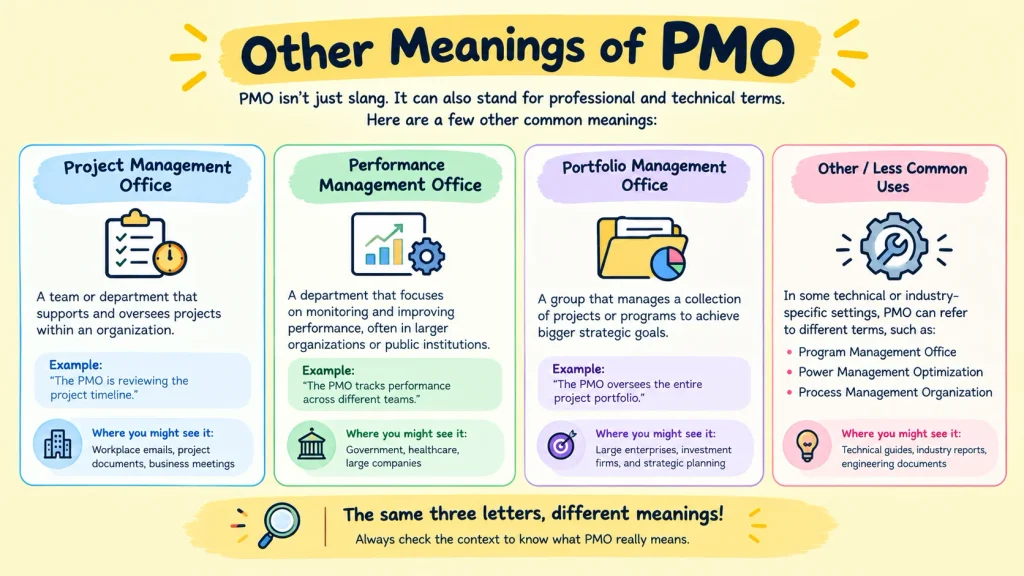
Outside slang, PMO is a real professional abbreviation. The most common meaning is Project Management Office. The Project Management Institute notes that the PMBOK Guide describes a PMO as an organizational unit that centralizes and coordinates the management of projects, and that some people read the “M” as “program” management instead (PMI).
CIO describes it as a group that sets and maintains project standards inside an organization. Wikipedia’s PMO page also lists the Prime Minister’s Office in several countries and an airport code for Palermo, Italy. The setting overrides slang: in a workplace email, project document, or official announcement, assume the institutional meaning.
Frequently Asked Questions
What does PMO mean in texting?
Usually “put me on” or “piss me off,” depending on the sentence. At work, it usually means Project Management Office.
Does PMO mean “put me on” or “piss me off”?
It can be either. No source we found shows one is universally more common, so read the whole message.
Is PMO rude?
“Piss me off” contains profanity and can sound blunt. “Put me on” is a request, not an insult.
How can I tell which meaning someone intends?
Check what comes before and after PMO, and whether the sender is asking or venting. If two readings fit, ask.
What does PMO mean in a workplace context?
Usually Project Management Office, a group that coordinates projects and sets standards.
Final Takeaway
PMO meaning in text is a context question, not a definition question. “Put me on” asks for a recommendation or introduction, “piss me off” expresses annoyance, and at work it usually means Project Management Office. The sentence pattern helps, but it is a hint, not a rule, and no current data shows which slang meaning is more common.
When you see PMO, ask what comes before and after it, and whether the sender is asking or venting. If the answers conflict, or the message is only “PMO,” ask a short question instead of guessing. That small step prevents most misunderstandings and keeps the conversation friendly.
Related reads: TS meaning in text · SN meaning in text · TFTI meaning in text

Curriculum Developer
Rachel has spent over a decade developing English learning curriculums for schools and online platforms across the United States. Her specialty is structuring content so that even beginner learners can follow along with confidence.