
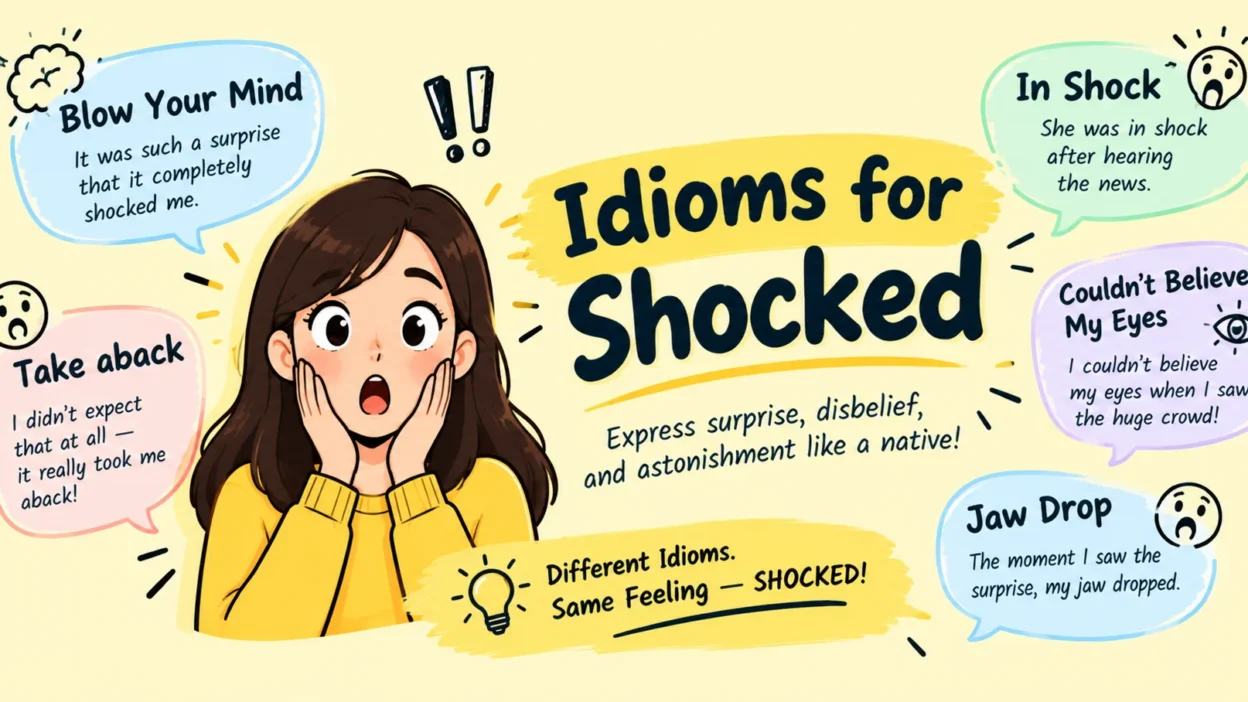
Idioms for shocked are fixed phrases that describe a sudden, strong jolt of surprise. They show how a moment feels instead of stating it plainly. Some signal a small nudge, like “taken aback.” Others show total disbelief, like “thunderstruck.” This guide gives you 25 of them, sorted from mild to extreme.
Each idiom is explained in simple words. You will find clear meanings, natural example sentences, true origins, US and UK differences, and the mistakes learners make most often. Read it once, and you can pick the right phrase for any moment, whether you are texting a friend, writing an email, or telling a story.
⚡ Quick Answer
The most common idioms for shocked are taken aback (mild), jaw dropped (strong), knocked for six (strong, British), and thunderstruck (extreme). Pick the phrase by three things: how strong the shock is, how formal the setting is, and whether the news is good or bad.
What Are Idioms for Shocked?
Idioms for shocked are set phrases that describe the jolt you feel when something unexpected happens.

The words do not mean what they say. Nobody’s jaw really hits the floor. The phrase paints a picture of how the moment feels, so listeners understand your reaction at once.
Shock is stronger than plain surprise. A surprise can be small and happy, like a birthday card. Shock hits harder and often upsets you.
The word “shocked” is an ordinary adjective, not an idiom. But “in a state of shock” is a true idiom, and Merriam-Webster lists it.
25 Idioms for Shocked at a Glance
The 25 phrases below run from mild surprise to total disbelief, and each one carries a tone you should match to the situation.
| Idiom | Level | Tone | Mood |
| Taken aback | Mild | Neutral to formal | Often negative |
| Caught off guard | Mild | Neutral | Either |
| Threw me for a loop | Mild | Informal | Either |
| Do a double take | Mild | Neutral | Either |
| Came as a shock | Mild | Neutral | Negative |
| Jaw dropped | Strong | Informal | Either |
| Blown away | Strong | Informal | Usually good |
| Floored | Strong | Informal | Either |
| Knocked for six | Strong | Informal, British | Negative |
| Hit like a ton of bricks | Strong | Informal | Negative |
| Drop a bombshell | Strong | Neutral | Negative |
| Bolt from the blue | Strong | Neutral | Usually bad |
| Stopped in my tracks | Strong | Neutral | Either |
| Knocked the wind out of me | Strong | Informal | Negative |
| Blew my mind | Strong | Informal | Usually good |
| Could have knocked me down with a feather | Strong | Humorous, dated | Either |
| Shell-shocked | Extreme | Neutral | Negative |
| Thunderstruck | Extreme | Literary | Either |
| Stunned into silence | Extreme | Neutral | Either |
| At a loss for words | Extreme | Neutral | Either |
| Gobsmacked | Extreme | Informal, British | Either |
| Couldn’t believe my eyes | Extreme | Neutral | Either |
| Heart skipped a beat | Extreme | Neutral | Either |
| Jumped out of my skin | Extreme | Informal | Fright |
| The shock of my life | Extreme | Informal | Either |
Mild Shock
Mild shock phrases describe a small jolt that makes you pause, not freeze.
- Taken aback means surprised enough to stop for a second, often by something rude or odd. “I was taken aback when my manager asked me to lead the project.” The usual pattern is be taken aback by or at something.
- Caught off guard means surprised while unprepared. “The pop quiz caught the whole class off guard.”
- Threw me for a loop describes surprise mixed with confusion. “My sister’s sudden move abroad threw me for a loop.”
- Do a double take means to look again because you doubt what you saw. “I did a double take when I spotted my old neighbor at the airport.”
- Came as a shock says something was unexpected and upsetting. “The test results came as a shock to the whole class.” Add to plus the person.
Strong Shock
Strong shock phrases describe news or events that hit hard and leave you reeling.
- Jaw dropped pictures a mouth falling open. “My jaw dropped when I saw my exam score.”
- Blown away means amazed or shocked, usually in a good way. “We were blown away by the surprise party.”
- Floored feels like being knocked flat. “His honest apology floored me.”
- Knocked for six means badly shocked or upset. It is British. “A failed driving test knocked him for six, and he stayed quiet all evening.”
- Hit like a ton of bricks describes a heavy, sudden realization. “When the bank called, the size of the debt hit him like a ton of bricks.”
- Drop a bombshell is what the speaker does when sharing shocking news. “Dad dropped a bombshell at dinner: we are moving in June.”
- Bolt from the blue names a total surprise, usually bad. “The layoff notice was a bolt from the blue.”
- Stopped in my tracks means you froze mid step. “The smell of my grandmother’s cooking stopped me in my tracks.”
- Knocked the wind out of me describes shock that leaves you breathless. “Her sudden goodbye knocked the wind out of me.”
- Blew my mind means amazed beyond easy words. “Seeing Earth from space in that film blew my mind.”
- Could have knocked me down with a feather is a joking way to say you were stunned. “When my cousin said she had won the lottery, you could have knocked me down with a feather.”
Extreme Shock
Extreme shock phrases describe a total freeze, where you cannot move, speak, or think straight.
- Shell-shocked means dazed and numb after overwhelming events. “The fans left the stadium shell-shocked after the last-minute loss.”
- Thunderstruck means hit with surprise like lightning. “I stood thunderstruck when my little brother played the whole song by ear.”
- Stunned into silence means too shocked to make a sound. “When the coach read out the final score, the team was stunned into silence.”
- At a loss for words means you cannot find anything to say. “I was at a loss for words when my friends sang to me at the airport.”
- Gobsmacked is British slang. “Gob” means mouth. “I was gobsmacked when the tiny shop turned out to be a famous bakery.”
- Couldn’t believe my eyes describes doubting what you see. “I couldn’t believe my eyes when my lost dog walked up the driveway.”
- Heart skipped a beat describes a quick physical jolt. “My heart skipped a beat when the phone rang at 3 a.m.”
- Jumped out of my skin fits sudden fright more than sad or happy news. “I nearly jumped out of my skin when the door slammed behind me.”
- The shock of my life names the biggest jolt you can recall. “We got the shock of our lives when the old wall fell and showed a hidden room.”
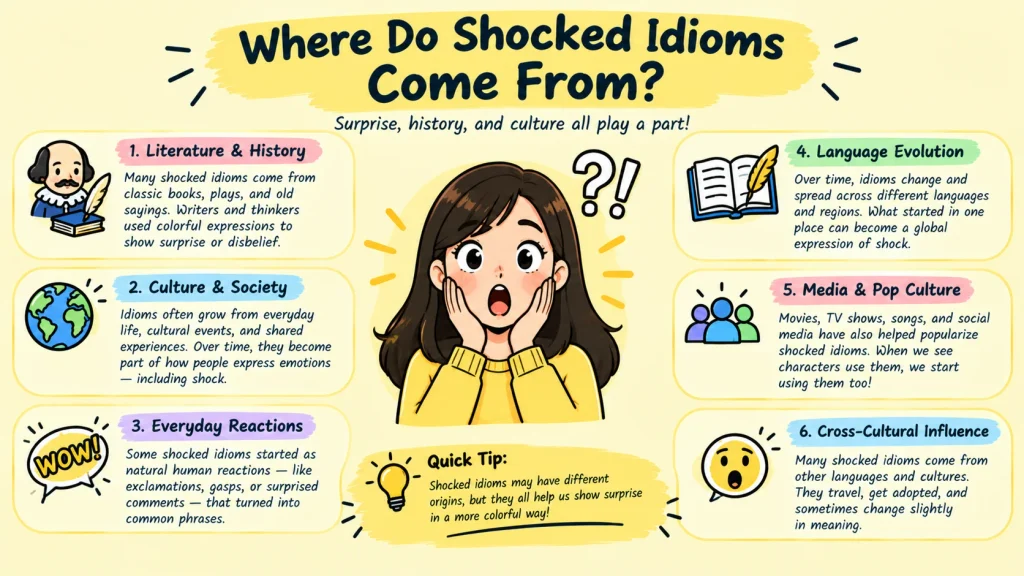
Where Do Shocked Idioms Come From?
Only a few shock idioms have a documented origin, and most of the rest are simple body images with no recorded first use.
Taken aback comes from sailing. A ship’s sails were “aback” when the wind pressed them flat against the masts. If the wind shifted suddenly, the ship was “taken aback.” The surprise meaning shows up in print in the 1800s.
Knocked for six comes from cricket. A batter scores six runs by hitting the ball over the boundary without a bounce. Phrase Finder’s Gary Martin cites an 1866 newspaper as the earliest “hit for six” he has found. The shock meaning came later, around the mid-1900s.
Bolt from the blue pictures lightning from a clear sky. Merriam-Webster dates the first known use to 1856. A few web pages credit Milton’s Paradise Lost, but I found no reliable source, so treat that as unconfirmed.
Gobsmacked simply uses “gob,” a British slang word for mouth. Shell-shocked comes from “shell shock,” a term used for soldiers’ battle stress in the First World War. For “jaw dropped,” “floored,” and the other body images, no first use is on record.
How to Choose the Right Idiom for Shocked
Match the phrase to three things: how strong the shock is, how formal the setting is, and whether the news is good or bad.
Formal or casual?
In emails and reports, pick taken aback, caught off guard, or came as a shock. Save blown away, floored, and blew my mind for chats and stories.
- Formal: “We were taken aback by the sudden change in schedule.”
- Casual: “That schedule change totally floored me.”
US or UK?
Merriam-Webster labels “knock for six” as British informal, and “gobsmacked” is British slang too. American speakers will usually follow both from context, but they use them less. Taken aback, jaw dropped, and blown away work on both sides.
Good news or bad news?
Some phrases lean one way. Blown away, blew my mind, and jaw dropped often carry delight. Shell-shocked, hit like a ton of bricks, and drop a bombshell lean toward bad news. Caught off guard and stunned into silence work for either.
Common Mistakes With Idioms for Shocked
Learners most often slip on prepositions, small word changes, and mixing up shock with fear.
- Wrong preposition. Say “shocked by” or “shocked at” the news, not “shocked of.” Say “taken aback by,” not “taken aback of.”
- “Taken back” for “taken aback.” The first means returned. The second means surprised.
- Adding “a” to “for six.” The set form is “knocked for six.”
- Shocked vs shocking. You feel shocked. The news is shocking. “I am shocking” says you shock other people.
- Mixing up speaker and listener. The person who shares news drops a bombshell. The person who hears it is floored or taken aback.
- Using fear phrases for plain surprise. “Jumped out of my skin” and “hair stood on end” describe fright, so they sound odd after happy news.
- Using “out of the blue” as a feeling. It describes how something happens: “The call came out of the blue.” You cannot say “I was out of the blue.”
Quick Practice
Fill each gap, then check the answers below.
- The bank’s letter hit me a ton of bricks.
- We were all by the sudden rule change. (taken)
- The ending of the film my mind.
- A failed test knocked him six.
Answers: 1. like; 2. aback; 3. blew; 4. for.
FAQs
What is an idiom for being shocked?
A common idiom for being shocked is “taken aback,” which means surprised so suddenly that you pause. Other popular choices are “jaw dropped,” “knocked for six,” and “thunderstruck.” Pick the one that fits how strong the shock was.
What is the difference between “taken aback” and “shell shocked”?
“Taken aback” describes a brief, mild jolt, while “shell-shocked” describes a deep and lasting daze. You can be taken aback by a rude comment and be over it in a minute. Shell-shocked fits a person who is still reeling after a major event.
Can I use idioms for shock in formal writing?
Yes, but choose the calmer ones, such as “taken aback,” “caught off guard,” and “came as a shock.” Avoid slang and strong images like “floored” or “knocked the wind out of me” in reports and formal emails.
Do US and UK English use different shock idioms?
Mostly they share the same phrases, with a few clear exceptions. “Knocked for six” and “gobsmacked” are British. Speakers in the US will usually understand them but are less likely to use them.
Final Thoughts on Idioms for Shocked
Idioms for shocked turn a plain reaction into a clear picture. Start with the mild ones, like taken aback and caught off guard, when you want a calm, safe choice at work or school. Move to jaw dropped, floored, and blown away when the news hits harder. Keep thunderstruck and shell shocked for moments that truly freeze you.
Watch your prepositions, remember that shocked describes you while shocking describes the news, and match the tone to your listener. Idioms stick best when you learn them inside real sentences. Try using three new phrases this week, one mild, one strong, one extreme. Soon they will come to you without effort.
Read More: Idioms for Kids: 44 Easy Examples With Meanings

A former actress and voice coach, Clara helps learners lose their fear of speaking out loud. She breaks down tricky sounds, stress patterns, and rhythm using techniques borrowed from theater training.
[…] Read More: Idioms for Shocked: 25 Powerful Phrases With Meanings and Examples […]
[…] More Read: Idioms for Shocked: 25 Powerful Phrases With Meanings and Examples […]