
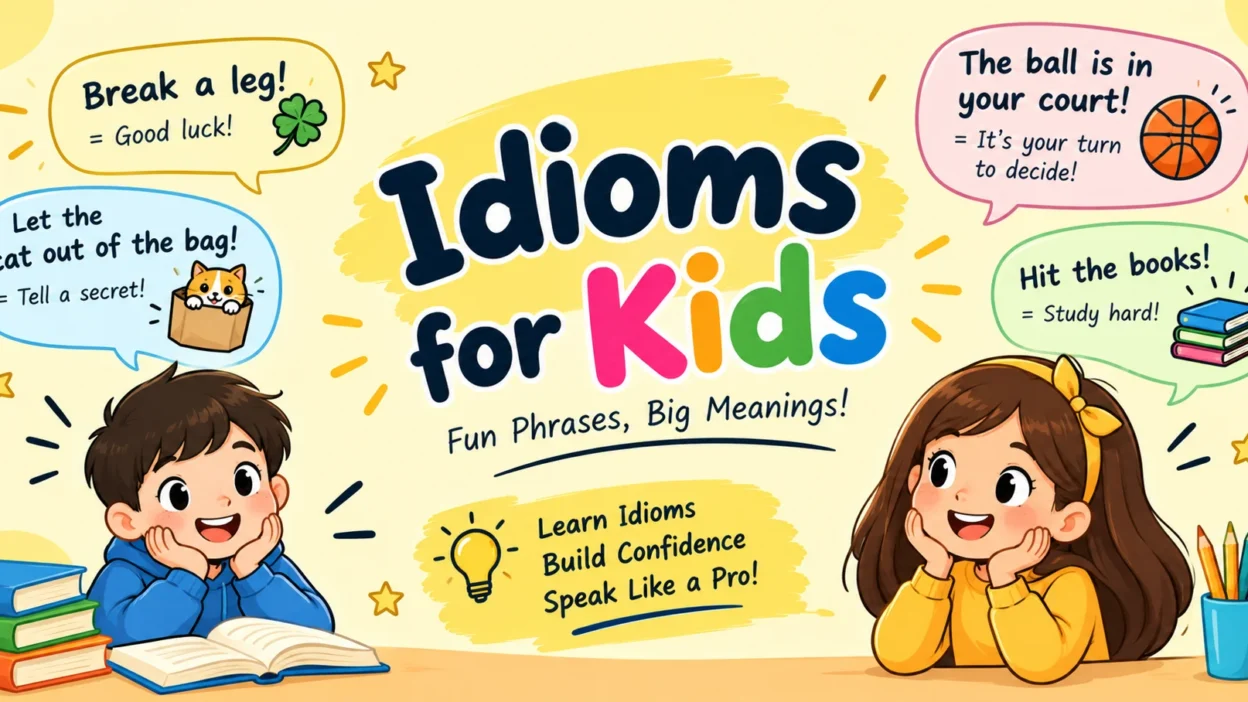
Idioms for kids are everyday phrases that carry a different message than their words suggest, and they make English far more fun to learn. Children hear them at school, in cartoons, and at the dinner table.
Calling something “a piece of cake” describes a very easy task, “under the weather” points to feeling a little sick, and “break a leg” wishes someone good luck. A friend who “spills the beans” has told a secret. This guide lists 44 easy examples sorted by age, with plain meanings, real sentences, tone tags, origin notes, and common mistakes, plus a simple trick for decoding new phrases.
Quick Answer
Idioms for kids are fixed phrases whose real meaning differs from their words, like “hit the hay” for going to bed. Learning them helps children read, listen, and talk more naturally. Start with two or three at a time, match each one to a picture, and check the tone before using it.
What Are Idioms for Kids?
Idioms for kids are short, fixed phrases that describe an idea with a picture instead of plain words. Each one carries two layers. The literal layer is what the words say, and the figurative layer is the message the speaker wants you to catch. In “raining cats and dogs,” the literal picture is pets dropping from clouds, while the real message is heavy rain.

The wording stays locked. “Hit the hay” works, but “hit the straw” does not, even though the picture is close.
Idioms also get mixed up with two cousins, similes and metaphors. This quick sort keeps them apart:
| Type | How to spot it | Example |
|---|---|---|
| Idiom | A fixed phrase you learn as a whole | Hit the books (study) |
| Simile | Compares two things with “like” or “as” | She runs like the wind |
| Metaphor | Says one thing is another | The classroom was a zoo |
A few phrases belong to two groups. “Cool as a cucumber” uses “as” like a simile, yet people repeat it word for word, so it counts as an idiom too.
How Can a Child Work Out an Idiom They Have Never Heard?
A child can decode a new idiom in three moves: say it, picture it, then swap it.
- Say it. Read the whole sentence out loud and notice where the odd phrase sits.
- Picture it. Imagine the words as a real scene. A silly or impossible picture is a clue that the phrase is an idiom.
- Swap it. Replace the phrase with plain words and test whether the sentence still makes sense.
Try it on this line: “Dad said the tickets cost an arm and a leg.” The picture is a strange trade at the ticket booth. Swapping in “cost a lot of money” keeps the sentence sensible, so the phrase must describe a high price. Nearby clues help, too. If the next sentence says Dad frowned at the receipt, the meaning gets even clearer.
Idioms for Kids Ages 4 to 6
Children aged 4 to 6 learn idioms best when the phrase matches a clear picture or a simple action. Each table has a tone tag: Friendly (kind to anyone), Neutral (plain, no extra feeling), Playful (fun with friends), and Careful (can sound bossy or sting).
| Idiom | Meaning | Example sentence | Tone |
|---|---|---|---|
| A piece of cake | Very easy | “Tying my shoes is a piece of cake now.” | Friendly |
| All ears | Listening closely | “Tell me about your trip. I’m all ears!” | Friendly |
| Under the weather | Feeling a little sick | “Dad stayed home from work because he felt under the weather.” | Neutral |
| Hit the hay | Go to bed | “It’s eight o’clock, so it’s time to hit the hay.” | Neutral |
| Busy as a bee | Working hard on many things | “Grandma was busy as a bee before the party.” | Neutral |
| Cool as a cucumber | Calm when others feel nervous | “Our teacher stayed cool as a cucumber during the fire drill.” | Friendly |
| On cloud nine | Extremely happy | “I was on cloud nine when we adopted a puppy.” | Friendly |
| Hold your horses | Wait and slow down | “Hold your horses! The cookies are still baking.” | Careful |
| Raining cats and dogs | Raining very hard | “We played board games because it was raining cats and dogs.” | Neutral |
| Couch potato | Someone who sits around, often watching TV | “My brother turns into a couch potato on rainy Sundays.” | Playful |
Idioms for Ages 7 to 9
Ages 7 to 9 are ready for idioms about feelings, secrets, and social moments.
| Idiom | Meaning | Example sentence | Tone |
|---|---|---|---|
| Spill the beans | Tell a secret | “Who spilled the beans about the surprise party?” | Neutral |
| Let the cat out of the bag | Reveal a secret by accident | “Mia let the cat out of the bag when she thanked Dad for the gift.” | Neutral |
| Break the ice | Help people relax at the start | “A silly game broke the ice on the first day of camp.” | Friendly |
| Once in a blue moon | Very rarely | “We eat at a restaurant only once in a blue moon.” | Neutral |
| Two peas in a pod | Very alike, or very close | “Those twins are two peas in a pod.” | Friendly |
| Butterflies in my stomach | A nervous, fluttery feeling | “I had butterflies in my stomach before the spelling bee.” | Neutral |
| Cold feet | Sudden nerves before something big | “Leo got cold feet at the top of the diving board.” | Neutral |
| Cost an arm and a leg | Very expensive | “That video game console costs an arm and a leg.” | Neutral |
| Fish out of water | Out of place and uncomfortable | “I felt like a fish out of water on my first day at the new school.” | Neutral |
| In the same boat | In the same situation | “We all forgot our lunches, so we’re in the same boat.” | Friendly |
| Out of the blue | Without any warning | “Out of the blue, my cousin called from Canada.” | Neutral |
| Bite the bullet | Do a hard thing you have been avoiding | “I bit the bullet and told my coach the mistake was mine.” | Neutral |
| Break a leg | Good luck, said before a performance | “Break a leg in the school play tonight!” | Friendly |
| Head in the clouds | Daydreaming | “Zoe’s head was in the clouds during the math lesson.” | Careful |
Idioms for Ages 10 to 12
Kids aged 10 to 12 can handle idioms that need a little thinking, such as hidden meanings, planning, and warnings.
| Idiom | Meaning | Example sentence | Tone |
|---|---|---|---|
| Hit the nail on the head | Say or do exactly the right thing | “You hit the nail on the head: we need a bigger table.” | Friendly |
| On the same page | Understanding things the same way | “Let’s get on the same page before we start the project.” | Neutral |
| Back to square one | Starting over | “The tower fell down, so it was back to square one.” | Neutral |
| Cry over spilled milk | Be upset about something that cannot be fixed | “The game is over. There’s no use crying over spilled milk.” | Careful |
| Bite off more than you can chew | Take on too much | “I bit off more than I could chew when I joined three clubs.” | Careful |
| The ball is in your court | It’s your turn to act | “I sent the invitation, so the ball is in your court.” | Neutral |
| Beat around the bush | Avoid the main point | “Stop beating around the bush and tell me what happened.” | Careful |
| Read between the lines | Find a hidden meaning | “She said she was fine, but reading between the lines, she was upset.” | Neutral |
| Get the ball rolling | Start something | “Let’s get the ball rolling on our science fair project.” | Friendly |
| On thin ice | In a risky spot, close to trouble | “After being late three times, Sam was on thin ice with his coach.” | Careful |
| A blessing in disguise | Looks bad but turns out good | “Missing the bus was a blessing in disguise; I made a new friend on the walk.” | Friendly |
| The last straw | The final thing that ends your patience | “Spilling juice on my homework was the last straw.” | Careful |
| A wild goose chase | A search that leads nowhere | “Looking for my lost sock turned into a wild goose chase.” | Neutral |
| A dime a dozen | Very common | “Plain yellow pencils are a dime a dozen.” | Neutral |
Funny Idioms Kids Love
Silly idioms win kids over fast because the literal picture is so funny.
| Idiom | Meaning | Example sentence | Tone |
|---|---|---|---|
| When pigs fly | Never going to happen | “I will love broccoli when pigs fly.” | Playful |
| Pull someone’s leg | Tease or joke | “Relax, I’m only pulling your leg. There’s no test today.” | Playful |
| Ants in your pants | Unable to sit still | “I had ants in my pants before recess.” | Playful |
| Full of beans | Full of energy | “The puppy is full of beans this morning.” | Friendly |
| Use your noodle | Think hard | “Use your noodle and you’ll solve that riddle.” | Playful |
| Mumbo jumbo | Confusing nonsense | “The game rules sounded like mumbo jumbo to me.” | Careful |
Which Idioms Sound Kind, Silly, or Rude?
Most idioms are harmless, yet a few can sound bossy, cold, or rude depending on who speaks and who listens.

The tone tags in the tables flag the risky ones. “Hold your horses” is fine between friends but sounds bossy from a stranger. “Cry over spilled milk” can feel unkind when a child just lost something precious, so a warm “Let’s fix it together” lands better. “Mumbo jumbo” insults someone’s words if it is aimed at them.
Skip idioms that call a person stupid. Some lists include phrases of that sort, and kids repeat them on the playground.
Setting matters too. “Hit the hay” suits a chat with family. In a school report or a note to the principal, “go to bed” or “rest” reads better. For writing, one idiom per paragraph is plenty.
Where Do Idioms Come From?
Most idioms for kids have no proven origin, and the popular stories behind them are often guesses. Three well-known examples show how to talk about this honestly:
- Raining cats and dogs. The phrase has been in English since the 1600s, yet nobody knows who first said it. Tales about Norse myths or flooded streets remain guesses.
- Break a leg. Performers say it instead of “good luck” because they feel wishing luck out loud brings the opposite. Theater people were using it by the early 1900s, but the exact story behind it is unproven.
- Spill the beans. One famous tale says ancient Greeks voted with beans and a tipped jar gave away the result. Nobody has confirmed that story, and the full phrase first shows up in print in the early 1900s.
When you share an origin story with a child, add one honest sentence: “People tell this story, but nobody has proven it.”
Common Mistakes Kids Make With Idioms
With idioms for kids, children most often read an idiom word for word, change one of its words, or pick an idiom that clashes with the mood.
| Mistake | What it sounds like | Easy fix |
|---|---|---|
| Reading it word for word | “Why would Dad pay with an arm and a leg?” | Use say, picture, swap. A silly picture signals an idiom. |
| Changing a word | “Let’s hit the straw.” | Repeat the right phrase once in a natural reply, then keep talking. |
| Blending two idioms | “She let the beans out of the bag.” | Teach “spill the beans” and “let the cat out of the bag” on different days. |
| Wrong mood | “I was on cloud nine when I fell off my bike.” | Link each idiom to a feeling. Cloud nine equals joy. |
| Too many in one piece | Four idioms in one short paragraph | Keep one idiom per paragraph. |
| Idiom where plain words fit | “The volcano test was a piece of cake,” in a science report | Choose plain words for formal writing. |
Idioms in the US and the UK
Most of the idioms for kids in this guide work in both the US and the UK, but a few come from local money, sports, or slang.
| Idiom | Heard mostly in | Meaning | Example |
|---|---|---|---|
| A dime a dozen | US and Canada | Very common | “Plain pencils are a dime a dozen.” |
| Ten a penny | UK | Very common | “Plain pencils are ten a penny.” |
| Bob’s your uncle | UK | “And there you go,” said after simple steps | “Add water, stir, and Bob’s your uncle.” |
| Cost a bomb | UK | Very expensive | “That bike must have cost a bomb.” |
The Oxford Learner’s Dictionary lists “ten a penny” as the British partner of “a dime a dozen.” “Cost an arm and a leg” works in both countries.
How to Teach Idioms to Kids at Home or in Class
Two or three new idioms a week, repeated in real moments, works better than a long list in one sitting. Teaching idioms for kids is easiest when it feels like a game, not a test.
- Tie each idiom to something happening today, such as rain, bedtime, or a surprise.
- Draw the silly literal picture next to the real meaning.
- Use the phrase three times that week in your own talk.
- Check understanding with three questions: What does it mean in plain words? Can you make a new sentence? When would you not use it?
- For multilingual kids, compare the idea with a phrase from the home language instead of translating word for word.
Frequently Asked Questions
The six answers below cover what parents and teachers ask most about idioms for kids.
What are 5 easy idioms for kids?
Five easy idioms for kids are “a piece of cake” (very easy), “all ears” (listening), “under the weather” (sick), “hit the hay” (go to bed), and “busy as a bee” (very busy). Each one paints a clear picture and appears often in stories and everyday talk.
At what age can kids understand idioms?
Children can start enjoying simple idioms around ages 4 to 6 when a picture or action explains the phrase. Trickier ones, such as “read between the lines,” usually click around age 10 or later. Every child moves at a different pace, so follow their questions.
How many idioms should a child learn at once?
Two or three at a time is enough. Repeat them over several days in real situations before adding more. Short, frequent practice beats one long list.
What is the difference between an idiom and a simile?
A simile compares two things with “like” or “as,” while an idiom is a fixed phrase whose meaning must be learned as a whole. “Runs like the wind” is a simile you can reword freely, but “hit the books” must stay exactly as it is. A few phrases, such as “cool as a cucumber,” act as both.
Are idioms hard for kids to learn?
Idioms can feel tricky because the words do not mean what they say. Kids usually pick them up quickly when each idiom comes with a silly picture, a short example, and repeated use in daily talk.
How can I help my child remember idioms?
Use picture cards, act outs, and bedtime stories. Asking your child to explain an idiom in their own words is the fastest way to lock it in.
Final Thoughts
Learning idioms for kids works best when each phrase comes with a picture, a real sentence, and a clear feeling. Start small. A few favorites, like “a piece of cake” for something easy and “break a leg” for good luck, build confidence faster than a long list. Use the three decoding moves, say it, picture it, swap it, whenever a new phrase pops up.
Read More: Idioms for Shocked: 25 Powerful Phrases With Meanings and Examples

Curriculum Developer
Rachel has spent over a decade developing English learning curriculums for schools and online platforms across the United States. Her specialty is structuring content so that even beginner learners can follow along with confidence.


[…] Read More: Idioms for Kids: 44 Easy Examples With Meanings […]