
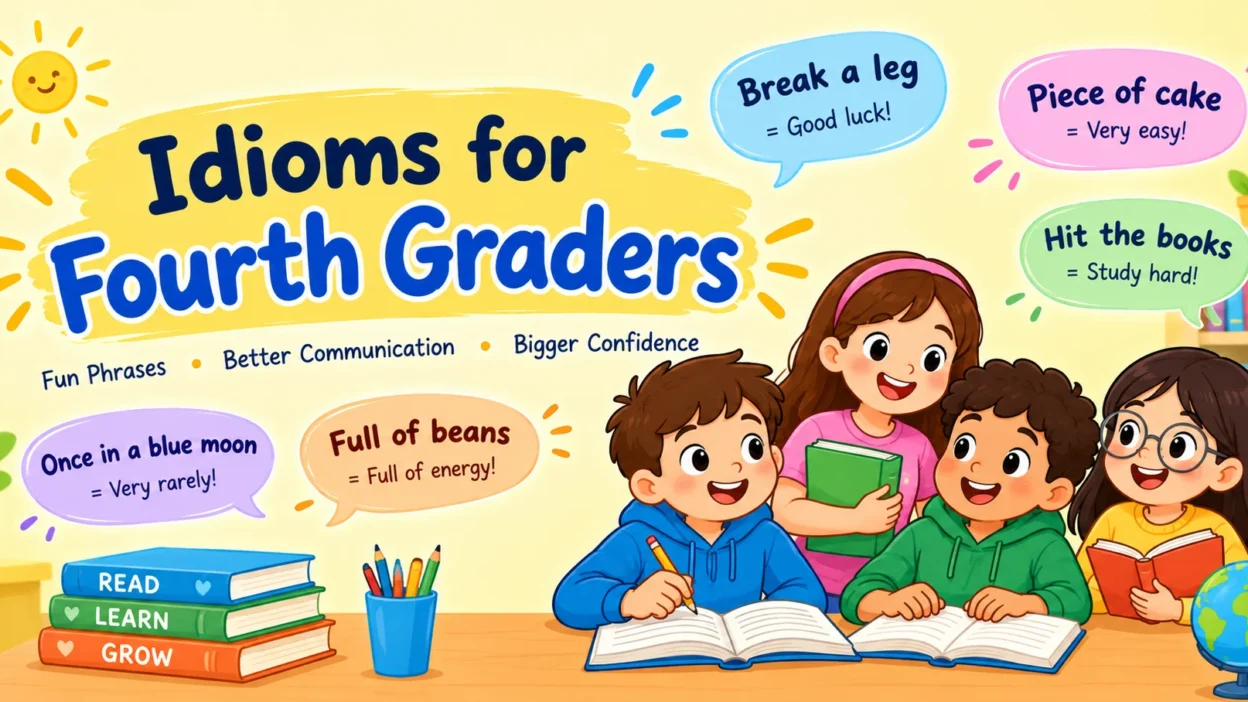
Idioms for fourth graders are short phrases whose real meaning differs from the words on the page. A phrase like “under the weather” has nothing to do with rain; it means feeling a little sick. Learning these figurative expressions helps kids read stories more clearly, write with more color, and understand what friends and teachers really say.
This guide shares 30 common idioms with simple meanings and fresh example sentences, sorted by theme. You will also learn how to spot an idiom, see where one famous phrase came from, avoid common mistakes, and test yourself with a short quiz. It works well for school, homework, and home practice.
Quick Answer
An idiom is a phrase with a hidden figurative meaning that differs from its literal words. Good idioms for fourth graders include piece of cake (very easy), under the weather (a little sick), hit the books (study hard), and raining cats and dogs (raining very hard).
What Is an Idiom?
An idiom is a phrase that means something different from what its words say on their own.
Take “it’s raining cats and dogs.” No animals fall from the sky. The phrase describes very heavy rain. You can’t work out that meaning by looking up each word, so you have to learn it, much like a new vocabulary word.
In the United States, the Common Core standard known as L.4.5.b asks fourth graders to recognize and explain common idioms, adages, and proverbs. This page covers the idioms. The comparison table below helps with the other two.
30 Idioms for Fourth Graders, Sorted by Theme
These 30 idioms cover feelings, school, friends, and everyday life, and each one comes with a plain meaning and a sample sentence.
Feelings and Mood
| Idiom | What It Means | Example |
|---|---|---|
| Over the moon | Extremely happy | Dani was over the moon when her drawing won first place. |
| Down in the dumps | Sad or gloomy | I was down in the dumps when rain canceled our picnic. |
| Butterflies in your stomach | A nervous, fluttery feeling | Nia had butterflies in her stomach before she played her flute solo. |
| Cold feet | Sudden fear about doing something you planned | Mia meant to read her poem aloud, but she got cold feet and sat down. |
| Keep your chin up | Stay hopeful when things are hard | Keep your chin up. You can try out for the team again next year. |
| Under the weather | Feeling a little sick | Ms. Lee sounded hoarse, so she told us she was under the weather. |
| Cool as a cucumber | Very calm | With the whole class watching, Priya stayed cool as a cucumber. |
| On cloud nine | Very joyful | Eli was on cloud nine after riding his bike without help. |
School and Learning
| Idiom | What It Means | Example |
|---|---|---|
| Hit the books | Study hard | I’ll hit the books after dinner so I can do well on Friday’s quiz. |
| Piece of cake | Very easy | Once Dad showed me the trick, long division felt like a piece of cake. |
| Pass with flying colors | Do very well on a test | Zoe passed her swimming test with flying colors. |
| Read between the lines | Notice a hidden meaning the writer never states | The story never says Max is lonely, but you can tell if you read between the lines. |
| Hit the nail on the head | Say or guess something exactly right | Your guess about the story’s ending hit the nail on the head. |
| Head in the clouds | Daydreaming and not paying attention | I forgot my lunch again because my head was in the clouds this morning. |
| Go the extra mile | Do more than expected | My dad went the extra mile at work and finished his report a day early. |
Friends and Family
| Idiom | What It Means | Example |
|---|---|---|
| See eye to eye | Agree | My cousin and I never see eye to eye on which movie to watch. |
| Give someone the cold shoulder | Ignore someone on purpose | After the argument, Tia gave Ben the cold shoulder all through lunch. |
| Through thick and thin | In good times and bad times | Our team stuck together through thick and thin, even after ten losses in a row. |
| Pull someone’s leg | Tease by saying something untrue | My uncle said he once met a dinosaur. He was only pulling my leg. |
| Spill the beans | Give away a secret | Kai spilled the beans and told his sister about her new puppy early. |
| In the same boat | Facing the same problem as others | Everyone forgot their gym shoes, so we were all in the same boat. |
| Apple of someone’s eye | A person who is loved above all | Little Rosa is the apple of her grandfather’s eye. |
Everyday Life
| Idiom | What It Means | Example |
|---|---|---|
| Raining cats and dogs | Raining very hard | We watched cartoons inside because it was raining cats and dogs. |
| Once in a blue moon | Very rarely | My big brother calls from college only once in a blue moon. |
| Cost an arm and a leg | Be very expensive | Front-row concert tickets can cost an arm and a leg. |
| Time flies | Time seems to pass quickly | It’s already five o’clock? Time flies when we’re building the fort. |
| Hold your horses | Wait and slow down | Hold your horses, Leo. We need to read the rules before the game starts. |
| Break the ice | Make people feel comfortable at the start | Ms. Park played a name game to break the ice on the first day. |
| On the fence | Unable to decide | Dad is on the fence about getting a cat or a hamster. |
| Cry over spilled milk | Be upset about a mistake that can’t be fixed | The cake fell, but there’s no use crying over spilled milk. Let’s bake another. |
How Do You Spot an Idiom in a Sentence?
You can spot an idiom when the words make no sense if you read them literally.
Try these three steps:
- Read for oddness. Ask yourself whether the sentence could really happen. A person can’t literally “hit the books” with a fist and learn from it.
- Check the clues nearby. The sentences around an idiom usually hint at its meaning.
- Swap in a plain meaning. Replace the phrase with your guess. If the sentence still makes sense, you’ve probably got it.
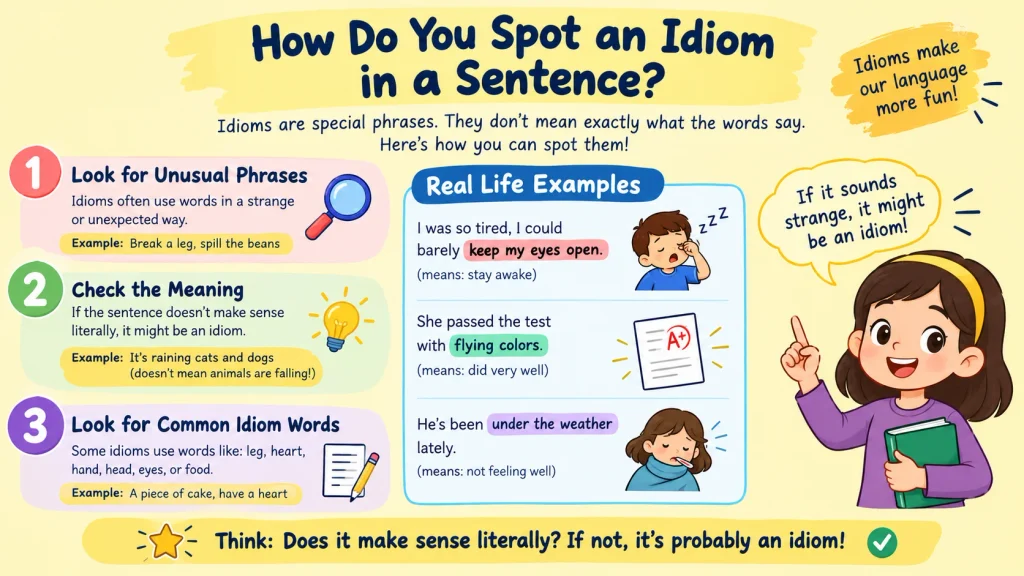
Here’s a quick test: Mia had butterflies in her stomach. She kept tapping her foot and checking the clock. Tapping and clock-watching are context clues. They point to nervousness, not real insects.
Idioms vs. Similes, Metaphors, and Proverbs
An idiom is a fixed phrase with a hidden meaning, while a simile compares using “like” or “as,” a metaphor says one thing is another, and a proverb gives advice.
| Type | What It Does | Example |
|---|---|---|
| Idiom | Uses a fixed phrase with a hidden meaning | “Under the weather” |
| Simile | Compares two things with like or as | “As brave as a lion” |
| Metaphor | Says one thing is another | “Time is a thief.” |
| Proverb | Gives a lesson or advice | “Practice makes perfect.” |
Some phrases blur the lines. “Cool as a cucumber” is a simile in shape and an idiom in how people use it.
Where Do Idioms Come From?
Most idioms have no proven origin, and the popular stories about them are often guesses.
“Raining cats and dogs” shows how tricky this is. It appeared in print in the 1600s. Writer Jonathan Swift used it in a 1738 book of pretend conversations, which helped it spread.
Nobody has confirmed where it began, though. Guesses include Norse storm myths, an old Greek phrase (“cata doxa,” meaning “against belief”), and an old word for waterfall. These are often repeated, but none is confirmed.
One popular tale is almost certainly wrong. It says pets slept on thatched roofs and slid off in storms. Thatch sheds water by design, so the story doesn’t hold up.
When you read an idiom’s “origin story” online, look for a named book or a date. A story with neither is probably folklore.
Common Mistakes Fourth Graders Make With Idioms
The most common mistakes are reading idioms word for word, changing the wording, and mixing two idioms together.
- Reading it literally. A student who sees “butterflies in my stomach” and pictures real butterflies has missed the point. Ask, “What feeling or action does the whole phrase describe?”
- Changing the words. Idioms are fixed. Say “give someone the cold shoulder,” not “give a cold shoulder.” Say “put your foot in your mouth,” not “foot in your mouth.” Say “hit the nail on the head,” not “hit the nail in the head.”
- Mixing two idioms. “Spill the beans” and “let the cat out of the bag” both mean giving away a secret. A blended phrase like “spill the cat out of the bag” is wrong. Pick one.
- Stuffing too many into one piece of writing. One idiom in a paragraph adds color. Five in a row make it hard to read.
- Translating word for word. Idioms rarely carry over directly into another language. A phrase that’s common in a student’s home language may sound strange in English, and the other way around.

Tone and Formality: Which Idioms Fit Where?
Idioms usually sound casual, so match each one to the person you’re talking or writing to.
| Idiom | Tone | Where It Fits |
|---|---|---|
| Over the moon | Positive | Chat with friends, personal stories |
| Under the weather | Neutral, polite | Telling a teacher you’re sick |
| Pull someone’s leg | Playful | Joking with family |
| Give someone the cold shoulder | Negative | Stories about arguments |
| Cost an arm and a leg | Casual | Everyday talk about prices |
| Go the extra mile | Positive | Praising someone’s effort |
In a story or a spoken report, idioms help. In a formal science or social studies report, plain words usually work better.
Easy Ways to Learn Idioms at Home and in Class
Fourth graders learn idioms fastest when they connect each phrase to a picture, a story, or an action.
- Draw both meanings. On one page, sketch the silly literal picture. On the other, show the real meaning.
- Start an idiom of the day. Learn one phrase each morning and use it in a sentence by bedtime.
- Play charades. Act out an idiom and let others guess it.
- Hunt in books. Keep a notebook of idioms found in stories, along with the sentence around each one.
- Use context clues. When you find an unfamiliar phrase, read the lines before and after it before you reach for a dictionary.
Practice Quiz
This six question quiz checks whether you can match each idiom to its real meaning.
- Your friend says the test was a piece of cake. Was it hard or easy?
- What does “once in a blue moon” tell you about how often something happens?
- If someone is “on the fence,” have they made up their mind?
- Your teacher says, “Hold your horses.” What should you do?
- Which feeling goes with “butterflies in your stomach”: nervous or sleepy?
- Which phrase means you’re facing the same problem as others: “in the same boat” or “cold feet”?
Answers: 1. Easy. 2. Very rarely. 3. No. 4. Wait and slow down. 5. Nervous. 6. In the same boat.
Frequently Asked Questions
What are some good idioms for 4th graders?
Good idioms for 4th graders include “piece of cake,” “hit the books,” “raining cats and dogs,” “under the weather,” and “over the moon.” They’re easy to picture and show up often in school books and everyday talk. The tables above sort 30 of them by theme.
What is the difference between an idiom and a literal sentence?
A literal sentence means exactly what its words say, while an idiom carries a hidden meaning. “He is studying” is literal. “He is hitting the books” is an idiom for the same thing. If a phrase sounds strange when read word for word, it’s probably an idiom.
How do you teach idioms to 4th graders?
You teach idioms by pairing each phrase with a picture, a sentence, and a plain-language meaning. Drawing the literal and real meanings, playing charades, and keeping an idiom-of-the-day notebook all work well. Practice with context clues helps students work out unfamiliar phrases on their own.
What Common Core standard covers idioms in fourth grade?
Common Core standard L.4.5.b covers idioms in fourth grade. It asks students to recognize and explain the meaning of common idioms, adages, and proverbs. Many worksheets and quizzes carry this code, which makes it easy to find matching practice.
Final Thoughts on Idioms for Fourth Graders
Fourth graders learn idioms best when they link each phrase to a picture, a sentence, and a real moment from their day. Start small. Pick three idioms from the tables, use each one aloud this week, and write one in a story. Check the plain meaning whenever a phrase sounds odd, and keep the wording exactly as written.
Over time, these colorful phrases turn confusing sentences into easy ones and make writing more fun to read. Keep this page handy for homework, classroom practice, or a quick review before a reading test, and come back to the quiz whenever you want a fresh challenge.
More Read: Idioms for Shocked: 25 Powerful Phrases With Meanings and Examples

Curriculum Developer
Rachel has spent over a decade developing English learning curriculums for schools and online platforms across the United States. Her specialty is structuring content so that even beginner learners can follow along with confidence.



[…] More Read: Idioms for Fourth Graders: Stop Struggling with 30 Powerful Meanings & Fun Examples […]
[…] Read More: Idioms for Fourth Graders: Stop Struggling with 30 Powerful Meanings & Fun Examples […]