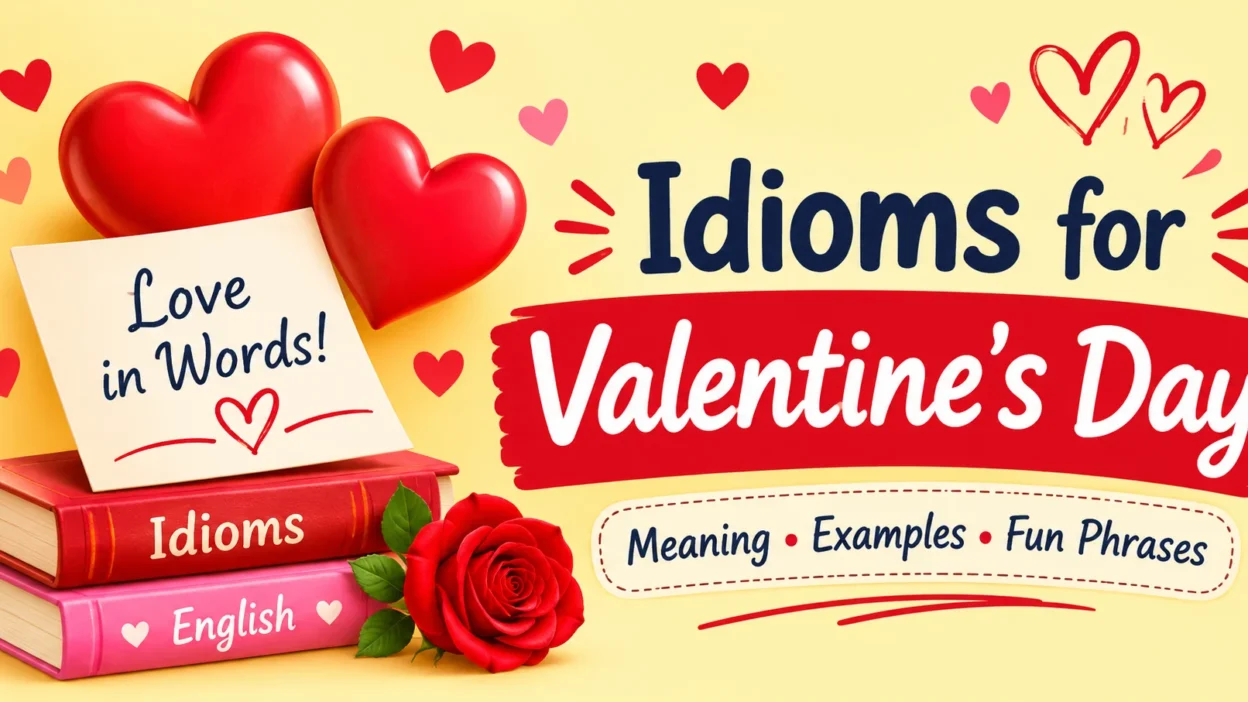
Idioms for Valentine’s Day are fixed English phrases that describe love and romance in colorful, non-literal ways. Say someone is “head over heels,” and you mean they are deeply in love, not upside down. The right phrase can make a card, text, or toast feel warm and personal. The wrong one can sound cold, teasing, or childish. This guide explains 15 love idioms with plain meanings, real example sentences, and honest origin notes.
You will also learn which phrases are safe for a Valentine’s card, which ones to skip, and which popular origin stories are myths. Pick the phrase that sounds like you.
QUICK ANSWER
What are the best idioms for Valentine’s Day? An idiom is a set phrase whose meaning differs from its words. The five most useful for February 14 are:
- Head over heels: completely in love
- Love at first sight: falling in love the moment you meet
- A match made in heaven: a perfect pair
- The apple of my eye: the person you treasure most
- Wear your heart on your sleeve: show your feelings openly
Writing a card or text? Pick warm phrases like these. Skip love is blind, puppy love, and carry a torch for someone, because they sound teasing, childish, or sad.
What Are Idioms for Valentine’s Day?
Idioms for Valentine’s Day are everyday English phrases about love, dating, and marriage, and people use them all year, not only on February 14.
You can’t work out an idiom from its words alone. “Tie the knot” has no rope in it. It describes getting married.
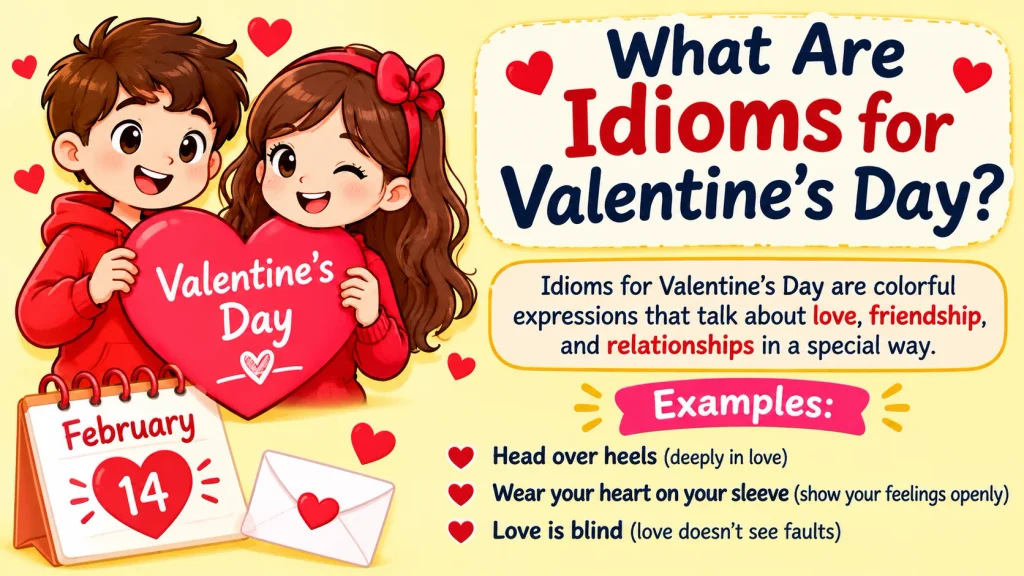
An idiom also differs from a plain expression. “Happy Valentine’s Day” is a greeting that says exactly what it means. “Love is in the air” is an idiom, because nobody can see love floating around.
Why does February 14 point to romance at all? The earliest known link comes from Geoffrey Chaucer’s poem Parlement of Foules, written in the early 1380s. In it, birds gather on St. Valentine’s Day to pick their mates. One Penn State scholar adds a twist: the poem may not describe mid-February at all, so the date match could be partly luck.
Valentine’s Day Idioms at a Glance
Here are the 15 idioms in this guide, each with a one-line meaning and the feeling it carries.
| Idiom | Meaning | Tone |
|---|---|---|
| Love at first sight | Falling in love the moment you meet | Warm |
| Head over heels | Completely in love | Warm |
| Have a crush on | Feel secret romantic interest in | Playful |
| Hit it off | Like each other right away | Casual |
| Sweep someone off their feet | Win someone with charm | Warm |
| Wear your heart on your sleeve | Show your feelings openly | Neutral |
| The apple of my eye | The person you treasure most | Tender |
| A match made in heaven | A perfect pair | Warm |
| Pop the question | Ask someone to marry you | Playful |
| Tie the knot | Get married | Casual |
| Love is blind | Love hides a person’s faults | Teasing |
| Puppy love | Young, light romantic feelings | Dismissive |
| Carry a torch for someone | Keep loving someone who doesn’t love you back | Sad |
| An old flame | A person you once loved | Mixed |
| Kiss and make up | Forgive each other after a fight | Light |
Idioms About Falling in Love
These five idioms cover the first spark, from a single glance to a full tumble.
Love at First Sight
Meaning: Falling in love the moment you meet someone.
Example: “She swears it was love at first sight when he walked into her uncle’s shop.”
Origin (documented): The earliest use that can be confirmed is in Christopher Marlowe’s poem Hero and Leander, printed in 1598. Shakespeare echoed a line from it in As You Like It. You may see the phrase labeled ancient Greek. The tale in Marlowe’s poem is Greek myth, but no earlier English use turned up.
Head Over Heels
Meaning: Completely and deeply in love.
Example: “I’m head over heels for you. Happy Valentine’s Day!”
Origin (documented): In the 1300s the phrase ran the other way. “Heels over head” described a flip or somersault. The flipped version showed up in the 1700s, and over time it became the go-to phrase for falling in love. The first known printed “head over heels,” from 1771, describes a kick that sent a man flying, not a romance.
Have a Crush on Someone
Meaning: To feel romantic interest in someone, often in secret.
Example: “Leo has had a crush on his lab partner since September.”
Usage note: Say crush on, never crush to. A crush is usually private and often one-sided.
Hit It Off
Meaning: To like each other straight away.
Example: “The two new hires hit it off at the team lunch.”
Usage note: This idiom does not always mean romance. Friends and coworkers can hit it off too. The past tense stays “hit,” and the word “it” must stay in.
Sweep Someone Off Their Feet
Meaning: To win someone’s heart fast with charm, attention, or big gestures.
Example: “The charming new neighbor swept her off her feet in just three weeks.”
Usage note: The person who is charmed is the one “swept.” You can also say “she was swept off her feet.”
Idioms for Showing Your Feelings
These three idioms describe open feelings and the people we treasure.
Wear Your Heart on Your Sleeve
Meaning: To show your feelings openly.
Example: “I wear my heart on my sleeve, so my cards are always mushy.”
Origin (disputed): It is often traced to knights who wore a lady’s token on their arm, though that isn’t confirmed. The figurative phrase is documented by at least 1604, when Shakespeare used it in Othello.
The Apple of My Eye
Meaning: The person you cherish above all others.
Example: “Her little granddaughter is the apple of her eye.”
Origin (documented): This one is very old. In Old English, “apple” could mean the pupil of the eye. The earliest known use is in an Old English translation linked to King Alfred, from the 800s. The King James Bible of 1611 uses it in Deuteronomy 32:10, and Sir Walter Scott used it in 1816. Today it sounds warm and a little old-fashioned.
A Match Made in Heaven
Meaning: Two people, or two things, that fit together perfectly.
Example: “My sister and her husband both wake up at 5 a.m. to bake bread. It’s a match made in heaven.”
Usage note: It also works for non-romantic pairs, like hot chocolate and a rainy afternoon. No reliable origin source turned up, so treat any neat origin story with care.
Idioms About Marriage and Commitment
Two idioms mark the big steps: asking the question and getting married.
Pop the Question
Meaning: To ask someone to marry you.
Example: “On their fifth anniversary, Sam popped the question over breakfast.”
Origin (documented): It dates to the 1700s. At first it could mean any big, sudden question. Over time it narrowed to marriage proposals, and one reference puts that shift in the mid-1800s. Here “pop” suggests something sudden. The tone is informal and playful.
Tie the Knot
Meaning: To get married.
Example: “Two people from our office tied the knot last weekend, and we all signed the card.”
Origin (disputed): The word “knot” has meant the bond of marriage since about 1225. The full phrase was recorded in 1717 by the poet Matthew Prior. Whether it began with real knots in wedding rituals or with a symbol is unclear. The popular Celtic handfasting story is unproven.
Usage note: Tie the knot is the wedding. Pop the question is the proposal. Don’t mix them up.
Idioms for Complicated Love
These five idioms cover love that is blind, young, one-sided, finished, or mended.
Love Is Blind
Meaning: When you love someone, you don’t see their faults.
Example: “Everyone else can see his jokes aren’t funny, but she laughs every time. Love is blind.”
Origin (documented, date shaky): It first appears in English in Chaucer’s Merchant’s Tale, around 1400. Sources give dates from 1401 to 1405, and Chaucer died in 1400, so treat the exact year with care. Shakespeare used the phrase in The Merchant of Venice in the 1590s. The idea is older still, since Plato wrote that a lover is blind about the person he loves.
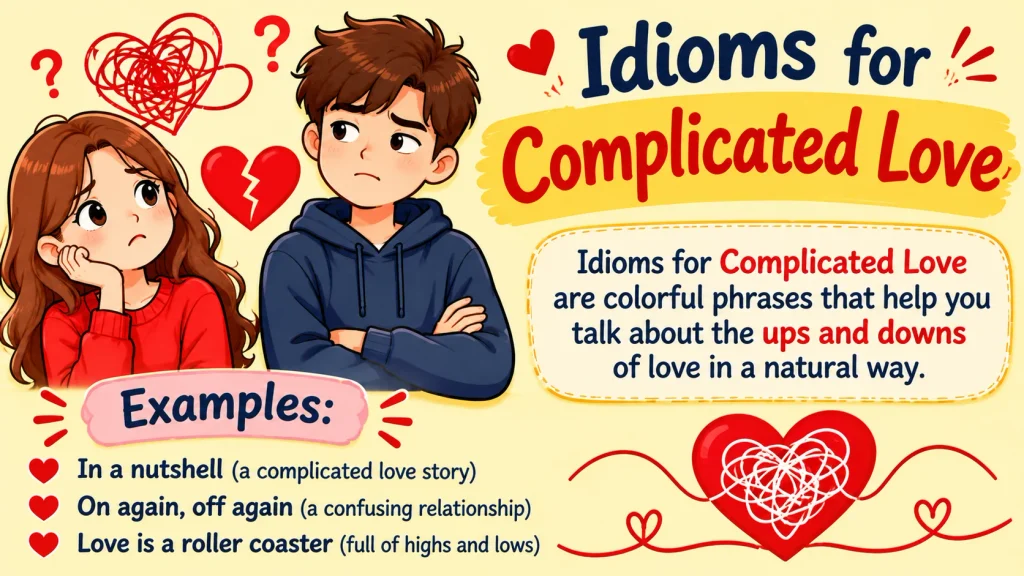
Tone: Teasing or critical. Keep it out of a card.
Puppy Love
Meaning: Young, light romantic feelings that adults don’t take seriously.
Example: “Mom called my first crush puppy love, and I was furious.”
Tone: Dismissive. Skip it when you talk about your own partner.
Carry a Torch for Someone
Meaning: To keep loving someone who doesn’t love you back, or a past partner.
Example: “Ten years later, he still carries a torch for his first girlfriend.”
Origin (unclear): It looks like 1920s American slang, and the sad love song called a “torch song” took its name from it. Guesses about Greek or Roman wedding torches have no proof behind them.
Tone: Sad. It belongs in a story, not in a Valentine.
An Old Flame
Meaning: A person you once loved or dated.
Example: “My cousin’s old flame showed up at the wedding, and the whole table went quiet.”
Usage note: The feeling depends on context, from fond to awkward. Never use it for a current partner.
Kiss and Make Up
Meaning: To forgive each other and be friendly again after a fight.
Example: “After a silent car ride home, the twins kissed and made up before dinner.”
Usage note: No actual kiss is needed. It works for friends and siblings too.
Which Idioms Fit a Card, a Text, or a Toast?
For a Valentine’s card, pick warm idioms like head over heels, the apple of my eye, or a match made in heaven, and skip the teasing or sad ones.
| Where you will use it | Safe picks | Skip |
|---|---|---|
| Valentine’s card to a partner | head over heels, a match made in heaven, love at first sight, sweep someone off their feet | love is blind, puppy love, an old flame, carry a torch |
| Text or chat | head over heels, have a crush on, hit it off, wear your heart on your sleeve | pop the question (unless you truly mean it) |
| Wedding toast | a match made in heaven, the apple of my eye, tie the knot | an old flame, puppy love, kiss and make up |
| Formal writing (essays, reports, cover letters) | plain words: get married, propose, deep affection | tie the knot, pop the question, hit it off |
US and UK Notes
Every idiom in this guide is understood in both the US and the UK, so you don’t need separate lists. One small difference: a reference column on head over heels notes that British speakers also say “head over ears,” which grew out of an older phrase, “over head and ears.”
Fact Check: Love Idiom Origin Stories
Only some famous love-idiom origin stories hold up, and others are folklore that gets repeated without proof.
| Story you may have read | Verdict | What the record shows |
|---|---|---|
| Heart on your sleeve comes from knights wearing a lady’s token | Unconfirmed | Often traced to a jousting custom. The earliest figurative use found is in Othello, about 1604. |
| Tie the knot comes from Celtic handfasting | Unproven | Knots appear in wedding customs across many cultures. The phrase is recorded in 1717. |
| Head over heels was invented in the 1800s | Not supported | The older “heels over head” dates to the 1300s. “Head over heels” was in print by 1771. |
| Love at first sight is ancient Greek | Unproven | The earliest confirmed English use is Marlowe, 1598. |
| Love is blind appears in Chaucer in 1405 | Date shaky | Chaucer’s Merchant’s Tale, around 1400. Sources vary from 1401 to 1405. |
| Pop the question always meant a proposal | Not supported | In the 1700s it could mean any important question. |
| Valentine’s Day became romantic in the Canterbury Tales | Mixed up | The earliest known link is Chaucer’s Parlement of Foules. |
Common Mistakes With Love Idioms
Most mistakes with love idioms come from swapping a small word, mixing up two idioms, or picking the wrong tone.
| Mistake | Better | Why |
|---|---|---|
| It was love on first sight. | It was love at first sight. | The small word is fixed. |
| She has a crush to him. | She has a crush on him. | Crush takes “on.” |
| He fell heels over head for her. | He fell head over heels for her. | Today’s phrase puts “head” first. |
| He still carries a torch of her. | He still carries a torch for her. | “For” links the torch to the person. |
| You are the apple of my eyes. | You are the apple of my eye. | The phrase is singular. |
| He wore his heart in his sleeve. | He wore his heart on his sleeve. | The heart sits on the sleeve, not in it. |
| They tied the knot when he gave her the ring. | He popped the question when he gave her the ring. | Tie the knot is the wedding, not the proposal. |
| You are my puppy love. (as a compliment) | I’m head over heels for you. | Puppy love sounds childish. |
Frequently Asked Questions
These four answers cover common questions about Valentine’s Day idioms.
What are some idioms about falling in love?
Common idioms about falling in love include head over heels, love at first sight, have a crush on, hit it off, and sweep someone off their feet. Each one covers a different stage, from a first glance to a deep attachment.
Can you use idioms for Valentine’s Day in a text or card?
Yes, warm idioms like head over heels or a match made in heaven fit a text or card well. Skip teasing or sad ones such as love is blind, puppy love, and carry a torch, because they can sound like a joke at the other person’s expense.
Why do we say “head over heels” when our heads are always over our heels?
The phrase began as “heels over head,” which described a flip, and the words swapped places in the 1700s, so the modern version makes no literal sense. It still works because it paints a picture of being dizzy and turned upside down by love.
What is the difference between an idiom and an expression?
An idiom is a phrase whose meaning differs from its words, while an expression is any common phrase, including plain ones like “Happy Valentine’s Day.” Every idiom is an expression, but most expressions are not idioms.
Bottom Line
The best idioms for Valentine’s Day are the warm, clear ones: head over heels, a match made in heaven, the apple of my eye, and love at first sight. Keep teasing phrases like love is blind and sad ones like carry a torch for stories, not cards. Remember that usage matters more than origin, because tales about Celtic knots and knightly tokens are unproven folklore. Get the small words right (at first sight, on a crush), match the tone to the setting, and choose two or three phrases that sound like you. That is how a few simple words become a message the other person remembers.
Read More: Idioms for Anger: 6 Costly Mistakes to Avoid

Curriculum Developer
Rachel has spent over a decade developing English learning curriculums for schools and online platforms across the United States. Her specialty is structuring content so that even beginner learners can follow along with confidence.