
The FR meaning in text is simple: FR stands for “for real.” People use it to agree (“I feel the same”), to show sincerity (“I mean this”), or to add emphasis (“this is true, and I’m not exaggerating”). Add a question mark and “FR?” means “Really?”, a request to confirm that something is true. Double it and “FRFR” means “for real, for real,” which adds stronger emphasis.
The exact job depends on the message around it, not on the two letters alone. This guide covers FR on Snapchat, Instagram, and TikTok, the difference between FR and FRFR, “be so FR,” and how to reply.
Quick Answer
FR Meaning in text = “for real.” Use it to agree (“fr, same”), to stress that you mean it (“I’m proud of you, fr”), or to ask for confirmation (“FR?”). FRFR is the stronger version. It suits casual chats, not work or formal messages.
| Expression | Meaning | Typical use |
|---|---|---|
| FR / fr | For real | Agreement, sincerity, or emphasis |
| FR? | For real? / Really? | Surprise, or checking whether something is true |
| FRFR / fr fr | For real, for real | Stronger emphasis or firm agreement |
| FR tho | For real though | Reinforcing a point you just made |
| Be so FR | Be for real | Asking someone to be serious or honest |
What Does FR Meaning in Text?
FR is shorthand for “for real,” an ordinary English phrase. Merriam-Webster’s entry for “for real” labels it informal and lists three related senses: genuine, genuinely good or capable of success, and in earnest (seriously). The dictionary gives 1950 as the first known use of the phrase in the sense of “genuine.”
Text-speak FR borrows all three senses, which is why one abbreviation can feel like agreement in one message and like a sincerity check in another.
In practice, people use it in five ways:
- Agreement. Someone says the movie dragged on, and you reply “fr.” You mean “exactly.”
- Sincerity. “I’m proud of you, fr.” The sender wants you to know the compliment is not just politeness.
- Emphasis. “I’m so tired today, fr.” The abbreviation adds weight to a statement.
- Surprise or disbelief. “FR?” asks whether the news is real.
- Relatability. Under a video about hitting snooze five times, “this is me fr” means “I do this too.”
These uses overlap, and one message can do two at once. “Fr, that’s the best idea you’ve had” is agreement and praise together.
Not every use carries exactly the same emotion, so treat the list above as a set of tendencies rather than separate dictionary entries.
Where Does FR Come From?
The abbreviation has a documented history online, though not a tidy one. Know Your Meme says “for real” appeared in tweets as early as 2008, while “fr fr” was not used until December 2010, when several Twitter users began writing it. It adds that the phrase became more notable in the early 2020s.

Know Your Meme’s explainer says the abbreviation “FR” was first added to Urban Dictionary in 2003. It ties the phrase to hip hop diction and to Zoomer slang.
The same sources say “for real” is said to come from the Yiddish “for true?” in the 1940s, citing The Dictionary of American Slang. Beyond that, the exact path is hard to document, so treat any precise origin story with caution.
How FR Is Used in Texting
FR appears in three positions, and position affects how it lands. Punctuation and tone add a second layer of meaning on top.
Where FR Appears in a Message
At the start of a message, it usually reacts to what came before: “FR, I thought the same thing.” At the end, it stamps the statement with sincerity: “I need a day off, fr.”
On its own, as a one-word reply, it generally means “I agree” or “same.”
How Punctuation Changes the Signal
“FR?” is a question. “FR!” tends to carry excitement or strong agreement. A flat lowercase “fr” often reads as casual and low-key, while all caps can sound louder.
That is a tendency of tone rather than a rule, because some people type everything in lowercase no matter how they feel.
Related Phrases: “No Cap Fr” and “Fr Tho”
You may also see “no cap fr,” which stacks two sincerity markers, and “fr tho,” short for “for real though.” The second one reinforces a point or adds a reluctant admission: “That quiz was brutal, fr tho.”
Does It Matter Who Sends FR?
Does it matter whether the sender is a guy or a girl? Not for the meaning. FR says the same thing from anyone. What changes the interpretation is the relationship and the conversation.
A short “fr” in reply to your long message usually just means they agree. It is not automatically cold, flirty, or dismissive, so read the surrounding messages before assuming more.
FR Meaning on Snapchat, Instagram, and TikTok
The core meaning does not change from app to app, and no platform has its own official definition. What changes is the situation around the word.
On TikTok and Instagram, FR often appears in public comments, where it works as a quick reaction: agreeing with a creator, calling a video relatable, or praising a post.
On Snapchat, Instagram DMs, and WhatsApp, it more often shows up in short private replies that mirror spoken conversation. A “fr” in answer to a friend’s complaint is the text version of a nod. In a group chat, a lone “fr” can act as a quick vote of agreement with the last message.
Reading FR correctly on any app comes down to the same question: is this person agreeing, stressing something, or asking something? The platform supplies context. It does not change the definition.
FR vs. FRFR
FRFR, also written “fr fr,” is “for real, for real.” Doubling the phrase raises the emphasis, much as saying “seriously, seriously” does out loud.
The practical difference is intensity. A plain “fr” is flexible and often works as casual punctuation. “FRFR” usually signals stronger conviction or full agreement: “I’m never eating there again, fr fr.”
Repetition can also be a joke, though. Know Your Meme notes the ironic use of “fr fr” in the Zoomerification meme trend, so the doubled version is not always solemn. As with single FR, the tone comes from the sentence around it.
What Does “Be So FR” Mean?
“Be so FR” is related to FR but works differently. Instead of adding emphasis to a statement, it is an instruction: be for real. The sender is asking you to be honest, stop joking, or drop an excuse.
You may also see “rn” attached (“be so fr rn”), meaning right now, which sharpens the demand.
Its tone swings widely. Between friends it is usually teasing: “Be so FR, you ate the whole pizza.” In a tense argument, the same words can sound impatient or accusatory.
It is close in spirit to “get real” or “come on, be serious,” and it can express disbelief at something outrageous without expecting any answer. Because it is newer and less documented than plain FR, there is no settled dictionary definition, so rely on the conversation and ask if you are unsure.
Examples of FR in Conversations
The conversations below are invented illustrations, not real messages.
Agreeing with a friend
“That group project could have been an email.” “fr, I lost an hour of my life.”
Here “fr” means “exactly, I agree.”
Emphasizing a genuine feeling
“Thanks for helping me move. I couldn’t have done it alone, fr.”
The ending marks the thanks as sincere rather than polite filler.
Reacting to surprising news
“They’re bringing the show back for another season.” “FR?? When?”
The double question mark signals surprise, and the follow-up shows the sender wants confirmation.
A TikTok comment
On a video of someone failing to get out of bed after five alarms: “this is me every single morning fr.” The commenter is calling the video relatable.
An Instagram comment
On a friend’s hiking photos: “These are unreal fr.” The sender is stressing that the compliment is sincere.
A Snapchat message
A photo of a rainy window, captioned “Monday.” The reply: “brutal fr.” It is short, casual agreement.
FRFR in a serious moment
“I’m sorry I missed your recital. It won’t happen again, fr fr.”
Doubling the phrase underlines a promise. The seriousness comes from the apology, and the letters simply reinforce it.
Sarcastic or doubtful
“I’m five minutes away.” “Sure you are. Fr.”
This reads as doubt only because of “Sure you are” and the shared history of lateness. The same “Fr.” after an honest update would read as agreement.
“Be so FR” as a playful challenge
“I only had one cookie.” “Be so fr, the jar is empty.”
The speaker is teasing and asking for honesty.
How to Reply to FR
The best reply depends on what the sender meant.
- They are agreeing. Match the energy: “Exactly.” “I know, right?” “Yeah, seriously.” Often no reply is needed.
- They are stressing a feeling. Respond to the feeling, not the slang: “Yeah, that sounds exhausting.”
- They wrote “FR?” Answer the question: “Yes, for real,” or add a detail that backs it up.
- You cannot tell whether they agree or doubt you. Ask one short question: “Do you mean you agree, or you’re not sure it’s true?” A quick question beats a wrong guess.
If you want to echo the slang, “FR, I agree” works in casual chats. Keep it natural rather than copying the sender every time.
Common Mistakes When Interpreting FR
- Treating every FR as agreement. In “I’m so tired, fr,” there is nothing to agree with. It is emphasis.
- Reading “FR?” as a statement. The question mark changes the job from emphasis to confirmation.
- Assuming FRFR is always more serious. It is usually stronger, but it can also be exaggerated on purpose.
- Expecting each app to have its own definition. The meaning stays the same. Only the setting differs.
- Missing a non-slang meaning. In formal or religious writing, “Fr.” before a name usually abbreviates Father.
- Ignoring the thread. Tone lives in the previous few messages, not in the abbreviation.
When to Use FR and When to Avoid It
FR suits friends, casual DMs, comments, and group chats, where an informal voice is expected and nobody needs the full phrase spelled out.
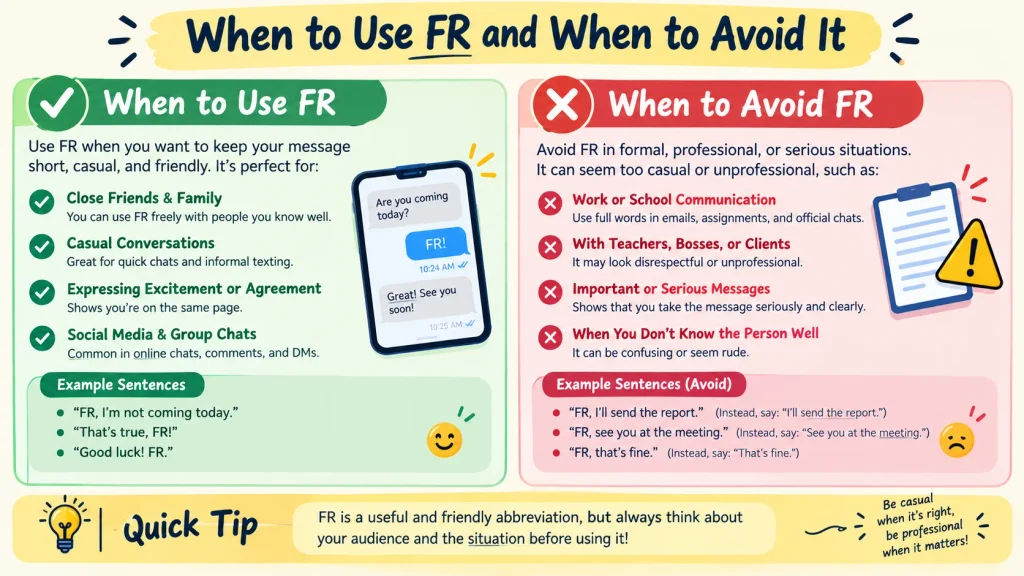
Avoid it in work emails, job applications, customer-service replies, and school communication. Avoid it in serious or emotional conversations too, where “for real,” “honestly,” or “I mean that” is clearer and warmer.
If you are unsure the other person knows the slang, spell it out. And do not attach it to every sentence: overuse weakens the sincerity it is supposed to signal.
Frequently Asked Questions
What does FR mean in text?
It means “for real.” People use it to agree, show they mean something, add emphasis, or ask whether something is true. The exact tone depends on punctuation and the conversation around it.
Does FR mean something different depending on who sends it?
No. The meaning is the same whether it comes from a guy, a girl, or anyone else. Interpret it through the relationship and the conversation: a short “fr” usually signals agreement, not coldness or romantic interest.
What does FR mean on Snapchat, Instagram, and TikTok?
The same thing: “for real.” On TikTok and Instagram it often appears in public comments as a reaction. On Snapchat and in DMs it works as a quick private reply. The app changes the setting, not the definition.
What does “FR?” mean in a message?
The question mark turns it into “for real?” The sender is expressing surprise or asking you to confirm something. A direct answer, such as “yes, for real” or a supporting detail, is the natural reply.
Can FR mean something other than “for real”?
Rarely. In formal or religious writing, “Fr.” can abbreviate Father. Check the surrounding text. In casual chat, “for real” is by far the most likely reading.
Is FR formal or informal?
It is informal. It fits casual chats with friends. In professional or serious writing, use “for real,” “genuinely,” or “I mean it” instead.
Conclusion
FR means “for real,” and the job it does, whether agreeing, stressing a point, or asking a question, depends on context. Punctuation, position, and the previous message tell you more than the letters themselves. FRFR raises the volume, “be so FR” asks for honesty, and “FR?” asks for confirmation. Nothing about the abbreviation changes from one app to the next.
Keep it for casual chats and spell out “for real” in serious messages. When you cannot tell what someone meant, a short question is the safest reply. Now you can read the FR meaning in text and answer it with confidence.
More Read: DM Meaning in Text: Avoid Awkward Mistakes & Reply Smartly in 2026


[…] Read More: FR Meaning in Text: Stop Guessing and Get It Right in 2026 […]
[…] Read More: FR Meaning in Text: Stop Guessing and Get It Right in 2026 […]