
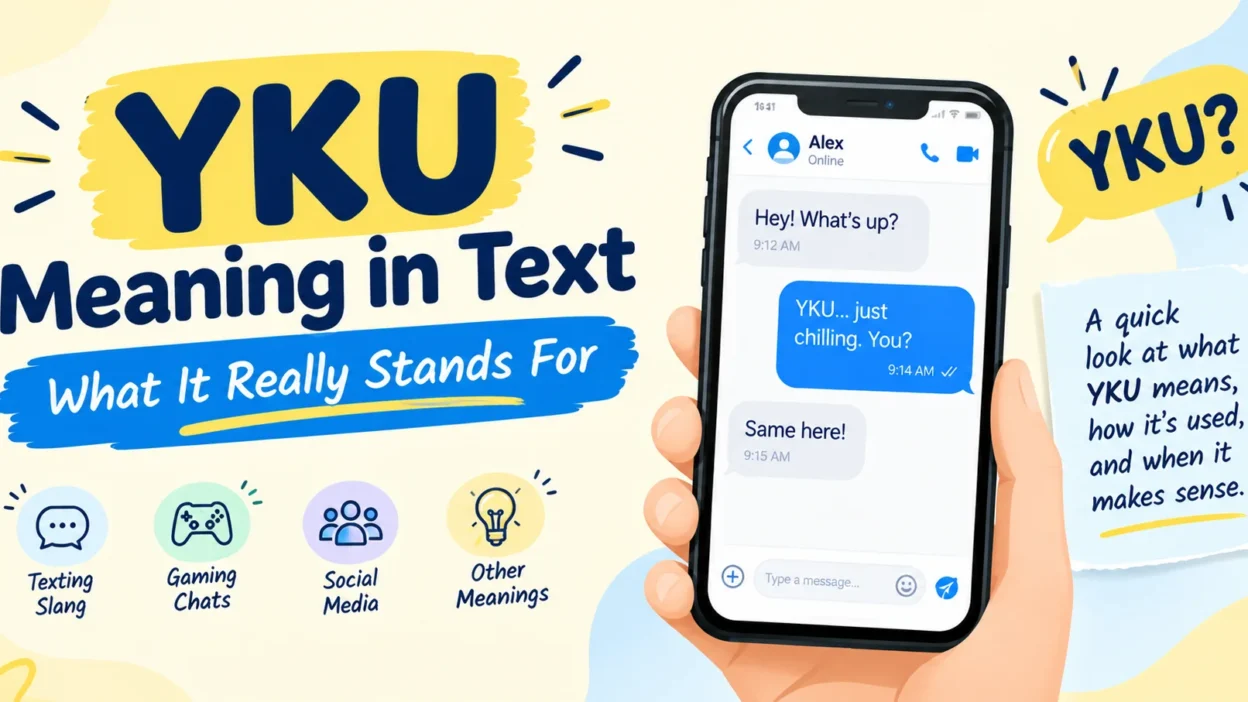
The YKU meaning in text is not fixed, which is why a quick search leaves many readers confused. No major reference lists it, so context is the safest guide. One plausible reading is “you know you,” used to start a teasing line about the reader.
It can also be a typo for “you” or a typo for “yk,” which is short for “you know.” Between close friends, it may even be private shorthand that only they understand. This guide shows how to tell these readings apart, how YKU differs from YK and IYKYK, and how to reply to the message without guessing wrong.
What Does YKU Meaning in Text? Quick Answer
There is no single verified definition of YKU. Three readings are realistic, and each one depends on how the sender uses it.
1. “You know you”
This is the reading many people reach for when YKU opens a statement about the reader, as in “yku wanted to stay longer.” It makes grammatical sense, and the tone fits casual teasing. However, it is an interpretation based on how the phrase reads, not a documented definition.
2. A typo for “you” or “yk”
On a phone keyboard, the O key sits close to K, and U sits close to Y and I. A fast thumb can easily turn “you” into “yku.” Because “yk” is a common shorthand for “you know,” an extra letter can also produce “yku.” This reading is plausible from keyboard layout, but it is not confirmed by any source.
3. Private or in group shorthand
Friends, couples, and online communities invent abbreviations all the time. If YKU appears repeatedly between the same people, it may carry a meaning they agreed on privately. Outsiders cannot decode that from the letters alone.
Why Online Definitions Disagree
Most pages that define YKU, or similar terms, appear to be auto-generated or copied from one another. Some attach statistics that cannot be traced to any study, and at least one automated summary claims YKU means “yeah, you got it.”
These claims should not be treated as authoritative. When the evidence is this thin, the honest answer is that the meaning depends on the message.
How to Understand YKU in a Message
You can usually work out the intended meaning in under a minute. Look at the clues around the letters, not at the letters alone.

Check the Words That Follow
Read the words immediately after YKU and ask whether the sentence makes sense with “you know you” or with just “you.”
- A statement about you: “yku wanted to come tonight” most likely means “you know you wanted to come tonight.”
- A question: “yku free later?” is more likely a typo for “you free later?”
- A trailing tag: “That meeting was so long, yku” is most likely a typo for “yk,” meaning “you know.”
Notice the Sender’s Typing Habits
Scroll up in the conversation. If the sender often drops or swaps letters, a typo is more likely. If they usually type carefully and use shorthand such as “yk” or “tbh” elsewhere, YKU may be deliberate. A single message is weak evidence, but a pattern across several messages is much stronger.
Consider the Relationship and the Mood
The same letters can mean different things between different people. A joking, playful chat supports the teasing reading. A practical, fast exchange about plans supports the typo reading. If the sender is someone new, remember that you have less context to rely on.
When Nothing Fits
If none of these checks gives a clear answer, do not force a reading. A short question to the sender is quicker and safer than a wrong guess.
Examples of YKU in Texting
The examples below are illustrative. They show how each reading would work in practice. They are not records of real conversations, and they are not evidence of how common any reading is.
Example 1: “you know you” Text: “yku wanted to come tonight, admit it.” Plain English: “You know you wanted to come tonight. Admit it.”
Example 2: typo for “you” Text: “yku free around six?” Plain English: “Are you free around six?”
Example 3: typo for “yk” Text: “That meeting was so long, yku?” Plain English: “That meeting was so long, you know?”
Example 4: private shorthand Text: “yku” sent alone in reply to a photo. Plain English: Unclear. Without a shared history, there is no way to know. This is the case where asking is the only reliable option.
What Tone Can YKU Convey?
The tone depends on the reading and on who is sending the message.
- Teasing or playful: As “you know you,” it usually sounds like a light joke between friends. It suggests the sender thinks you already know or feel something and will not admit it.
- Flirty: Between people who are attracted to each other, the same teasing can come across as flirtatious. Do not assume this without other signals, such as compliments or a change in how often they message you.
- Neutral: As a typo, YKU has no tone of its own. The tone comes from the rest of the sentence.
- Slightly pushy: A statement that assumes you agree can sound presumptuous if you do not know the sender well.
When the tone is unclear, read the whole message and the messages around it before reacting.
YKU vs. YKY, YK, IYKYK, and YKYK
These abbreviations look alike, but they are not interchangeable.
- YK is commonly listed as short for “you know,” and it works like the spoken filler phrase. It is the most likely source of confusion if YKU is a typo.
- IYKYK stands for “if you know, you know.” It is well documented and refers to a reference or inside joke that only certain people will understand. Its meaning is about shared insider knowledge, which differs from teasing someone about what they already feel.
- YKY is sometimes said to mean “you know you,” but I could not find a reliable source to confirm it. There is no evidence that YKY came first or that YKU grew out of it.
- YKYK has no reliable definition that I could verify. Some people may use it as a shortened IYKYK, but that is a guess.
In short, only IYKYK has a clear, well-sourced meaning. YK is widely listed. YKU, YKY, and YKYK are best read from context.
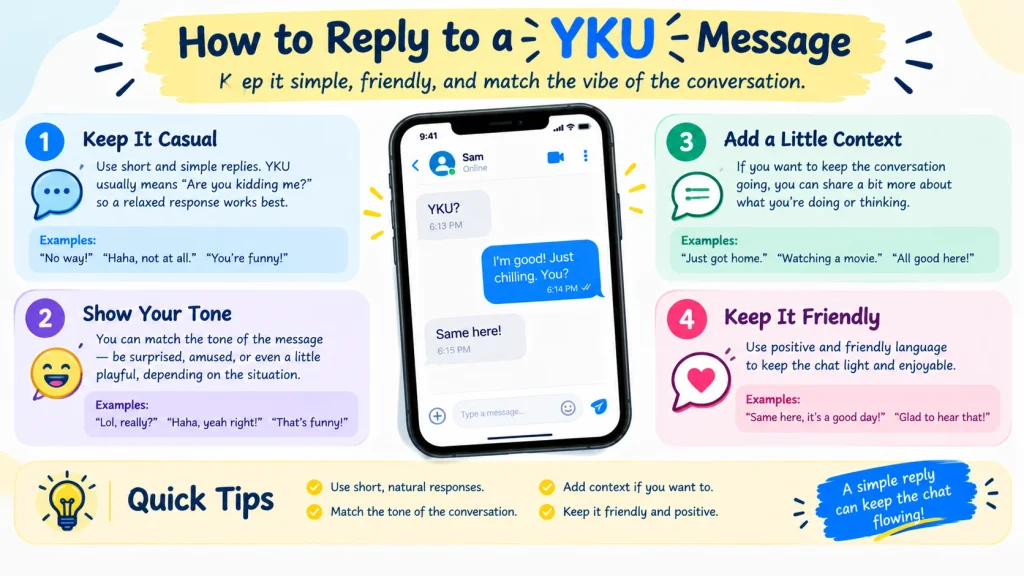
How to Reply to a YKU Message
Your reply depends on how you read the message. Pick the option that matches.
If It Reads as Teasing
You can play along or push back. Both are friendly.
- “Okay, maybe.”
- “I do not.”
- “Okay, you got me.”
If It Looks Like a Typo
Answer the question or comment itself, as if the message said “you” or “yk.” No explanation is needed, and pointing out the typo can make the exchange awkward.
If You Are Unsure
Ask directly. A short, friendly question works well:
- “Wait, do you mean ‘you know you’?”
- “Sorry, what does yku mean here?”
Asking is especially wise with someone you do not know well, where a wrong guess could cause offense.
Should You Use YKU Yourself?
Probably not, at least not without a reason. Because many people will not recognize it, YKU risks being misread as a typo or ignored. Clearer options exist.
- Write “you know you” in full when you mean the teasing phrase.
- Use “yk” if you mean “you know,” since it is more widely listed.
- Avoid abbreviations in work or school messages, where clarity matters more than speed.
If you and a friend have already settled on a meaning, using it between yourselves is fine. Just do not expect others to understand it.
Can YKU Have Other Meanings?
Yes. Outside texting, YKU is the name used by Young Koreans United, a Korean American grassroots organization. According to the Korean Resource Center in Los Angeles, activist Yoon Han Bong founded it in 1984. You would meet this meaning in writing about Korean American organizing or history, and it is unrelated to message slang.
Frequently Asked Questions
Is YKU a real texting abbreviation?
Some people use it, but it is not a standardized abbreviation with a documented definition. Treat it as informal and dependent on context.
Does YKU mean “you know you”?
Often that reading fits, especially when YKU begins a teasing statement. But no reliable reference confirms it, so check the context before assuming.
Is YKU flirty?
It can be, depending on the sender and the situation. The abbreviation itself does not signal flirting. Look at the whole message and how the two of you usually talk.
What is the difference between YKU and YK?
YK is commonly listed as “you know.” YKU has no verified meaning. It may be a “you know you” shorthand, a typo for “you,” or a typo for “yk.”
Is YKU the same as IYKYK?
No. IYKYK means “if you know, you know” and refers to insider knowledge. YKU is not documented as a form of it.
Should I use YKU in my own texts?
It is safer to write the full phrase or use “yk.” Use YKU only with people who already understand how you mean it.
Final Takeaway
YKU has no verified standard meaning, so the safest way to read it is through context. If it opens a teasing statement, “you know you” is a reasonable guess. If it sits where “you” or “yk” would fit, it is probably a typo. Between close friends, it might be private shorthand.
Compare it with YK and IYKYK, but do not treat them as the same thing. When you truly cannot tell, ask the sender. A quick question takes seconds and prevents a wrong reply, while a confident guess can leave both of you confused and may even sour a friendly conversation.
Read More: FR Meaning in Text: Stop Guessing and Get It Right in 2026



[…] Read More: YKU Meaning in Text: Confusing Message? Simple Clues Decoded in 2026 […]
[…] Read More: YKU Meaning in Text: Confusing Message? Simple Clues Decoded in 2026 […]