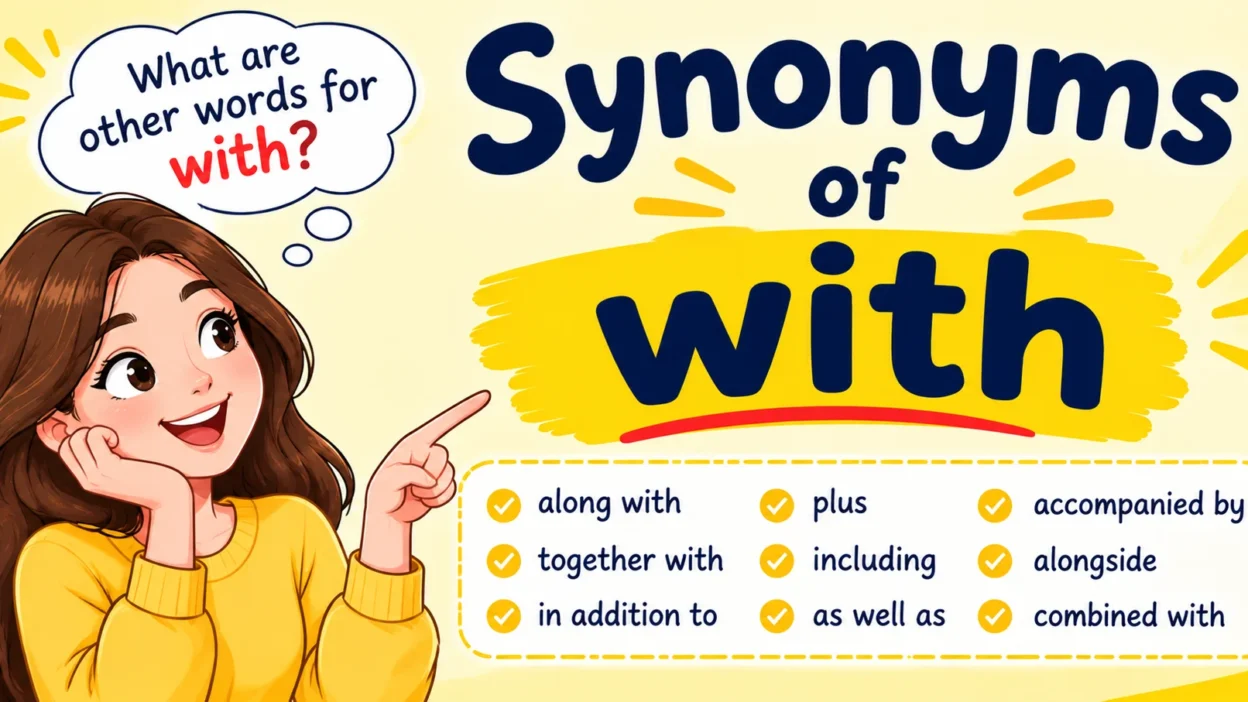
Repeating with again and again makes your writing feel flat. The best synonyms for with are alongside, along with, together with, accompanied by, using, including, plus, and as well as. But here is the catch: “with” does at least eight different jobs, so there is no single replacement. This guide gives you 22 alternatives grouped by meaning, with original examples, tone labels (formal, casual, academic, business), a comparison table, common learner mistakes, and a short quiz.
Looking for another word for with in an essay or email? Start by naming the job “with” is doing. Then pick the word that matches your tone and meaning.
Quick Answer: Synonyms of With by Meaning
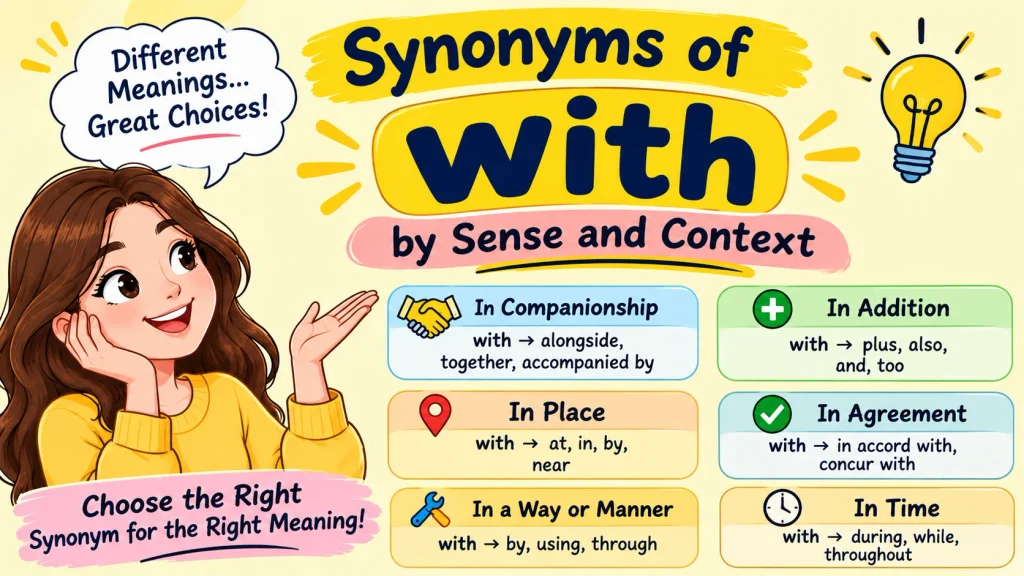
The most useful swaps are alongside (company), using (tools), including (extras), featuring (features), because of (cause), and despite (contrast). Pick by meaning, not by sound:
- Company: alongside, along with, together with, accompanied by
- Tool or method: using, by means of, through, via
- Addition: including, plus, as well as, in addition to, combined with
- Features or clothing: featuring, containing, wearing
- Joint work: in collaboration with, in partnership with
- Cause: because of, thanks to
- Contrast: despite, in spite of
Need a formal option? Choose in addition to, by means of, or accompanied by. Need a casual one? Choose plus, along with, or using. And keep “with” in fixed phrases like “agree with” and “pleased with.” A swap there sounds wrong.
How we chose these synonyms: We kept only words that can replace “with” in a real sense, and we tested each one in sample sentences. We left out location words (beside, near), opposites (against, without), fixed phrases, and dated options.
What Does “With” Mean?
“With” is a preposition. It is one of the most common words in English, so it is easy to repeat by accident. It does at least eight different jobs:
- Company: She came with her sister.
- Tool or method: He cut the rope with a knife.
- Addition: The room costs $90 with breakfast.
- Features or clothing: a cabin with a fireplace; the girl with the red scarf.
- Collaboration: We wrote the guide with two nurses.
- Cause: With the roads flooded, we stayed home.
- Contrast: With all her training, she still missed the shot.
- Manner: He spoke with care.
Pronunciation: In American English, “with” is usually /wɪð/ or /wɪθ/. Both are accepted. In fast speech the word is short and weak.
Origin: “With” comes from Old English wið, which meant “against” or “toward.” That old sense survives in withstand, withhold, and withdraw. Later, “with” replaced the older word mid in the sense of company. Today mid survives only in midwife.
Quick fix for manner “with”: Phrases like “with care” and “with ease” can often become one adverb: carefully, easily. The sentence gets shorter and cleaner.
Synonyms by Sense and Context
1. When “with” means “together with someone”
Alongside means working or standing next to someone as an equal. It feels warmer than “with.” Register: neutral.
Volunteers worked alongside firefighters to fill sandbags.
My father has fished alongside his brother for forty years.
Along with adds a second person or thing to the first. The verb still agrees with the first subject. Register: neutral.
The coach, along with three players, was late.
Pack a jacket along with your umbrella.
Together with works like “along with” but sounds a little more formal. It stresses the joined group. Register: neutral to formal.
The mayor, together with city engineers, inspected the bridge.
Send the form together with a copy of your ID.
Accompanied by means joined by a person, or by things that come as a pair. It is formal and polite. Register: formal.
The minister arrived accompanied by two aides.
Heavy rain, accompanied by strong winds, hit the coast on Friday.
2. When “with” means a tool or method
Using is the plainest swap for a tool. The doer of the action must be the subject of the sentence. Register: neutral.
She sliced the bread using a serrated knife.
You can pay using your phone.
By means of sounds exact and written. It suits reports and essays, but feels stiff in speech. Register: formal.
The samples were tested by means of a simple dye.
Farmers moved the water by means of a narrow canal.
Through points to a process or effort over time. It often works with abstract nouns. Register: neutral.
Ayesha improved her accent through daily practice.
Small shops often find customers through word of mouth.
Via names a channel or route. It is short and slightly technical. Register: neutral.
He applied via the company website.
Send me the photos via email.
3. When “with” means addition
Including shows that something is part of a larger set. Use it when “with” could mean “and this too.” Register: neutral.
The tour costs $80, including lunch.
Several countries, including Brazil, sent teams.
Plus is a quick, casual add-on. Avoid it in academic essays. Register: informal.
He bought a pen, plus two notebooks.
The fee is $20 plus tax.
As well as adds an item without ranking it above the first. It can be followed by a noun or an -ing form. Register: neutral.
The hotel offers free Wi-Fi as well as a gym.
She coaches chess as well as teaching math.
In addition to adds something on top of what you already named. It is a safe choice for emails and essays. Register: formal.
In addition to tuition, students pay a lab fee.
In addition to her day job, Maya coaches a swim team.
Combined with shows a blend or a joint effect. The result can be good or bad. Register: neutral to formal.
Strong writing combined with clear data makes a report convincing.
Heavy traffic combined with rain made us late.
4. When “with” describes features or clothing
Featuring highlights a key feature. It has an advertising tone, so use it for hotels, products, and events. Register: neutral.
The hotel has rooms featuring sea views.
We visited a museum featuring local pottery.
Containing tells the reader what is inside something. It is exact and factual. Register: neutral to technical.
The box containing the keys never arrived.
Choose snacks containing less sugar.
Wearing replaces “with” when you describe clothes or accessories. It makes the person easier to picture. Register: neutral.
Look for the guide wearing a green vest.
A child wearing a raincoat splashed through puddles.
5. When “with” means joint work
In collaboration with suits creative, academic, or professional projects where partners share the work. Register: formal.
The film was made in collaboration with local students.
We wrote the guide in collaboration with two nurses.
In partnership with suggests an official agreement between organizations. It sounds stronger and more corporate than “in collaboration with.” Register: formal.
The library runs free classes in partnership with a college.
The app launched in partnership with three banks.
6. When “with” gives a cause
Because of is the clearest swap when “with” opens a sentence and explains a reason. Register: neutral.
Because of the storm, the ferry stopped running.
Because of her cold, Ana skipped practice.
Thanks to gives a positive cause and shows credit. In casual speech it can also be ironic, as in “Thanks to him, we’re late.” Register: neutral to informal.
Thanks to Omar’s notes, I passed the exam.
We finished early thanks to the new software.
7. When “with” shows contrast
Despite means “even though this was in the way.” It replaces “with all her…” in many sentences. Register: neutral to formal.
Despite the heavy rain, the match went ahead.
She smiled despite feeling nervous.
In spite of has the same meaning and sounds a little more spoken. Never say “despite of” or “in spite” alone. Register: neutral.
In spite of the delay, the show started on time.
He walked home in spite of the cold.
Comparison Table: Word, Tone and Best Use
| Word | Meaning | Tone / register | Best used when | Example |
|---|---|---|---|---|
| alongside | next to someone as an equal | Neutral | Team tasks | Interns trained alongside senior editors. |
| using | by means of a tool | Neutral | Instructions | Measure the table using a tape. |
| by means of | through a method | Formal | Reports, essays | Water is moved uphill by means of a pump. |
| via | through a channel or route | Neutral, technical | Communication | Updates arrive via text message. |
| including | as part of a larger set | Neutral | Prices, lists | Every room, including the attic, has Wi-Fi. |
| plus | one more thing | Informal | Casual lists | I need milk, plus eggs. |
| in addition to | on top of | Formal | Emails, essays | In addition to rent, tenants pay for gas. |
| featuring | highlighting a key feature | Neutral, promotional | Ads, reviews | A café featuring live jazz on Fridays. |
| in partnership with | official joint agreement | Formal | Announcements | The park reopened in partnership with local schools. |
| thanks to | positive cause | Neutral to informal | Giving credit | Thanks to an early start, we beat the traffic. |
| despite | against an obstacle | Neutral to formal | Essays, news | Despite his age, he finished the race. |
With vs. Confusable Words
Some words look like good replacements for “with,” but they do a different job. Learners often pick them by mistake.
With vs. within. “Within” means inside a limit of space, time, or rules. It does not show company or tools.
She worked with the team. / She worked within the budget.
With vs. beside and besides. “Beside” shows position. “Besides” means “in addition to.” Neither one means “together with” in the way “with” does.
He sat beside me. / Besides the pool, the hotel has a gym.
With vs. by. “By” names the doer. “With” names the tool. Both can appear in one sentence.
The cake was made by my aunt with a new mixer.
With vs. among and amid. “Among” places someone inside a group of three or more. “Amid” places someone inside noise or change. Both describe position, so they are not safe swaps for “with.”
A rare book lay hidden among the old magazines. / The singer paused amid the applause.
With vs. regarding and with regard to. These phrases mean “about.” They replace “about,” not “with.” In “with regard to,” the word “with” is just part of the fixed phrase.
I am writing regarding your order.
How to Choose the Right Synonym for With
Use this three-step check before you swap any word.
- Name the job. Is “with” showing company, a tool, an addition, a feature, a cause, or a contrast?
- Match the tone. Pick a word from the same register as the rest of your text.
- Read the sentence aloud. If your new word sounds heavier than the sentences around it, choose a simpler one.
- Casual: along with, plus, using, thanks to. Example: I fixed my bike using a few video tutorials.
- Academic: by means of, through, in addition to, combined with, despite. Example: The effect was measured through repeated trials.
- Business: in partnership with, in collaboration with, accompanied by, via. Example: Our team is working in partnership with two local suppliers.
- Creative: alongside, wearing, accompanied by. Example: He crossed the empty hall accompanied only by his own footsteps.
Regional note: “Owing to” is a formal way to say “because of,” and it sounds more British. American writers usually choose “because of” or “due to.” “Amongst” and “amidst” are also more common in British English.
[INTERNAL LINK: formal vs. informal English -> /formal-vs-informal-english/]
Antonyms of With
The opposite of “with” depends on the sense you are using.
- Without means lacking someone or something. I prefer tea without sugar.
- Excluding is the opposite of “including.” The price is $50 excluding tax.
- Against is the opposite when “with” means moving or acting in the same direction. They rowed with the current on the way out and against it on the way back.
- Minus is an informal way to remove something. I’ll take the burger minus the onions.
Related Words, Idioms, and Collocations
Word family: within, without, withstand, withhold, withdraw. In several of these, the old “with-” carries the early sense of “against,” “away,” or “back.”
Verbs followed by “with”: agree with, deal with, cope with, comply with, compare with, fill with, help someone with. Adjectives followed by “with”: pleased with, satisfied with, familiar with, angry with. These pairings are fixed, so do not replace “with” in them.
Phrasal verbs: put up with (tolerate), come up with (think of), get away with (avoid punishment), go along with (agree to), keep up with (stay at the same pace as).
Idioms:
- with flying colors: very successfully
- with open arms: warmly
- with bated breath: while anxiously waiting (it is “bated,” not “baited”)
- take something with a grain of salt: doubt it a little
- come to terms with: accept a hard fact
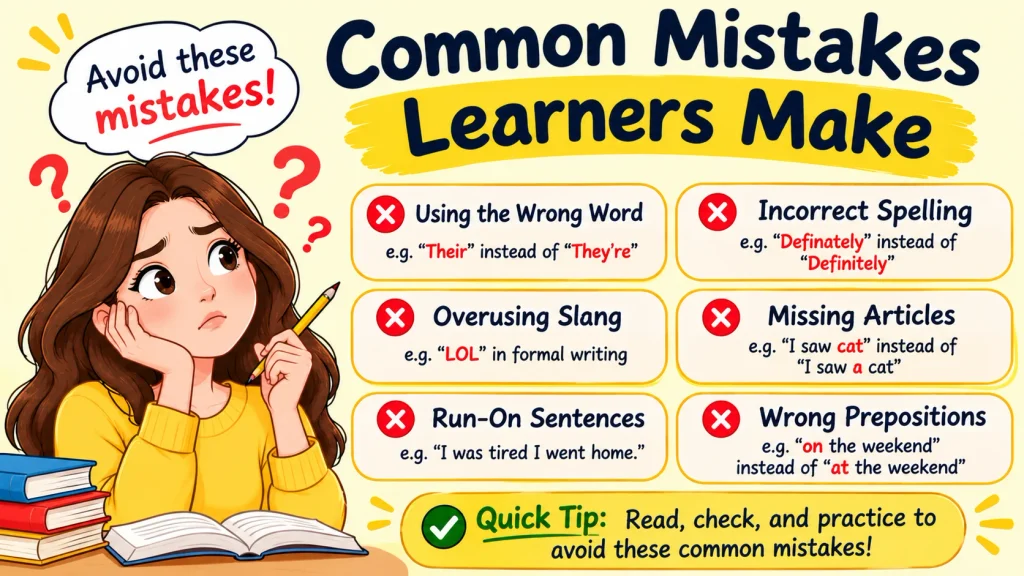
Common Mistakes Learners Make
Mistake 1: Wrong verb after “along with.” The verb follows the first subject.
Wrong: The manager, along with his staff, are late.
Right: The manager, along with his staff, is late.
Mistake 2: A dangling “using.” The person using the tool must be the subject.
Wrong: Using a calculator, the answer was wrong.
Right: Using a calculator, I got the wrong answer.
Mistake 3: “Despite of.”
Wrong: Despite of the rain, we left.
Right: Despite the rain, we left. or In spite of the rain, we left.
Mistake 4: “Regarding” instead of “with.”
Wrong: Can you help me regarding my homework?
Right: Can you help me with my homework?
Mistake 5: Swapping a fixed collocation.
Wrong: I agree along with you.
Right: I agree with you.
Mistake 6: Using a formal phrase in a casual sentence.
Odd: I opened the door by means of my key.
Natural: I opened the door with my key.
Classroom tip: Underline every “with” in your draft. Write its job above it (company, tool, addition, and so on). Then pick a word only from the matching group in this guide.
Mini Quiz: Test Your Word Choice
- Which phrase is the best formal swap in this sentence? “We collected the data with a survey.”
a) plus b) by means of c) beside - Choose the correct verb: The captain, along with his crew, ___ ready.
a) is b) are - Replace “With” in this sentence: “With the heavy fog, flights were delayed.”
a) Because of b) Via c) Alongside - Which word shows position only, not company?
a) alongside b) beside c) accompanied by - Choose the correct form: “___ the cold, we played outside.”
a) Despite of b) In spite c) In spite of
Answers:
- b) by means of. It is formal and fits a method.
- a) is. The verb agrees with “captain,” the first subject.
- a) Because of. The word “with” gives a cause here.
- b) beside. It tells you where someone sits, not who they are with.
- c) In spite of. “Despite of” is wrong, and “in spite” needs “of.”
FAQs About Synonyms for With
What is another word for “with”?
Alongside, along with, together with, using, including, and as well as are the most common alternatives. The right choice depends on meaning: use alongside for company, using for tools, including for inclusion, and as well as for addition. No single word fits every sentence, so match the sense first.
What is a formal synonym for “with”?
In addition to, accompanied by, by means of, and in collaboration with are strong formal options. Choose by meaning: “by means of” for methods, “accompanied by” for people or items that come together, “in addition to” for extras, and “in collaboration with” for joint projects. Avoid “plus,” which is informal.
Can “using” replace “with”?
Yes, but only when “with” means a tool or method, as in “She cut the cloth using scissors.” It does not work for company (“with a friend”) or features (“a house with a garden”). Also make sure the subject is the person doing the action, or the sentence will sound wrong.
Is “along with” singular or plural?
The verb follows the first subject, not the phrase after “along with.” Say “The coach, along with three players, is late,” not “are late.” The same rule applies to “together with” and “as well as.” If you want a plural verb, join the subjects with “and” instead.
What is the opposite of “with”?
“Without” is the main opposite. It means lacking something or someone, as in “She left without her keys.” Other opposites depend on the sense: “excluding” opposes “including,” and “against” is the opposite of “with” when it means supporting something, as in “Are you with us or against us?”
When should I keep “with” instead of replacing it?
Keep “with” in fixed phrases and collocations, such as “agree with,” “deal with,” “pleased with,” and “help with.” Also keep it when a replacement makes the sentence longer or changes the meaning. “With” is a short, natural word. Replace it only to fix repetition or to match a formal tone.
Bottom Line
There is no one-size-fits-all swap among the synonyms for with, because the word does many jobs. The right replacement depends on meaning. Use alongside or along with for company, using or through for methods, including or in addition to for extras, and because of or despite for cause and contrast. Match your tone as well: formal for essays and reports, casual for everyday chat. And keep “with” in fixed phrases like “agree with.”
Read More: Synonyms for Overall: 20 Powerful Words That Sound Smarter